Madrid Tuk Tuk & Olé Experience – Private 1.5h Cultural Tour
- 1h 30m
- Free cancellation up to 24h before
- 5 languages
- Instant confirmation
Highlights
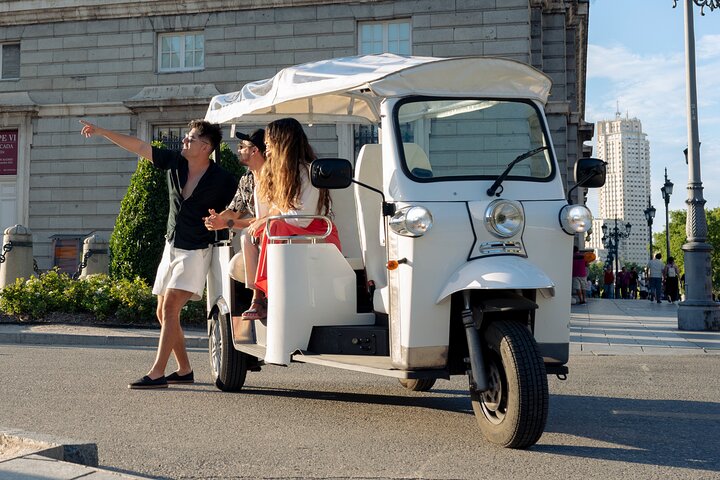
Explore the historic heart of Madrid in a unique 1.5-hour journey aboard a 100% electric tuk tuk. Glide silently through the city’s most iconic royal landmarks, charming literary quarters, and vibrant cultural hotspots with the comfort of a private guided tour. Perfect for first-time visitors and those seeking an authentic, eco-friendly experience. Why choose our tour? - Enjoy a smooth, silent ride on an environmentally friendly electric tuk tuk - Discover famous sites including the Royal Palace, Prado Museum, and Literary Quarter - Personalized service with a knowledgeable local guide sharing insider stories - Small group, private tour providing flexibility and intimate exploration - Ideal introduction to Madrid’s rich history and culture in a short time Book now to experience Madrid’s charm responsibly and comfortably!
Inclusions
What's included
- All Fees and Taxes
What's not
- Dinner
- Lunch
Itinerary
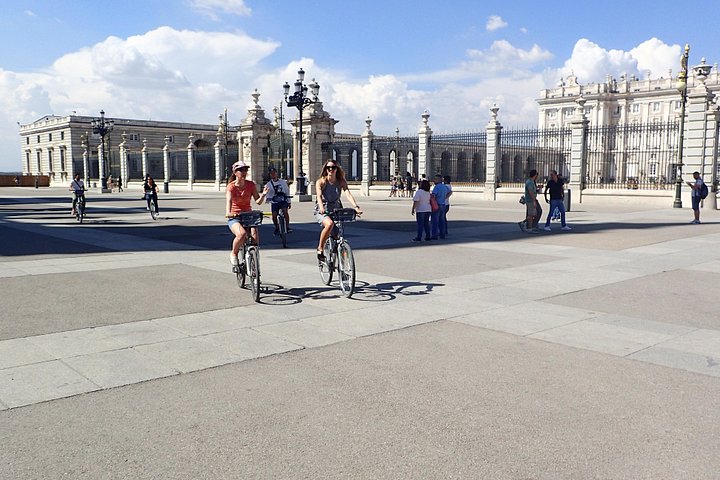
The Royal Palace of Madrid, also called the Royal Palace of the East, is the official residence of the King of Spain; With an area of 135,000 m² and 3,418 rooms, (almost double that of Buckingham Palace or the Palace of Versailles), it is the largest royal palace in Western Europe. our guide will give you details of this emblematic place.
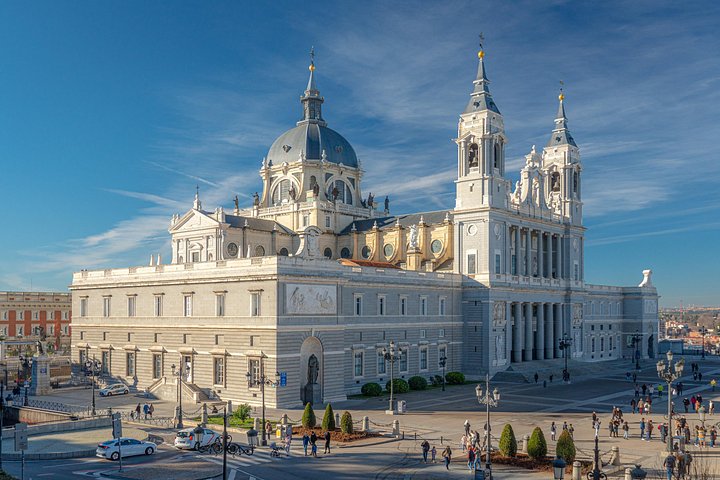
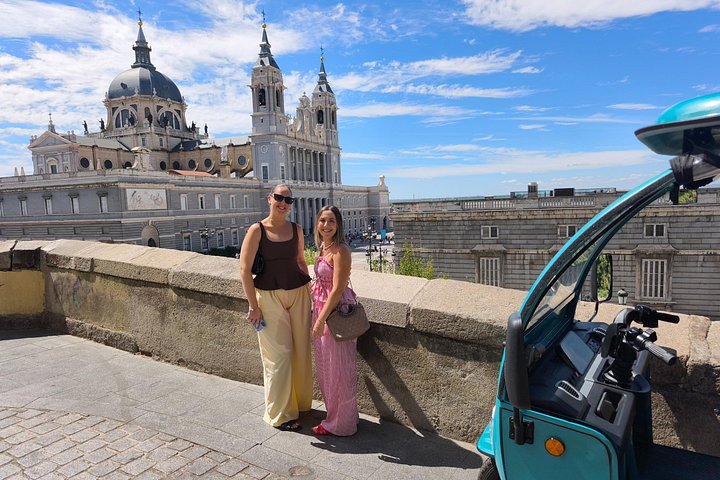
The Santa Iglesia Catedral Metropolitana de Santa María la Real de la Almudena, known simply as the Almudena Cathedral, is a cathedral of Catholic worship, dedicated to the Virgin Mary under the invocation of the Almudena, and the episcopal headquarters of Madrid. Built on the site of an old mosque, Almudena Cathedral takes its name from the Arabic word al-mudayna, which means "citadel". The cathedral is located in the historic center of the city of Madrid. The cathedral is the main temple of the Archdiocese of Madrid, seat of the archbishop and the metropolitan chapter. It is a building 102 meters long and 73 meters high, built from the end of the 19th century to the end of the 20th, in different architectural styles: Neoclassical on the outside, Neo-Gothic on the inside and Neo-Romanesque in the crypt
The Royal Basilica of San Francisco el Grande, officially Basilica of Our Lady of the Angels, is a Catholic church in Madrid, in the Palacio neighborhood, within the historic center of the capital of Spain. It presides over the western face of the Plaza de San Francisco, configured by the intersection of Calle Bailén and Carrera de San Francisco. It is part of the Franciscan convent of Jesus and Mary, founded at the beginning of the 13th century, on a defunct hermitage dedicated to Saint Mary.
The Toledo gate was one of the access gates to the city of Madrid. There were previously three other gates called Toledo in the vicinity, the current one dates from the first third of the 19th century and was designed by the Spanish architect Antonio Aguado, which is located in the middle of the Glorieta de la Puerta de Toledo as a roundabout . It was erected as a triumphal arch in honor of King Ferdinand VII as a commemoration of Spanish independence after the French occupation.
The Neptune Fountain is a neoclassical fountain that occupies the center of the roundabout to which it popularly gives its name, within the Plaza de Cánovas del Castillo, in the Spanish city of Madrid. This monumental fountain was proposed in 1777 and its construction, begun in 1782, ended in 1786. Originally it was located at the descent of the San Jerónimo race, facing the Cibeles fountain, but it was moved to the center of the aforementioned square. in 1898.
The Atocha station is a railway complex located near the Plaza del Emperador Carlos V, in Madrid, Spain. It acts as a railway junction, and this makes it the station with the highest passenger traffic in the country. The station arises as a simple halt (inaugurated in 1851), which is extended to become the Midi station (inaugurated in 1892)
The Museo Nacional Centro de Arte Reina Sofía (MNCARS), commonly known as Museo Reina Sofía, is a Spanish museum of 20th century and contemporary art, based in the city of Madrid. It took as its headquarters the old General Hospital of Madrid, a large neoclassical building from the 18th century located in the Atocha area, near the train station of the same name and the Metro Station of Art. This hospital was initially designed by José de Hermosilla and later continued by Francesco Sabatini, and is currently known as the Sabatini building in honor of this Italian architect. The museum as such was inaugurated in 1992, although the building had already housed temporary exhibitions in previous years. In September 2005, the institution's facilities were expanded with the opening of the Nouvel building at the beginning of the Ronda de Atocha.
The old monastery of San Jerónimo el Real, popularly known as "Los Jerónimos", was one of the most important monasteries in Madrid, originally ruled by the Order of San Jerónimo. Next to it there was the so-called Royal Room, later expanded as the Buen Retiro Palace in the times of Felipe IV.
The Casón del Buen Retiro is one of the only two buildings that have survived the destruction of the Buen Retiro Palace, from which it takes its name, in Madrid (Spain). Built by Alonso Carbonel in 1637, it was initially designed as a space for the ballroom of the Court of Felipe IV. Since 1971 it has been one of the buildings that make up the Prado Museum, and for decades it has housed its collections of 19th century paintings (about 3,000 paintings), as well as Pablo Picasso's Guernica. This famous painting was moved to the Reina Sofía Museum in 1992, and the Casón, after years of work, was reopened as a Museum Study Center in 2009, while the 19th century collections have been relocated to the Prado's main headquarters thanks to the expansion of Rafael Moneo.
The Salón de Reinos or large room was the authentic representative axis of the old Buen Retiro Palace in Madrid, built between 1630 and 1635, and the one that housed the best paintings, almost all now preserved in the Prado Museum. The room owes its name to the fact that the coats of arms of the twenty-four kingdoms that formed the Hispanic Monarchy in the time of Philip IV were painted on it. However, its most popular current name is the Army Museum, because it housed this institution between 1841 and 2005, when the transfer of its collections to the Alcázar of Toledo began. Along with the Casón del Buen Retiro.
The Royal Spanish Academy (RAE) is a publicly funded private Spanish cultural institution based in Madrid, Spain. This and twenty-three other language academies corresponding to each of the countries where Spanish is spoken make up the Association of Spanish Language Academies (ASALE). It was founded in 1713 on the initiative of the enlightened Juan Manuel Fernández Pacheco, VIII Marquis of Villena and Duke of Escalona, in imitation of the French Academy. The following year, King Felipe V approved its constitution and placed it under his protection.In 1715, the Academy approved its first statutes.
The Museo Nacional del Prado, in Madrid, Spain, is one of the most important in the world, as well as one of the most visited (the eighteenth in 2013 among art museums), and is considered the most important cultural institution in Spain, according to the 2020 Culture Observatory, a study carried out among several hundred professionals in the sector. Uniquely rich in paintings by Spanish and European masters from the 15th to the 18th centuries, and Spanish from the 19th Its main attraction lies in the wide presence of Velázquez, El Greco, Goya (the artist most widely represented in the museum), Titian, Rubens and Bosco, of which it has the best and most extensive collections that exist worldwide.
Cancellation
Free cancellation up to 24 hours before the experience starts, for a full refund.
Reviews
4.6
- 57
- 41
- 30
- 21
- 10
Ratings come from 9 reviews collected by our booking partner. They are travellers' own words, in the order they were written — never reordered to flatter the experience.
Know before you go
- Meeting point
- In front of the madrid stock exchange and the ritz hotel
- Pickup
- Everyone meets at the starting point; there is no pickup.
- Ticket type
- Mobile or paper ticket accepted
- Operated by
- Green Tours
- Infants are required to sit on an adult’s lap
- Not recommended for travelers with spinal injuries
- Not recommended for travelers with poor cardiovascular health
- Service animals allowed
- Public transportation options are available nearby
- Infants and small children can ride in a pram or stroller
- Wheelchair accessible
- Suitable for all physical fitness levels
How it compares in Madrid
- Its from-price is 24% above the median of the 1722 experiences we list in Madrid.
- It is shorter than most of them.
- By number of reviews it ranks 591 of 1722.
- The operator lists free cancellation on it.
About Madrid
Madrid is Spain's sunny, sociable capital, home to great art museums, royal palaces, leafy parks and tapas bars that stay busy past midnight.
Three great galleries line the Paseo del Prado: the Prado Museum with Velázquez and Goya, the Reina Sofía with Picasso's Guernica, and the Thyssen-Bornemisza with its sweeping private collection. Beside them, El Retiro Park offers a boating lake, shaded avenues and the glass Palacio de Cristal.
Top-ranked sights in Madrid: Plaza Mayor, Royal Palace of Madrid (Palacio Real de Madrid), Puerta del Sol.
Special offers in Madrid
Was/now prices come from the operator, never from us.