Eight Lakes and Scenery Afternoon Half Day Tour
- 4 hours
- Free cancellation up to 24h before
- Guided in English
- Instant confirmation
Highlights
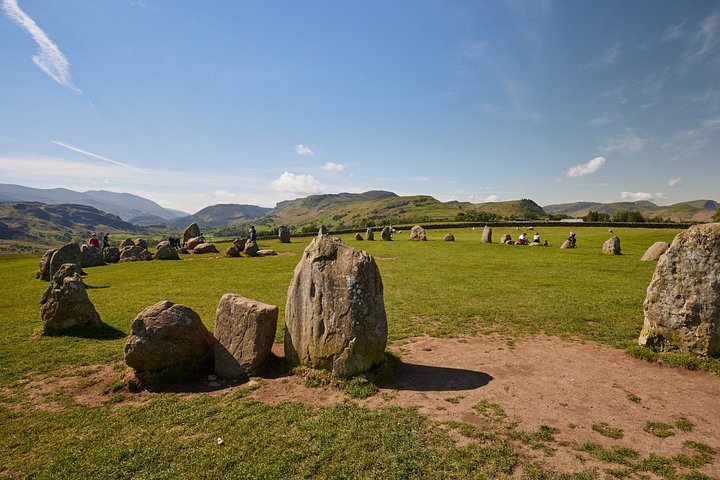
Close your eyes and picture it: standing inside a 4,500-year-old circle of stones, mountains rising on every side, the wind the only sound for miles. That's Castlerigg, one moment in an afternoon built around views most visitors never find. While sixteen-seater minibuses queue along the main road, you gently ascend in comfort along the steep, narrow lane out of Ambleside instead — a quieter, wilder approach to the Kirkstone Inn, the highest inhabited building in the National Park, before the legendary descent unfolds beneath you. You'll see eight lakes, not the usual six, plus Ashness Bridge framed against the fells, Surprise View's sudden reveal of Derwentwater, and Dunmail Raise, where a king is said to sleep beneath the stones. With only seven guests aboard, your guide shows you exactly where Wordsworth saw the daffodils that inspired his most famous poem, pointing out the sheep grazing the fells, brings geology and legend to life, mile after spectacular mile.
Inclusions
What's included
- Surprise View & Ashness Bridge
Itinerary
Few roads in England prepare you for what Kirkstone Pass delivers. As your minibus carries you up the pass, the valley floor falls away, the fells close in on every side, and the sky opens up above in a way that makes you understand why this UNESCO World Heritage landscape has stopped people in their tracks for centuries. At the summit, the Kirkstone Inn marks the highest inhabited building in the National Park — a pause, a breath, and then the famous descent begins. Your guide points out the Kirk Stone, a large standing stone said to resemble a church from a distance, Kirk being the Norse word for church and the stone that gave the whole pass its name. Then Red Pit car park, where you step out and the valley suddenly reveals itself: Brothers Water glittering far below, the fells rising sheer on either side, the full sweep of Ullswater beyond. One of those views that earns its reputation — a proper photo stop, and the kind of moment people talk about long after the tour is over.
Windermere is England's largest lake — over ten miles long, more than a mile wide at its broadest, and on a clear morning, breathtaking. The road runs along a stretch of its eastern shore, the water opening out beside you, the fells reflected in it on a still day like a second landscape suspended just beneath the surface. Across the lake, the Langdale Pikes rise in the distance, their twin peaks catching the light differently with every passing cloud. It's the kind of view that stops conversations mid-sentence. Your guide points out the details as you go: the surprising depth of the water, the wooded islands just visible offshore, the history of the steamers and launches that have crossed these waters since the Victorians first discovered the Lake District as a place worth the journey from the city. A stretch of road that earns its place in one of the world's most visited national parks, designated by UNESCO as a World Heritage Site for the beauty of its landscape.
Bowness-on-Windermere is the second pickup point of the morning, with collection from outside Pier 1, the main Windermere Lake Cruises departure point, right on the lakefront and easy to find. There's a full, wonderful day ahead, so we're always keen to get going on time and make the most of every minute. Bowness sits on the eastern shore of Windermere, England's largest lake, and is the busiest, most lively of the lakeside villages, packed with shops, cafés, and the steamers and launches that cross the water throughout the year. It has its own real Beatrix Potter connection: her mother lived nearby on this side of the lake, opposite Beatrix's own home in Near Sawrey, and Beatrix herself regularly crossed the water by ferry to visit. From here the minibus heads north towards Ambleside for the final pickup, then on to the Kirkstone Pass, the lake glimpsed in flashes through the trees as the road winds along the shoreline.
Ambleside is one of the morning's pickup points, with collection from Kelsick Road, right outside the library and opposite the bus interchange where the local public buses come and go — easy to spot, right in the heart of the village. It's the final pickup of the morning, after Windermere and Bowness, so there's a spectacular day ahead and we're always keen to get going on time and make the most of every minute. From here the minibus heads through the village, the main street giving way to open countryside and fells. Set at the head of Windermere, Ambleside has long been a gateway into the Lake District, full of outdoor shops, cafés, and stone buildings packed close together along narrow streets. It's a proper Lakeland town with real working character — not just a tourist stop, but somewhere people actually live and work, the fells rising steeply on every side reminding you what kind of landscape you're about to head into. The spectacular scenery starts here — and only gets better.
At the very top of the Lake District's highest pass, the Kirkstone Inn has stood here since the 17th century, watching over the summit through every season and storm. It's said to be haunted — the spirit of a woman who perished crossing the pass in a blizzard still wanders its corridors. Reimagined as a place to stay, its historic bar has just reopened under a local microbrewery — a welcome return for one of England's most dramatically situated buildings. We don't go in, but on a clear day we stop in the car park for one of the great views of the whole tour: looking back down the Struggle, the steep road from Ambleside that cyclists still attempt for the challenge of it, the valley floor far below, Windermere glinting in the distance, Esthwaite Water visible beyond, and on the very clearest days, the Irish Sea shimmering on the horizon. The highest point of the highest pass in the Lake District, and a place that feels genuinely remote — until you remember you got here in comfort.
Coming down from the summit, the road winds dramatically into the Hartsop valley, drystone walls on either side, the steep symmetrical slopes of Hartsop Dodd and High Hartsop Dodd rising on either flank — the "Dodds" as locals call them. At the bottom, Brothers Water appears, one of the smallest and most peaceful lakes in the district, shallow and fringed with reeds, quite different in shape from the ice-carved ribbons that form most of the others. The village of Hartsop takes its name from the Old Norse for "valley of the deer," its old stone cottages still bearing their original spinning galleries where villagers once made their own cloth. Water lilies bloom across the lake in summer. As for Brothers Water itself — the name has a story behind it, and your guide will tell you exactly what happened here. It's the kind of tale that makes you look at the lake differently once you've heard it. On a still day, the Dodds reflect perfectly in the water — a scene barely changed in centuries.
High above the valley to your right as you descend from Kirkstone Pass runs one of the most remarkable roads in England — though you'd never guess it from below. High Street, at 828 metres, is the highest point of the Far Eastern Fells, and along its broad grassy summit ridge runs a Roman road, built nearly two thousand years ago to connect the fort at Ambleside to Brougham Fort near Penrith. The Romans marched and rode that ridge in all weathers — soldiers, supply wagons, dispatch riders — crossing the highest ground in this part of Britain. In the 19th century the summit hosted annual sports days and horse racing, becoming known as Racecourse Hill. As you drive past, your guide traces the diagonal of the path on the fellside — that faint track cutting across the slope is High Street itself, one of the oldest roads in the Lake District, hiding in plain sight above you. What looks like an empty fell has been a military road, a drovers' track, and a racecourse for two thousand years.
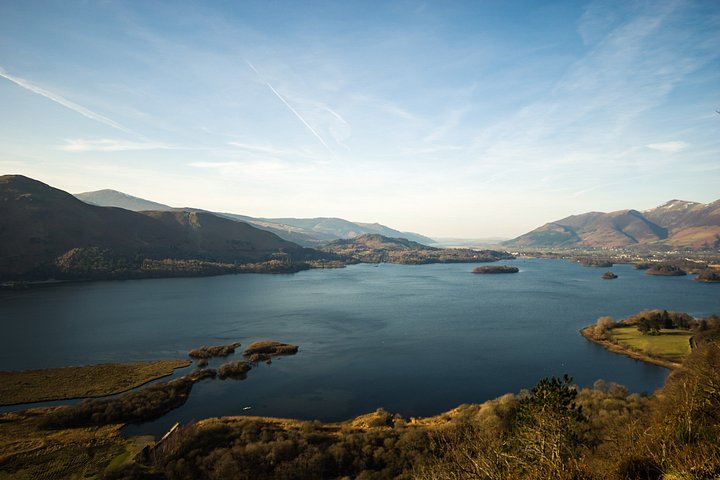
Ullswater — often called England's most beautiful lake and sometimes the dark lake, its waters deepened and shadowed by the great mountains that crowd right down to its shores — reveals itself fully here at Glenridding pier. You stop for a comfort break, with toilets at the Ullswater Steamers pier house, and time to step out and really breathe it in: eight miles of lake curving in a long slow S-bend through some of the most dramatic mountain scenery in England, the surface shifting from slate-grey to silver to deep black as clouds move over the fells. Helvellyn, England's third-highest mountain, rises steeply to the southwest, its reflection broken only by bow waves of elegant Victorian steamers sailing here for over 150 years. On a still morning, the silence is extraordinary — just the lap of water and the cry of a gull. On a wild one, the wind comes off the mountains fast and the lake turns dark and restless. Either way, few places stop you quite so completely in your tracks.
Glenridding is easy to drive through quickly — but your guide will slow you down enough to point out the pink Regency house right on the lakeshore where Charles Darwin spent five weeks in the summer of 1881. It was his last family holiday before his death the following April, and he wrote of it: "This place is magnificently beautiful, and I enjoy the scenery." The house is now a hotel, its blue-doored façade looking out across the dark water of Ullswater exactly as Darwin would have seen it, just ten metres from the shore. Like so many Lake District villages, Glenridding began as an industrial settlement — the Greenside lead mine, once the largest in the district, drove shafts 3,000 feet beneath Helvellyn itself before closing in 1962. What the mine left behind, the mountains have reclaimed: walkers and tourists fill the village now, heading up to Helvellyn and the famous knife-edge of Striding Edge, the whole valley transformed almost beyond recognition from its industrial past.
Glencoyne Bay is now known as Wordsworth Point — and the name tells you exactly why. On 15 April 1802, William and Dorothy Wordsworth walked around this bay on their way home to Grasmere and came upon what Dorothy described in her journal as "a long belt" of daffodils along the shore, growing among mossy stones, tossing and dancing in the wind off the lake. Two years later, drawing on Dorothy's own words, William wrote what became perhaps the most famous poem in the English language. It is a poem about memory as much as flowers — about how a moment in a landscape lodges so deeply it returns unbidden years later, bringing the same joy it brought first time. The wild daffodils still grow here in spring, beside the same water, on the same stretch of shore the National Trust now calls Wordsworth Point. If you haven't already stopped at Ullswater, this is the moment to walk to the lake's edge, feel the wind off the water, and stand exactly where one of England's most-loved poems began.
mention?
The road passes close enough to Matterdale church to almost touch it — a plain, cobble-built chapel sitting right at the roadside, consecrated in 1580, looking as though it has grown from the fellside rather than been built on it. Inside, massive oak beams unchanged since the Elizabethan villagers who petitioned the Bishop for their own church — tired of the long journey to Greystoke for every baptism, wedding and funeral — are still holding the roof up four and a half centuries on. Grade II* listed and still in use, it has the quiet permanence of a building that has simply always been there. Matterdale also sits in the heart of one of the last red squirrel strongholds in England. Dedicated rangers protect the native reds from grey squirrels that have pushed them out of almost every other part of the country. Keep an eye on the treeline as you pass — red squirrels have been spotted from this road. They are, of course, the real-life inspiration for Beatrix Potter's Squirrel Nutkin.
Cancellation
Free cancellation up to 24 hours before the experience starts, for a full refund.
Reviews
5.0
- 51
- 40
- 30
- 20
- 10
Ratings come from 1 reviews collected by our booking partner. They are travellers' own words, in the order they were written — never reordered to flatter the experience.
Know before you go
- Meeting point
- Our guide will meet you right outside of the ticket office at Windermere train station. Look out for our minivan.
- Pickup
- Everyone meets at the starting point; there is no pickup.
- Ticket type
- Mobile or paper ticket accepted
- Group size
- Up to 7 travellers
- Operated by
- English Lakes Tours
- Service animals allowed
- Public transportation options are available nearby
- Suitable for all physical fitness levels
How it compares in Windermere
- Its from-price is 57% below the median of the 58 experiences we list in Windermere.
- Its length is typical for the group.
- By number of reviews it ranks 44 of 58.
- The operator lists free cancellation on it.
About Windermere
Windermere is England's largest natural lake and the Lake District town beside it, with lake steamers, high fells and literary homes close by.
Windermere is the largest natural lake in England, about seventeen kilometres long, its shores wooded and dotted with islands. The town of Windermere stands a little inland, and Bowness-on-Windermere on the water is the hub of boat life, with steamers and launches sailing to Ambleside at the head of the lake. A museum on the shore shows the lake's historic steam launches.
Similar experiences
![Ultimate Full-Day Lake District Tour: 10 Lakes, Amazing Scenery & Lake Cruise]() Free cancellation