Granada Walking Tour with Audioguide on your Smartphone
- 3 hours
- Free cancellation up to 24h before
- 5 languages
- Instant confirmation
Highlights
The audio guide serves as a convenient mobile companion for a self-guided tour of Granada. This tour is specifically designed for those looking to explore the city within a short span of 2-3 hours. Simply follow the route on the app's map, which takes you from Granada train station to the San Nicolás observation deck, passing by the historic city's landmarks. You're guaranteed to see: Granada Cathedral, Royal Chapel, Moorish Gate, Dar al-Horra Palace, Granada Arena, Alhambra Fortress, The charming streets of the Arabian market. Once the tour is downloaded, the app functions offline. The audio guide can be clearly heard through your headphones at all times. Enjoy captivating stories and legends at your own pace, without the need to keep up with a tour group. If you only have a few hours to spare in Granada, make the most of it with the audio guide. You won't miss a thing.
Inclusions
What's included
- One-year access to the tour in your preferred language
- Audio guide app for iPhone and Android
- Illustrations to recognize landmarks
- Offline map featuring a route for effortless GPS navigation
- 25 audio recordings narrated by a professional historian
What's not
- In-Person Guide
- Smartphone and Headphones
- Transportation
- Food and Drinks
Itinerary
The Monumento a los Emigrantes in Granada, Spain, is a modern bronze sculpture located near the city’s Paseo del Violón. It honors the thousands of Andalusians who emigrated in search of better opportunities, especially during the 20th century. The artwork portrays a family in motion—suitcases in hand, gazes turned toward an uncertain future — capturing both the hardship and hope of leaving home. It's a moving tribute to resilience, memory, and the personal cost of migration, set quietly amid the city’s contemporary flow.
The Plaza de Toros de Granada, built in 1928, is one of Spain’s most beautiful bullrings, showcasing Neo-Mudéjar architecture with horseshoe arches and intricate brickwork. Located in the Beiro district, it seats around 14,000 spectators and has hosted not only traditional corridas, but also concerts and cultural events. While bullfighting remains controversial, the arena itself stands as a striking example of Andalusian heritage — where architecture, ritual, and spectacle converge in the rhythms of southern Spain.
The Monumento a Federico García Lorca in Granada stands in the Plaza de la Romanilla, near the city’s cathedral, honoring the poet and playwright whose work and tragic death have become symbols of 20th-century Spain. The bronze sculpture depicts Lorca with open arms, releasing a lark—echoing his deep connection to nature, language, and sorrow. Surrounded by cafés and street musicians, the statue invites quiet reflection on Lorca’s legacy and the enduring power of art in the face of repression.
IES Padre Suárez is one of Granada’s most historic educational institutions, founded in the 19th century and housed in a grand neoclassical building in the city center. Beyond its role as a high school, it's known for its impressive Science Museum, which preserves a remarkable collection of 19th- and early 20th-century scientific instruments. The school has educated generations of Andalusians and remains a proud symbol of Granada’s intellectual and academic heritage — where past and future meet in the service of learning.
The Puerta de Elvira is a monumental Moorish gate that once marked the main entrance to the city of Granada during the Nasrid period. Built in the 11th century and later expanded, it was part of the city’s medieval defensive walls and led directly to the old Muslim quarter of Albayzín. Though only a fragment remains today, its pointed arch and weathered stone speak to centuries of cultural layering. Once a threshold between city and empire, the gate now stands quietly at the edge of modern Granada, anchoring it to its Islamic past.
The Iglesia Parroquial de San Andrés in Granada is a small, historically significant church located near the Gran Vía de Colón. Built in the early 16th century on the site of a former mosque, it blends Mudejar and Gothic elements, with a modest whitewashed exterior and an ornate wooden ceiling inside. Though often overlooked by visitors, it reflects the layered religious and architectural transitions of post-Reconquista Granada. Quiet and atmospheric, it remains a living parish and a subtle piece of the city's spiritual mosaic.
The Palacio Müller in Granada is a lesser-known architectural gem tucked into the city’s urban fabric near the Gran Vía. Built in the early 20th century for the Müller family, it showcases an elegant mix of historicist and eclectic styles, with ornate balconies, sculptural details, and a distinctive façade that hints at French and Viennese influences. Though not open to the public, it’s admired for its architectural grace and stands as a quiet witness to Granada’s bourgeois past — where wealth, taste, and European fashion converged in Andalusian stone.
The Basílica de San Juan de Dios in Granada is a breathtaking example of Spanish Baroque architecture, built in the 18th century to honor St. John of God, founder of the Hospitaller Order. Behind its restrained stone façade lies a lavish interior filled with gilded altars, swirling columns, frescoed domes, and a dazzling display of relics. The saint’s silver-embellished tomb rests in the richly decorated sanctuary. More than a church, it’s a theatrical expression of faith — where devotion, art, and grandeur unite in overwhelming splendor.
The Cárceles secretas de la Inquisición in Granada refer to the hidden prison cells used by the Spanish Inquisition, located beneath what is now the Facultad de Derecho (Faculty of Law). These dark, cramped chambers once held those accused of heresy, often without formal charges or trial. Though not a major tourist site, remnants of these cells remind visitors of the oppressive mechanisms of religious control that once operated in the heart of the city. A haunting trace of fear and silence beneath Granada’s scholarly façade.
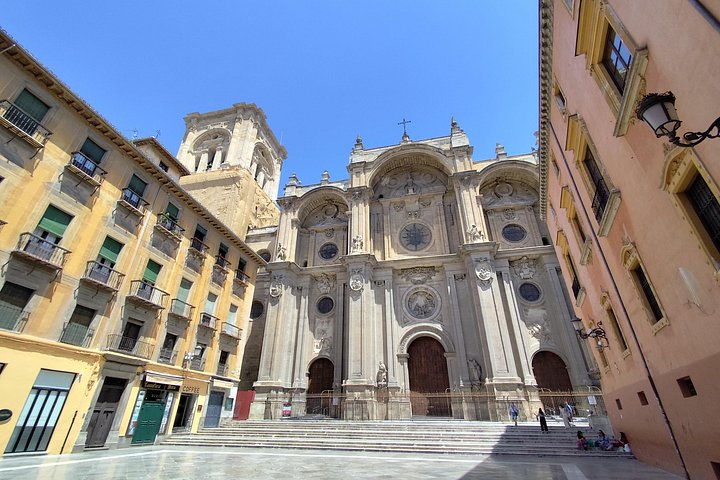
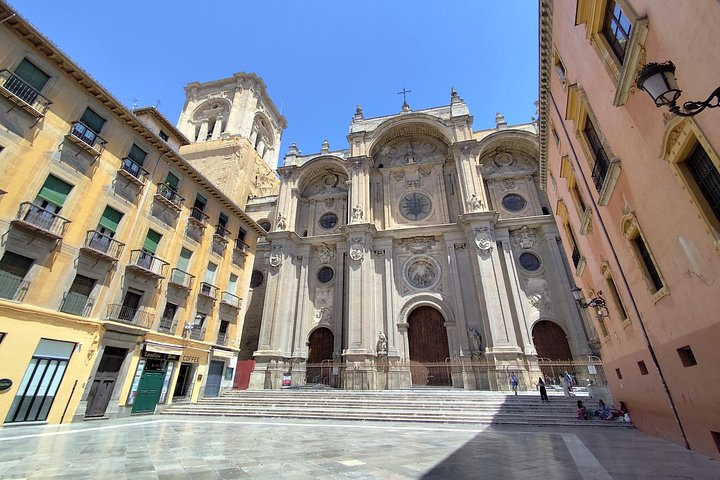
The Granada Cathedral, officially the Cathedral of the Incarnation, is a monumental symbol of Spain’s shift from Moorish rule to Catholic grandeur. Built on the site of a former mosque, it began in the early 16th century under Queen Isabella and blends Gothic, Renaissance, and Baroque styles. Its soaring white interior, massive pillars, and dramatic main altar reflect the triumph of the Christian Reconquista. Highlights include works by Alonso Cano and the adjacent Royal Chapel, where the Catholic Monarchs are buried. It’s both a spiritual center and an architectural statement of power and faith.
The Royal Chapel of Granada (Capilla Real) is the final resting place of Queen Isabella I and King Ferdinand II, the Catholic Monarchs who completed the Reconquista. Built in the early 16th century in Isabelline Gothic style, it stands beside Granada Cathedral as a powerful symbol of Spain’s imperial beginnings. Inside lie marble tombs, royal flags, and a treasury holding Isabella’s personal belongings. This sacred space, austere yet grand, marks the end of Muslim rule in Spain and the dawn of a unified Catholic kingdom — etched in stone and legend.
The Madrasah Palace (Palacio de la Madraza) in Granada was the city’s first university, founded in 1349 by Yusuf I, Sultan of the Nasrid dynasty. Located near the Cathedral, it once served as a center for Islamic learning in theology, law, medicine, and mathematics. Though its original architecture was largely altered after the Reconquista, traces of its Nasrid stucco work and mihrab remain. Today, it belongs to the University of Granada and hosts cultural events. A quiet but powerful reminder of Granada’s scholarly Islamic past, layered beneath its Catholic present.
Cancellation
Free cancellation up to 24 hours before the experience starts, for a full refund.
Reviews
5.0
- 52
- 40
- 30
- 20
- 10
Ratings come from 2 reviews collected by our booking partner. They are travellers' own words, in the order they were written — never reordered to flatter the experience.
Know before you go
- Meeting point
- - The tour begins at the Monument to the Emigrants, located near the Granada train station - This is a self-guided tour, so there will be no guide present at the meeting point - Open the app, initiate the Granada City Tour, and follow the designated route
- Pickup
- Everyone meets at the starting point; there is no pickup.
- Ticket type
- Mobile or paper ticket accepted
- Group size
- Up to 20 travellers
- Operated by
- TouringBee
- Public transportation options are available nearby
- Suitable for all physical fitness levels
- The audio guide is available through a mobile app for iOS and Android
- Entry tickets to the Cathedral, Royal Chapel, and museums are not included and must be purchased separately in advance
- The tour does not cover all the sights in Granada
- This is a self-guided tour, you will need to download the audio guide mobile app, activate your purchase, and follow the route on the app's map (without a human guide)
- The audio guide can be accessed at any time. The date and time provided during checkout are merely approximations
How it compares in Granada
- Its from-price is 92% below the median of the 69 city tours we list in Granada.
- Its length is typical for the group.
- By number of reviews it ranks 39 of 69.
- The operator lists free cancellation on it.
About Granada
Granada is an Andalusian city below the Sierra Nevada, home to the Alhambra palace complex, the Moorish Albaicín quarter and a famous tapas habit.
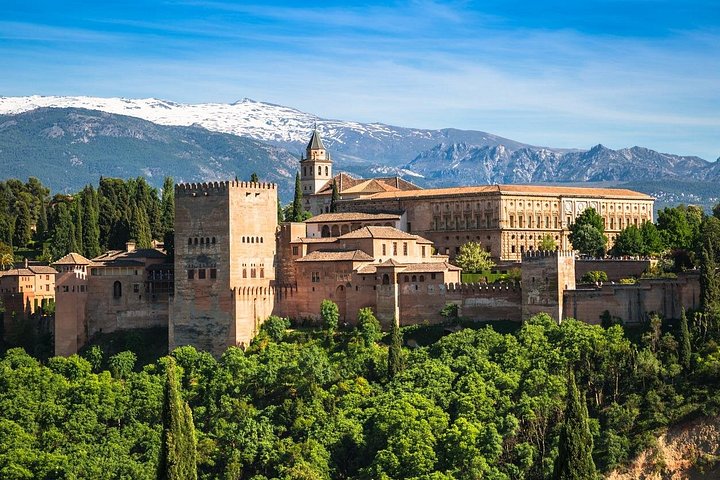
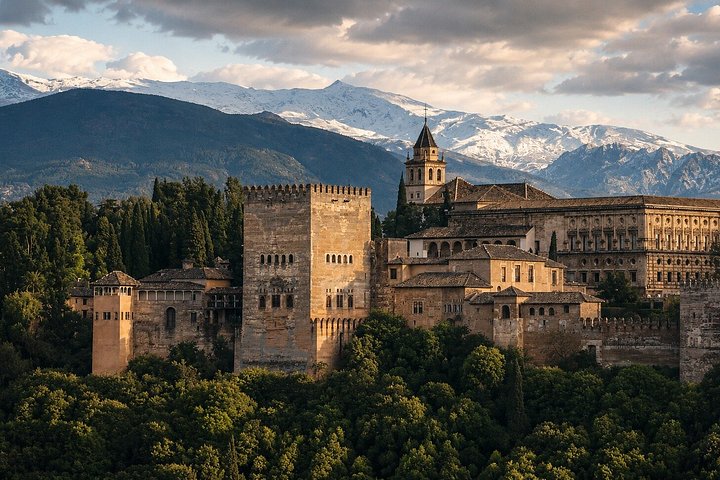
The Alhambra, a hilltop fortress and palace complex built by the Nasrid rulers in the thirteenth and fourteenth centuries, is one of Spain's most visited monuments, with carved plasterwork, courtyards and pools, and the Generalife gardens beside it. Granada fell in 1492, the last Muslim kingdom in Spain, and the cathedral and Royal Chapel, with the tombs of Ferdinand and Isabella, mark that turning point.
Top-ranked sights in Granada: Generalife Gardens, Alhambra (Alhambra de Granada), Palace of Charles V (Palacio de Carlos V).
Special offers in Granada
Was/now prices come from the operator, never from us.
 Likely to sell out5% off


Similar experiences




Hop-on hop-off in Granada
Alhambra Tour tickets included
from$114