Visit Archaeological Site of Philippi & Kavala, Private Day Tour
- 9 hours
- Free cancellation up to 24h before
- Guided in English
- Instant confirmation
Highlights
The archaeological site of Philippi, near Kavala, has one of the richest histories of all ancient Greek ruins, playing a pivotal role in Macedonian, Roman, and Early Christian history. As you explore the archaeological site, you will appreciate the city’s transition from Hellenistic settlement to the Roman colony, with the expansion of the theatre, the creation of the Forum (the Roman agora), and the proliferation of buildings central to everyday ancient life (including baths, cisterns, and latrines that had running water). The third chapter in Philippi’s story came in 49 or 50 AD when the Apostle Paul preached the words of the world’s newest religion within its walls. He was briefly thrown into jail as a result but that didn’t stop Philippi from becoming a metropolitan of Early Christianity. As you walk around, you will literally be retracing some of the first steps of Christianity in Europe.
Inclusions
What's included
- WiFi on board
- Pick up and drop off service from your hotel in Thessaloniki
- After the trip you will receive with email photos and video of your trip.
- Certified English Speaking Guide
- Transportation by air-conditioned V.I.P. vehicle
- Professional chauffeur (English-speaking)
- Bottle of water and coffee during the route (free)
What's not
- Gratuities
- Guide who speaks your language
- Lunch
- Coffee, Tea, Refreshments, Drinks or Juice, Snacks
Itinerary
Pick-up time from Thessaloniki: 09:00 Arrival at the Archaeological Museum of Philippoi at 11:00 The Archaeological Museum of Philippi contains two exhibition units in which the finds from the excavations in the ancient city are on permanent display: Unit A: This unit takes up the whole of the ground floor and has a surface area of 380 sq. m. It contains the archaeological (inscriptions, sculptures, vases, coins, jewellery), historical and visual material of the city of Philippi and its region from the prehistoric period until the end of Roman antiquity. Unit B: This unit occupies the first floor of the building, with a surface area of 205 sq. m. In here there is a presentation of the Christian city (inscriptions, architectural members, mosaics, vases, coins) from the Early Christian period of its rise until its decline in the seventh century AD, and its complete abandonment after the Turkish conquest of the late 14th century.
The most important archaeological site of eastern Macedonia, with characteristic monuments of the Hellenistic, Roman and Early Christian periods. The history of the site of Philippi begins in 360/359 B.C. when the colonists from Thasos founded the first city, called Krenides. In 356 B.C. the city is endangered by the Thacians and it turns to king Philip II for support. Philip had already foreseen the economic and strategic importance of the city, so he conquered it, he fortified it and he renamed it after himself (Philippi). After the battle of Philippi, in 42 B.C., the city became a Roman colony and its importance was stressed by the fact that it was located on the Via Egnatia. A landmark in the history of Philippi was the year A.D 49 or 50, when Apostole Paul visited the city and established there the first Christian Church of Europe. This made Philippi a metropolis of Christianity.
Arrival at the Archaeological Museum of Philippoi at 11:00 Next to the ancient, archaeological site of Philippi located the place where the Apostle Paul baptized the first Christian woman in Europe - Lydia, and it was here that the first baptismal ceremony was held in Europe. Today here is the Baptistery where the christenings are held today. In the town of Krynides in the Kavala region, next to the ancient city of Philippi there is a unique, monumental church of the Equal-to-the-Apostles Saint Lydia of the Philippisias. This is a modern architectural monument, the reason for the construction of which served as the stay of the Apostle Paul in this region. According to the narrative of Evangelist Luke, the Apostle Paul arrived in Philippi, the most important city in the region in the winter of the 49 - 50 AD during his first trip to Greece. Lydia was the first Greek and first European woman, baptized by the Apostle Paul.
Lunch Time Duration: 2 hours
Cancellation
Free cancellation up to 24 hours before the experience starts, for a full refund.
Reviews
5.0
- 53
- 40
- 30
- 20
- 10
Ratings come from 3 reviews collected by our booking partner. They are travellers' own words, in the order they were written — never reordered to flatter the experience.
Know before you go
- Pickup
- Pickup is included for everyone.
- Ticket type
- Mobile or paper ticket accepted
- Operated by
- Hello Thessaloniki
- Specialized infant seats are available
- Public transportation options are available nearby
- Infants and small children can ride in a pram or stroller
- Wheelchair accessible
- Suitable for all physical fitness levels
How it compares in Thessaloniki
- Its from-price is 164% above the median of the 101 day trips we list in Thessaloniki.
- Its length is typical for the group.
- By number of reviews it ranks 37 of 101.
- The operator lists free cancellation on it.
About Thessaloniki
Thessaloniki, Greece's second city, is a Byzantine and Ottoman port on the Aegean, with a waterfront tower, Roman monuments and excellent street food.
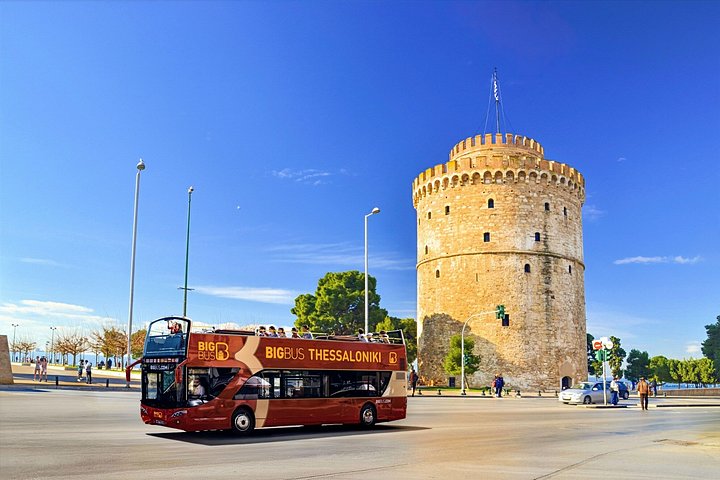
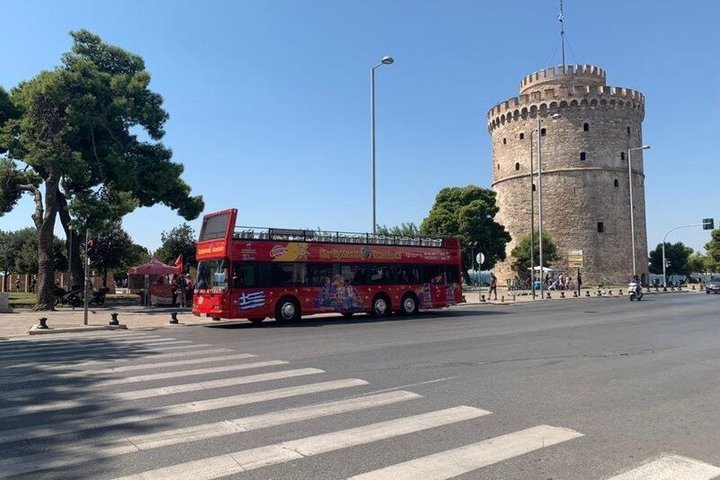
Thessaloniki was founded in 315 BC and became one of the main cities of the Roman and Byzantine worlds. The White Tower stands on the waterfront promenade, a rounded Ottoman-era tower that is now the city's emblem, and the Rotunda and the Arch of Galerius recall the Roman ruler who made the city his base. The early Christian and Byzantine churches, among them Agios Dimitrios, are listed by UNESCO.
Top-ranked sights in Thessaloniki: White Tower (Lefkos Pyrgos), Aristotelous Square, Church and Crypt of Ayios Dimitrios.
Special offers in Thessaloniki
Was/now prices come from the operator, never from us.