10% offFree cancellation
Explore the archaeology and mythology of ancient Greece on this private full-day tour. Following pickup at your Athens address, visit the archaeological sites of Epidaurus and Mycenae plus the historic port town of Nafplio. Along the way, discover 2,300-year-old amphitheaters, spectacular countryside scenery, and ancient ruins, and listen as your driver introduces mythical figures like King Agamemnon. Venture from Athens to discover highlights of the Peloponnese and visit two UNESCO sites in a single day. Enter the mythical kingdom of Agamemnon at the ancient ruins of Mycenae. Explore the historic harbor town of Nafplion, and step inside the classical Greek theater at Epidaurus, a 4th-century venue still prized for its acoustics.Enjoy regional cuisine with an optional lunch stop at a restaurant.
The fortified citadel of ancient Mycenae, the seat of the mythical and mighty King Agamemnon. An impressive and well-preserved site, the city of Mycenae gave its name to an entire civilization. Admire sites such as the Tomb of Clytemnestra, the infamous Lion’s Gate, the Cyclopean walls and learn of their blood-stained past. In the second millennium BC, Mycenae was one of the major centres of Greek civilization, a military stronghold which dominated much of southern Greece, Crete, the Cyclades and parts of southwest Anatolia. The period of Greek history from about 1600 BC to about 1100 BC is called Mycenaean in reference to Mycenae. At its peak in 1350 BC, the citadel and lower town had a population of 30,000 and an area of 32 hectares.
The archaeological site of Mycenae comprises the fortified acropolis and surrounding funerary and habitation sites, which are located mainly to its west and southwest. Most of the visible monuments date to the centre's great floruit, from 1350 to 1200 BC. Great Cyclopean walls surround the almost triangular acropolis, which is accessed from the northwest through the famous Lion Gate, the symbol of the Mycenaean rulers' power. The gate was named after the two opposing lions carved in relief and set into the relieving triangle, a typical feature of Mycenaean architecture, over the door.
The Lion Gate was the main entrance of the Bronze Age citadel of Mycenae, southern Greece. It was erected during the 13th century BC, around 1250 BC, in the northwest side of the acropolis and is named after the relief sculpture of two lionesses or lions in a heraldic pose that stands above the entrance. The Lion Gate is the sole surviving monumental piece of Mycenaean sculpture, as well as the largest sculpture in the prehistoric Aegean. It is the only monument of Bronze Age Greece to bear an iconographic motif that survived without being buried underground, and the only relief image which was described in the literature of classical antiquity, such that it was well known prior to modern archaeology.
The Archaeological Museum of Mycenae is found at the entrance of the ancient site, just a few steps before the Lion Gate.
The Treasury of Atreus or Tomb of Agamemnon is a large tholos or beehive tomb on Panagitsa Hill at Mycenae constructed during the Bronze Age around 1250 BC. The stone lintel above the doorway weighs 120 tons, with approximate dimensions 8.3 x 5.2 x 1.2m, the largest in the world. The tomb was used for an unknown period. Mentioned by the Roman geographer Pausanias in the 2nd century AD, it was still visible in 1879 when the German archaeologist Heinrich Schliemann discovered the shaft graves under the "agora" in the Acropolis at Mycenae.
Archaeological Museum of Epidaurus is a museum in Epidaurus, in Argolis on the Peloponnese peninsula, Greece. The museum, noted for its reconstructions of temples and its columns and inscriptions, was established in 1902 and opened in 1909 to display artifacts unearthed in the ancient site of Epidaurus in the surrounding area.
Archaeological Museum of Epidaurus is a museum in Epidaurus, in Argolis on the Peloponnese peninsula, Greece. The museum, noted for its reconstructions of temples and its columns and inscriptions, was established in 1902 and opened in 1909 to display artifacts unearthed in the ancient site of Epidaurus in the surrounding area.
The Temple of Asclepius was a sanctuary in Epidaurus dedicated to Asclepius. It was the main holy site of Asclepius. The sanctuary at Epidaurus was the rival of such major cult sites as the Sanctuary of Zeus at Olympia and Apollo at Delphi. The temple was built in the early 4th century BC. If still in use by the 4th century AD, the temple would have been closed during the persecution of pagans in the late Roman Empire, when the Christian Emperors issued edicts prohibiting non-Christian worship.
Free time for lunch, coffee, or shopping at the ‘Naples of the East’ rich in Venetian architecture, cobbled squares, and towering castles with commanding views of the Argolic Gulf. Afterwards, unwind by the harbor or get lost in the colorful back streets of the most elegant town in mainland Greece. Nafplio is a seaport town in the Peloponnese in Greece that has expanded up the hillsides near the north end of the Argolic Gulf. The town was an important seaport held under a succession of royal houses in the Middle Ages as part of the lordship of Argos and Nauplia, held initially by the de la Roche following the Fourth Crusade before coming under the Republic of Venice and, lastly, the Ottoman Empire. The town was the capital of the First Hellenic Republic and of the Kingdom of Greece, from the start of the Greek Revolution in 1821 until 1834. Nafplio is now the capital of the regional unit of Argolis.
Enjoy the view of the water castle of Bourtzi, a Venetian castle located in the middle of the harbor of Nafplio, and take fascinating photos from the harbor side.
The Acronauplia is the oldest part of the city of Nafplion in Greece. Until the thirteenth century, it was a town on its own. The arrival of the Venetians and the Franks transformed it into part of the town's fortifications. Later, part of it was used as a prison until the Greek government decided that the view provided from its location would benefit the local tourism and built a hotel complex which still stands there today.
Optional-(It is your choice if you want to visit the castle or spend more time walking at Nafplio beautiful city).Palamidi is a fortress to the east of the Acronauplia in the town of Nafplio in the Peloponnese region of southern Greece. Nestled on the crest of a 216-metre high hill, the fortress was built by the Venetians during their second occupation of the area (1686–1715). The fortress commands an impressive view over the Argolic Gulf, the city of Náfplio and the surrounding country. There are 913 steps in the winding stair from the town to the fortress. However, to reach the top of the fortress there are over one thousand, while locals in the town of Nafplion will say there are 999 steps to the top of the castle.
Free cancellation up to 24 hours before the experience starts, for a full refund.
5.0
Ratings come from 2 reviews collected by our booking partner. They are travellers' own words, in the order they were written — never reordered to flatter the experience.
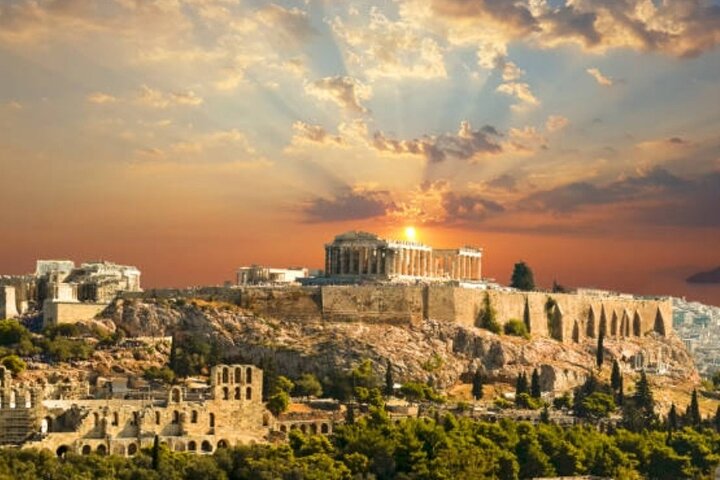
Athens sets the Acropolis above a sprawling modern capital, where ancient ruins, hillside lanes and long taverna evenings sit side by side.
The Parthenon crowns the Acropolis, flanked by the Erechtheion and its porch of caryatids, and the Acropolis Museum at the foot of the hill displays sculpture found on the rock. Around it, the Ancient Agora, the Temple of Olympian Zeus, Hadrian's Arch and the marble Panathenaic Stadium make the classical city easy to walk through.
Top-ranked sights in Athens: Acropolis, Parthenon, Acropolis Museum.
Was/now prices come from the operator, never from us.

from$2,277
Add Ticket Hall to your home screen
Tickets and city guides, one tap away, even offline.
Ticket Hall