Jewish tour and Athens sightseeing in 6 hours
- 6 hours
- Free cancellation up to 24h before
- Guided in English
- Instant confirmation
Highlights
Highlights of the half-day Jewish tour in Athens • Visit the old and new Synagogue of Athens (It's currently closed for visitors due to the war) • The Jewish museum of Athens • Visit the Acropolis and Parthenon • Enjoy a city tour in Athens with a professional English-speaking driver • The Jewish tour is also available as a shore excursion from your cruise ship at the Port of Praeus (Athens) • Travelers can customize the tour within the itinerary!
Inclusions
What's included
- Hotel pickup and drop-off
- Private tour
- A professional English speaking driver with good knowledge in history and culture of Greece, to guide you till you enter archaeological sites and museums. Tour drivers are not licensed to companion you inside the archaeological sites and museums. If you'd like to have a licensed by the state tour guide to escort you inside the sites and museums, we can arrange it for you with an additional cost. Licenced by the state tour guides are freelance and it is subject of availability on bookings day!
- Transport by air-conditioned vehicle appropriate for the size of your group
What's not
- Entrance fees to the archaeological sites and museum
- Gratuities
- Food and drinks
- Airports and all Ports pickup and drop-off not included in this price
- English-speaking licensed tour guide (We can arrange for a tour guide for you with an extra cost)
Itinerary
Welcome to Athens, the historical capital of Europe. Welcome to the birthplace of democracy, arts, science, and philosophy of western civilization. Home of Plato, Socrates, Pericles, Euripides, Sophocles, Aeschylus. Athens is one of the world’s oldest cities. It’s recorded history spanning around 3.400 years and it is being inhabited since the 11th millennium B.C. E. Today, under the shadow of the Parthenon, the contemporary urban scenery of the sprawling city reflects its exciting history, its multi-cultural modern personality as well as the infrastructure and facilities. The perfect Mediterranean climate with the legendary greek sunlight, the unique combination of glorious history with modern, urban innovation, the coexistence of great culture with astonishing natural beauty, the high standard hotel accommodation ... We will pick you up from your accommodation in Athens. Our tour starts traveling directly to the Acropolis in order to avoid traffic and crowd.
The Jewish Community of Athens has two functioning synagogues, both on the same street facing each other, in the area of Thission, near the city center. The older of the two is the Romaniote one, built-in 1904, at 8, Melidoni Steet. It is called Etz Hayyim, a common name for Romaniote synagogues. Still called “the Ioannina Synagogue” by the community’s older members, it is the smaller of the two and is used today only during the High Holidays. The ground floor houses the community’s offices, in rooms originally intended for a Jewish school. Right across the street, at number 5, is the newer and larger, Beth Shalom Sephardic synagogue, built-in 1935 of white Pentelic marble and the architecture is an austere Greek Revival style, renovated in 1975, and the one fully used today. Its exterior is in white marble with neoclassical elements, while the spacious interior bears not much resemblance to the Greek tradition regarding synagogue design.
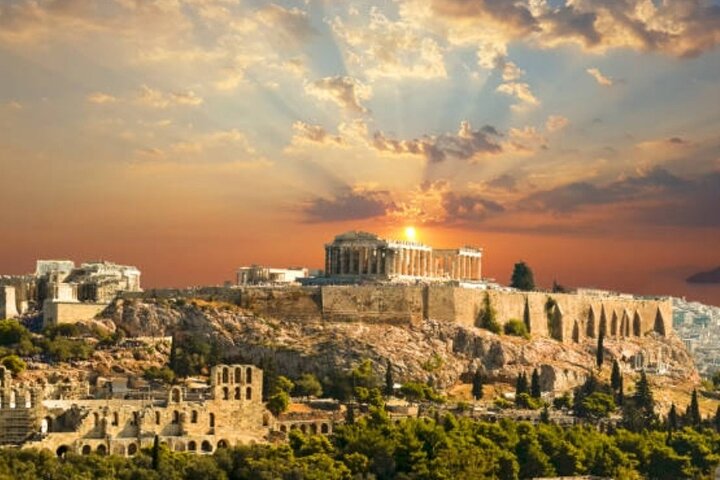
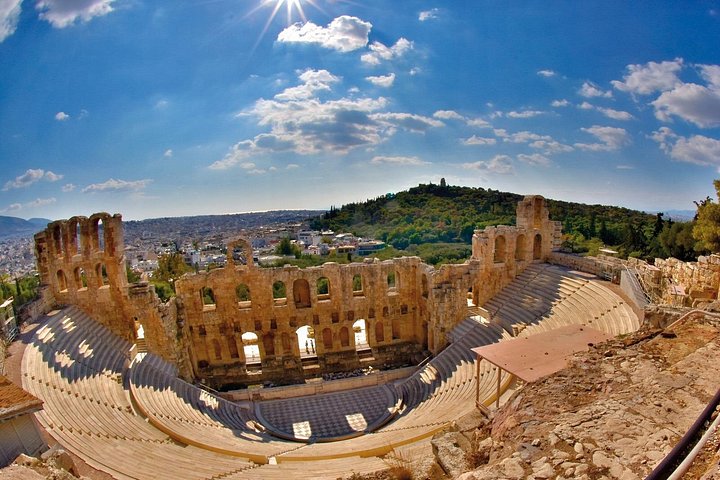
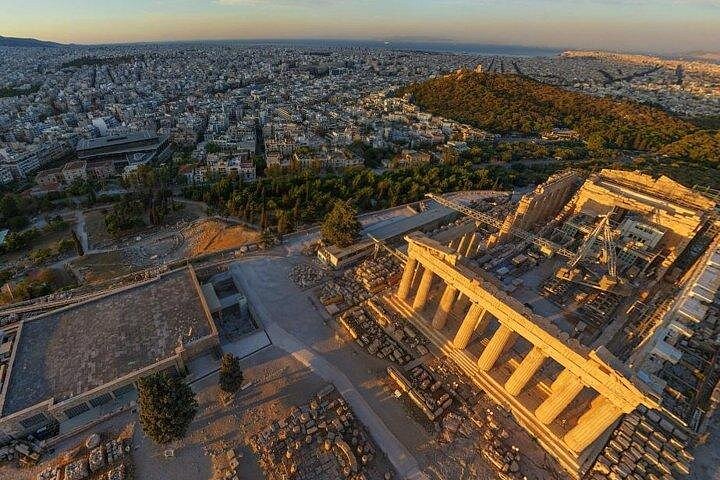
The Acropolis of Athens is an ancient citadel located on a rocky outcrop above the city of Athens, and its monuments are universal symbols of the classical spirit and civilization and form the greatest architectural and artistic complex bequeathed by Greek Antiquity to the world. In the second half of the 5th-century bc, Athens, following the victory against the Persians and the establishment of democracy, took a leading position amongst the other city-states of the ancient world. In the age that followed, as thought and art flourished, an exceptional group of artists put into effect the ambitious plans of Athenian statesman Pericles and, under the inspired guidance of the sculptor Pheidias, transformed the rocky hill into a unique monument of thought and the arts. The most important monuments were built during that time: the Parthenon, built by Ictinus, the Erechtheon, the Propylaea, the monumental entrance to the Acropolis, designed by Mnesicles, and the small temple Athena Nike.
The Propylaea of the Athenian Acropolis was built on the west side of the hill, where the gate of the Mycenaean fortification once stood. The first propylon, or gate, was constructed in the age of Peisistratos (mid-sixth century BC), after the Acropolis had become a sanctuary dedicated to Athena. A new propylon, built-in 510-480 BC, was destroyed by the Persians in 480 BC and repaired after the end of the Persian Wars, during the fortification of the Acropolis by Themistokles and Kimon. The monumental Propylaia admired by modern visitors was part of the great Periclean building program. They have erected in 437-432 BC, after the completion of the Parthenon, by architect Mnesikles. The original building plan was particularly daring both in architectural and artistic terms but was never completed. The pie-shaped building of Pentelic marble frames beautifully the entrance to the sacred precinct. The central section, the propylon proper, had an outer (west) and inner (east) facade...
The Propylaea of the Athenian Acropolis was built on the west side of the hill, where the gate of the Mycenaean fortification once stood. The first propylon, or gate, was constructed in the age of Peisistratos (mid-sixth century BC), after the Acropolis had become a sanctuary dedicated to Athena. A new propylon, built-in 510-480 BC, was destroyed by the Persians in 480 BC and repaired after the end of the Persian Wars, during the fortification of the Acropolis by Themistokles and Kimon. The monumental Propylaia admired by modern visitors was part of the great Periclean building program. They have erected in 437-432 BC, after the completion of the Parthenon, by architect Mnesikles. The original building plan was particularly daring both in architectural and artistic terms but was never completed. The pie-shaped building of Pentelic marble frames beautifully the entrance to the sacred precinct. The central section, the propylon proper, had an outer (west) and inner (east) facade...
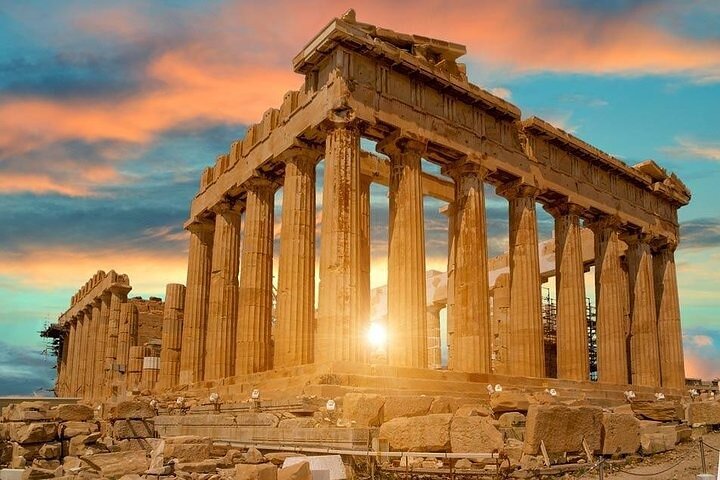
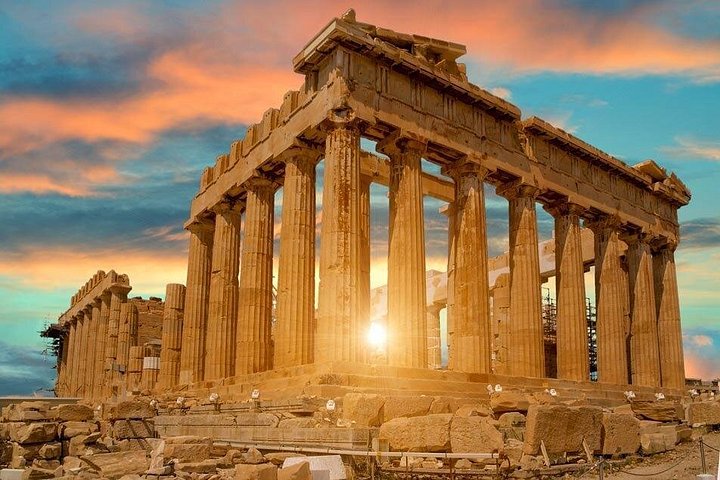
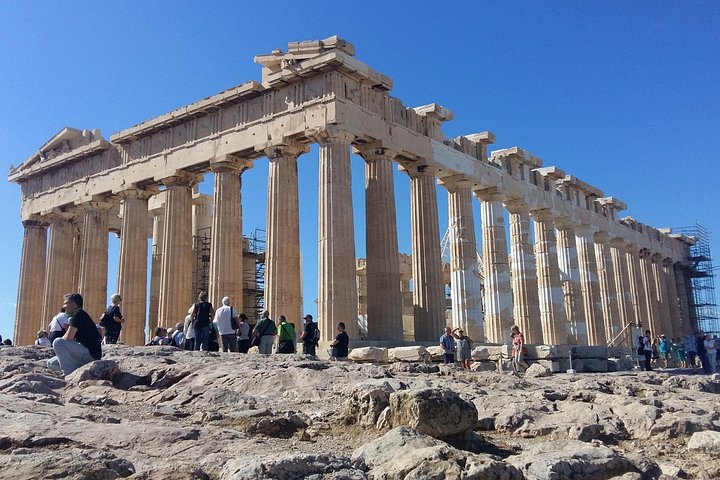
The Parthenon, dedicated by the Athenians to Athena Parthenos, the patron of their city, is the most magnificent creation of Athenian democracy at the height of its power. It is also the finest monument on the Acropolis in terms of both conception and execution. Built between 447 and 438 BC, as part of the greater Periklean building project, this so-called Periklean Parthenon (Parthenon III) replaced an earlier marble temple (Parthenon II), begun after the victory at the battle of Marathon at approximately 490 BC and destroyed by the Persians in 480 BC. This temple replaced the very first Parthenon (Parthenon I) of c. 570 BC from Periklis . The Parthenon was designed by architects Iktinos and Kallikrates, while the sculptor Pheidias supervised the entire building program and conceived the temple's sculptural decoration and a chryselephantine statue of Athena. The Parthenon is a double peripteral Doric temple with several unique and innovative architectural features.
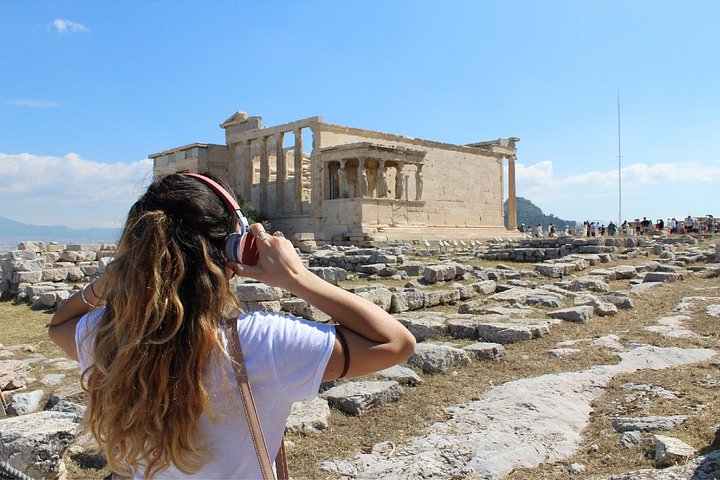
The elegant building known as the Erechtheion, on the north side of the sacred rock of the Acropolis, was erected in 421-406 BC as a replacement of an earlier temple dedicated to Athena Polias, the so-called "Old temple". The name Erechtheion, mentioned only by Pausanias (1, 26, 5), derives from Erechtheus, the mythical king of Athens, who was worshipped there. The sanctuary also contained the grave of Kekrops and the traces of the dispute between Athena and Poseidon for the possession of the city of Athens. Another door on the south facade of the western temple opened onto the porch of the Karyatides, a pi-shaped structure with six female statues instead of columns to support the roof. Created by Alkamemes or Kallimachos, the statues were later named Karyatides after the young women from Karyes of Laconia who danced in honor of the goddess Artemis. Five of them are in the Acropolis Museum and another in the British Museum; those on the building are casts.
The history of the impressive building of the Hellenic Parliament is intimately linked to the history of the Modern Greek state. Initially, the building served as the palace of Kings Otto and George I. It became the Parliament and Senate building a hundred years after it was constructed and still houses the Hellenic Parliament today. Through all those years, the building has undergone a series of changes and has been modernized. From 1836 to 1862; After the selection of Otto, Prince of Bavaria, as King of Greece, and the relocation of the Greek capital to Athens, it was decided to erect the palace on Boubounistra Hill. It proved an inspired choice. The chosen location was in the center of the new capital, easily defendable and cool. On February 6th, 1836 the founding stone was laid at the highest eastern point of the city. The ancient quarry of Pentele was the source of marble. King and queen Otto, and Amalia, took up residence on July 25th, 1843.
The Tomb of the Unknown Soldier is a war memorial located in Syntagma Square in Athens, in front of the Old Royal Palace. It is a cenotaph dedicated to the Greek soldiers killed during war. It was sculpted between 1930 and 1932 by sculptor Fokion Rok. The tomb is guarded by the Evzones of the Presidential Guard.
The Parthenon, dedicated by the Athenians to Athena Parthenos, the patron of their city, is the most magnificent creation of Athenian democracy at the height of its power. It is also the finest monument on the Acropolis in terms of both conception and execution. Built between 447 and 438 BC, as part of the greater Periklean building project, this so-called Periklean Parthenon (Parthenon III) replaced an earlier marble temple (Parthenon II), begun after the victory at the battle of Marathon at approximately 490 BC and destroyed by the Persians in 480 BC. This temple replaced the very first Parthenon (Parthenon I) of c. 570 BC from Periklis . The Parthenon was designed by architects Iktinos and Kallikrates, while the sculptor Pheidias supervised the entire building program and conceived the temple's sculptural decoration and a chryselephantine statue of Athena. The Parthenon is a double peripteral Doric temple with several unique and innovative architectural features.
The Academy of Athens was founded with the Constitutional Decree of March 18th, 1926, as an Academy of Sciences, Humanities, and Fine Arts. The same Decree appointed its first Members, who were all eminent representatives of the scientific, intellectual, and artistic circles of that era.
The National and Kapodistrian University of Athens (NKUA) is a public, self-governed Higher Education Institution, under the auspices of the Ministry of Education, Research, and Religious Affairs. Inaugurated in 1837, it has been the oldest higher education institution in the Modern Greek state and the first university in the Balkan and Eastern Mediterranean area. Since then it has been an internationally competitive, globally-focused, research-led university.
Cancellation
Free cancellation up to 24 hours before the experience starts, for a full refund.
Reviews
4.8
- 59
- 40
- 31
- 20
- 10
Ratings come from 10 reviews collected by our booking partner. They are travellers' own words, in the order they were written — never reordered to flatter the experience.
Know before you go
- Pickup
- Pickup is included for everyone.
- Ticket type
- Mobile or paper ticket accepted
- Operated by
- Athens Tours Greece
- Specialized infant seats are available
- Travelers should have at least a moderate level of physical fitness
- Dress: religious and marmoreal sites: shoulders and knee must be covered
- Important note: You will have a professional English-speaking driver with good knowledge of the history and culture of Greece, to guide you till you enter archaeological sites and museums according to the program. Tour drivers are not licensed to companion you inside the archaeological sites and museums. If you'd like to have one, we can arrange it for you at an additional cost. Licensed by the state tour guides are freelance and it is subject to availability on bookings day!
- Caution Restriction: Transfers from airports and ports are not include in this tour
- Pick up /drop off at Piraeus port can be arranged on request at an extra cost !
- Athens International Airport transfers can be arranged on request at an extra cost!
- We suggest that you have your admission tickets pre-purchased as there is a chance not to find availability, please note that we can buy the tickets for you in advance -under a small service fee.
How it compares in Athens
- Its from-price is 78% above the median of the 4134 experiences we list in Athens.
- It is longer than most of them.
- By number of reviews it ranks 1042 of 4134.
- The operator lists free cancellation on it.
About Athens
Athens sets the Acropolis above a sprawling modern capital, where ancient ruins, hillside lanes and long taverna evenings sit side by side.
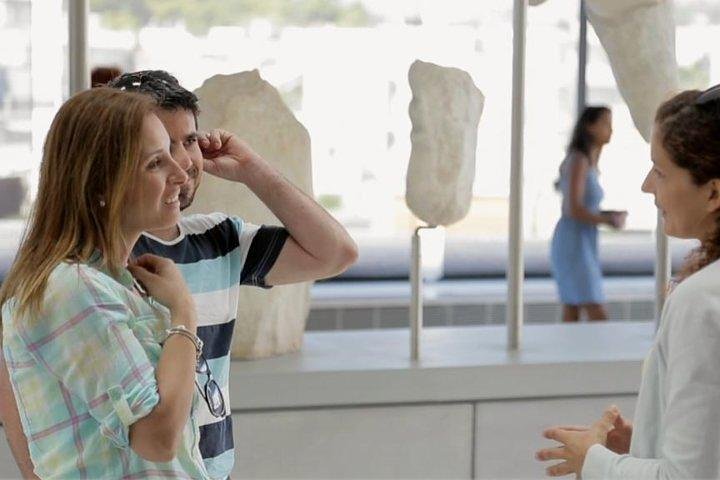
The Parthenon crowns the Acropolis, flanked by the Erechtheion and its porch of caryatids, and the Acropolis Museum at the foot of the hill displays sculpture found on the rock. Around it, the Ancient Agora, the Temple of Olympian Zeus, Hadrian's Arch and the marble Panathenaic Stadium make the classical city easy to walk through.
Top-ranked sights in Athens: Acropolis, Parthenon, Acropolis Museum.
Special offers in Athens
Was/now prices come from the operator, never from us.

Similar experiences
 10% offFree cancellation


Hop-on hop-off in Athens
![5 Day Mykonos & Santorini Trip]()
5 Day Mykonos & Santorini Trip
from$2,277