Belfast Troubles Tour: Walls and Bridges
- 2.7–3 hours
- Free cancellation up to 24h before
- Guided in English
- Instant confirmation
Highlights
Troubles Tour: Walls and Bridges is one part walking tour, one part street theatre and 100% astounding. It entertains, engages and informs using original songs and lived experience to help you understand the day to day realities of the Troubles. The tour brings history to life but not in chronological order — instead it builds an immersive picture of a city, its people and its conflicts through a powerful mix of education, storytelling and theatrics. Participants will visit political murals on both sides of the divide, pass through heavily fortified security gates and stand at the Peace Walls. Along the way, an original song captures the turbulent reality of the times in a way that no history book can. This tour goes beyond history. It reveals the culture, the humanity and the hidden stories that shaped this city — and the remarkable people who built bridges when others were building walls. Ideal for anyone interested in history, culture and politics — and unforgettable for everyone.
Inclusions
What's included
- Personalised recommendations from your guide
- Local guide
- Private tour
- Professional guide
- Visits to key areas including political mural sites, Peace Walls, Cathedral Quarter
What's not
- Gratuities
- Food and drinks
- Hotel pickup and drop-off
- Personal expenses
Itinerary
We begin at Belfast City Hall — one of the most magnificent civic buildings in these islands. Built at the height of Belfast's industrial power and opened in 1906, it is a statement in stone of a city that was once among the wealthiest and most productive on earth. Belfast built the ships, linen and ropes that supplied the world — and City Hall reflects that confidence and ambition. Walking along the front of the gardens we pause at the statue of Mary Ann McCracken — radical Presbyterian, abolitionist and humanitarian. She represents a hidden radical tradition at the heart of Belfast's story that will resurface at the very end of our tour. From here we walk from opulence and civic grandeur into the heart of West Belfast's working class communities. That journey — from wealth to deprivation, from the centre of power to the margins — is not accidental. Class and economics are central to understanding the Troubles.
Crossing to the Linen Hall Library — officially The Belfast Library and Society for Promoting Knowledge, founded 1788 — we encounter another product of Belfast's radical enlightenment tradition. A city that was thinking, debating and organising at the very moment revolution was reshaping the western world. We move into Donegall Place and pause. All is not as it seems here. Look carefully and you will find echoes of a past that the city has quietly absorbed into its everyday surface. Streets that once felt very different. A city centre that bore the marks of a conflict that many would prefer to forget. Your guide will help you see what others walk past without noticing — the traces of division that remain hidden in plain sight, written not in stone or bronze but in the ordinary fabric of the street itself. In this city, it is rarely what you see that tells the real story. It is what you don't.
The Spirit of Belfast sculpture stands at the heart of the city centre on Cornmarket — a striking and deliberately ambiguous piece of public art that invites interpretation. Known locally by rather more colourful nicknames, it sits at the junction of one of Belfast's busiest shopping areas, surrounded by the ordinary rhythm of daily city life. But your guide will ask you to look beyond the sculpture itself to what surrounds it — because this unremarkable corner of the city centre holds a story that Belfast has never fully acknowledged. Adjacent to where you are standing, something happened that deserves to be remembered. That it has not been — and why — is a question your guide will answer here. Sometimes the most significant places are hiding in plain sight."
On the surface, the offices of Finucane Solicitors on Castle Street appear unremarkable — a modest, nondescript building on an ordinary urban street. But appearances can be deceptive, and this is precisely the point. The name Finucane is central to one of the most disturbing and unresolved chapters of the Troubles — the issue of collusion between loyalist paramilitaries and the British state. It is a story that challenges comfortable narratives about the conflict and raises profound questions about justice, accountability and truth that remain unanswered to this day. Your guide will explain the full significance of this building and why it matters — not just to Belfast but to our understanding of what the Troubles really were and how they were conducted. It's a very ordinary office until it's not.
Approaching Divis, we encounter the first mural of the tour — a powerful statement of Irish identity in a community that was deliberately stigmatised and marginalised during the Troubles. The mural depicts Gaelic sports, boxing and an Irish dancer — cultural symbols that represented defiance and pride at a time when that identity was under profound pressure. A reminder that the Troubles were not simply a political conflict but a battle over identity, culture and the right to exist on your own terms. Towering above is Divis Tower — used as a military lookout post during the conflict, its upper floors occupied by the British Army for decades. For the community below, it was a constant reminder of the realities of living through the Troubles. This area carries deep trauma — one such case being featured in the acclaimed Netflix series, 'Say Nothing'.
The International Wall on the Falls Road is one of the most remarkable open air galleries in the world. Originally used by Irish Republicans as a political billboard to counter mainstream media narratives, it was designed to destigmatise and decriminalise the armed struggle — connecting Belfast's conflict to injustices across the globe. The murals change constantly, reflecting local, national and international events and causes. No two visits are ever quite the same. The wall represents a tradition of visual storytelling that goes to the heart of what the Troubles were about — the battle for narrative, identity and truth. Standing before it, you begin to understand not just what people were fighting for, but how they fought to be heard. Your guide will help you read between the lines — exploring not just what is depicted, but what is deliberately left out. Sometimes what is absent tells you as much as what is there
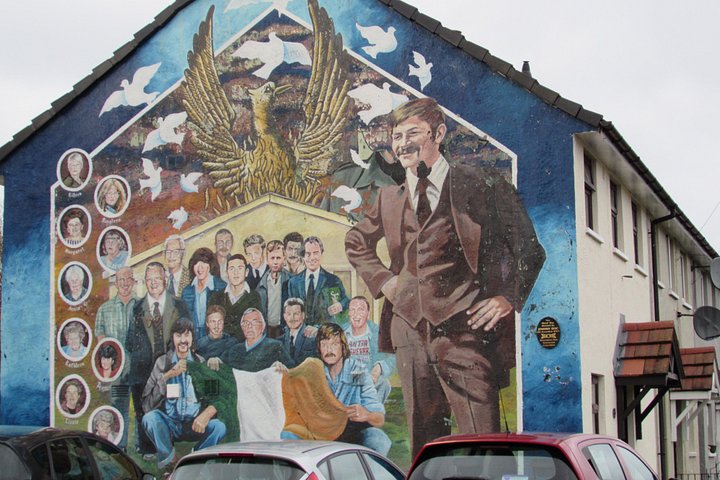
Passing through large, bolted security gates — effectively a border between Irish and British communities — you enter the Shankill Road, the heartland of loyalist, British-Protestant Belfast. Here, powerful murals tell an entirely different story of identity, loyalty and loss. Depicted across the walls are defining moments of the loyalist tradition — the Battle of the Somme, the signing of the Ulster Covenant, and the Twelfth of July celebrations. The murals also reference the Bayardo Bar atrocity and loyalist paramilitary organisations — a reminder that this community experienced its own profound tragedy and conflict. This is not a tourist trail. It is a living, breathing community with a story that deserves to be heard.
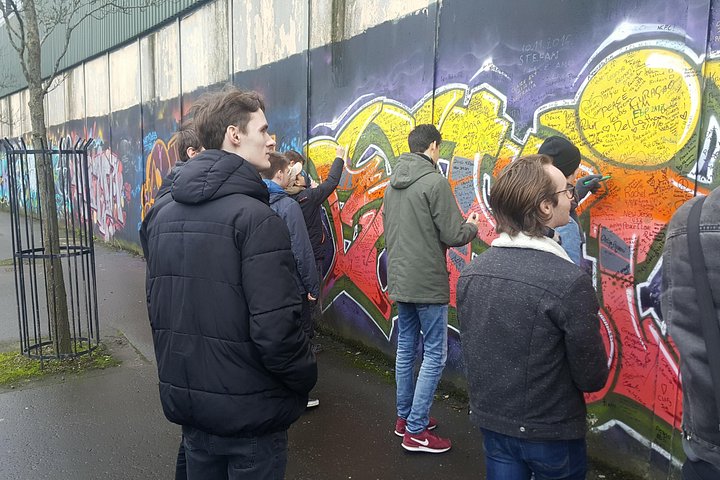
These Walls divide the two communities in Belfast. They are approximately 16 metres high topped with mesh to stop petrol bombs. There is plenty of time to photograph and examine the Walls with detailed explanations provided.
Leaving the Peace Walls, we pass back through new, imposing security gates — another no man's land — returning to the Falls Road. Your guide will explain the story behind their recent construction — a detail that tells you everything about where Belfast truly stands today. Your guide will point out two landmarks that encapsulate the republican experience — the Republican Memorial Garden and the world famous Bobby Sands mural on Sinn Féin's headquarters. Time does not permit a full visit but context will be provided as we pass. As we make our way back toward the city, the iconic Harland and Wolff cranes dominate the skyline — a reminder of a time when Belfast was among the most productive cities on earth. The return journey is as rich as the outward one — economic forces, fractured communities and the bridges quietly built across the divide in boxing gyms, music venues and the unexpected common ground of punk rock.
Back in Belfast City Centre, we pause at St Mary's Church on Chapel Lane — the oldest Catholic Church in Belfast, dating from 1784 and tucked away on a narrow lane just steps from the busy city centre streets. Modest and easily overlooked, St Mary's rewards those who look closely. Like so much in Belfast, the surface tells only part of the story. Behind its quiet exterior lies a history that connects directly to the radical tradition you have encountered throughout the tour — and one that has remarkable and surprising links to the First Presbyterian Church on Rosemary Street where our tour concludes. A connection that fundamentally challenges the standard narrative of division in this city — and that has been hiding in plain sight for over two centuries.
From High Street we can view Belfast's own leaning tower — the Albert Clock, standing 113 feet tall with a noticeable lean of 4 feet from the perpendicular. But this is more than a quirky landmark. The Albert Clock stands on the exact spot where the original crossing point of the River Farset established the town of Belfast itself. Where the clock stands, the city began. Look closely and you will spot the statue of Prince Albert at its summit — a reminder of the Victorian confidence and imperial pride that built this city. Film enthusiasts may recognise it from the iconic film noir Odd Man Out, starring James Mason, which captured Belfast at one of the most turbulent moments in its history.
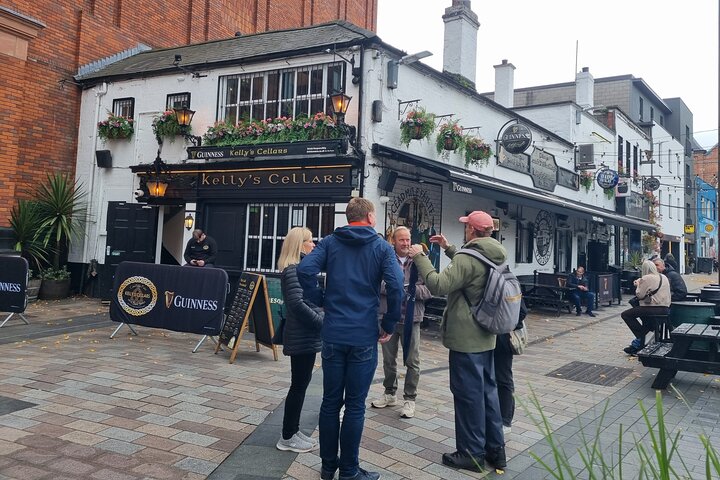
Belfast's Entries are narrow historic passageways threading through the city centre — hidden in plain sight, invisible to those who don't know where to look. We meander through them past the sites of revolution, intrigue and rebellion that shaped this city and its radical tradition. And yes, some rather fine pubs too.
Cancellation
Free cancellation up to 24 hours before the experience starts, for a full refund.
Reviews
5.0
- 51,075
- 413
- 30
- 23
- 11
Ratings come from 1,092 reviews collected by our booking partner. They are travellers' own words, in the order they were written — never reordered to flatter the experience.
Showing reviews written in English.
5A compelling insight into the troubles
This tour is an absolute must when visiting Belfast . Steve’s knowledge of the troubles is bordering on encyclopaedic and delivered in such a way that you can’t wait to hear the next chapter of this compelling history of Belfast . Despite the awful weather we were thoroughly captivated and learnt so much along the way. An excellent tour.
5A phenomenal tour
Steve delivered a very insightful and thoughtful history of the troubles in Belfast, from the very origins of the conflict to the current day. He had an encyclopedic knowledge of the area and was able to answer any questions the group had. He also provided a list of books and other resources that he referenced throughout the tour for us to find out more. We would highly recommend for anyone visiting Belfast.
5Steve was very...
Steve was very knowledgeable and educated me about the history of the troubles. His obvious love for his country and hope for its future was inspiring. Thanks so much Steve.
5Belfast Troubles Tour
Steve was an exceptional tour guide, his knowledge and delivery was second to none as he gave us a run through from 800 years up until present day! Plus followed up with a book and film list if you wanted to know more! I'd highly recommend!
5Best tour in town
Arthur was sincere, very articulate, funny and told us extra things we’d never know on a more traditional tour . He was thoughtful and involved everyone I’d recommend him 100 per cent and I loved his music knowledge and personal experience. Thanks Arthur you’re a gem !
5Belfast Troubles Walking Tour
Great tour with Arthur who was both knowledgeable and entertaining. He gave a really in depth, unbiased and realistic view of the ‘troubles’. Left us with hope and optimism for the future of the country. Tour was over 3 hours and never felt rushed. Did not constantly walk for 3 hours and did have a short comfort break. Everyone on tour was respectful of each other and of the locals as we walked the route. Highly recommend this tour.
Know before you go
- Meeting point
- The Meeting Point is on Donegall Square North, on the pavement outside the grounds of Belfast City Hall. Across the road is the main shopping avenue. Look for a large green and white umbrella. Please come 10 minutes before the start of your tour so I can distribute Listening sets.
- Pickup
- Everyone meets at the starting point; there is no pickup.
- Ticket type
- Mobile or paper ticket accepted
- Group size
- Up to 16 travellers
- Operated by
- Experience Belfast
- Service animals allowed
- Public transportation options are available nearby
- Travelers should have at least a moderate level of physical fitness
- Adult, graphic content - not suitable for children under 14
- High level of English required
How it compares in Belfast
- Its from-price is 93% below the median of the 62 city tours we list in Belfast.
- It is shorter than most of them.
- By number of reviews it ranks 3 of 62.
- The operator lists free cancellation on it.
About Belfast
Belfast is Northern Ireland's capital, a harbour city between hills and lough, known for shipbuilding, Victorian pubs, murals and the Titanic story.
Belfast grew with the linen and shipbuilding trades, and the giant yellow cranes of the old shipyard still stand over the docks where the Titanic was built and launched in 1911. The Titanic Quarter now holds a large museum on that story. In the centre, the domed City Hall, completed in 1906, stands in a square of Victorian and Edwardian buildings, and the Cathedral Quarter has cobbled lanes and old pubs.
Top-ranked sights in Belfast: Giant's Causeway, Dunluce Castle, Dark Hedges.
Special offers in Belfast
Was/now prices come from the operator, never from us.