
Comparison
Hop On Hop Off vs Walking Tour in London
- Routes3
- Stops48
- Shortest loop70M
- Sights8
Quick verdict: choose the hop-on hop-off bus if you want to see a lot of London's spread-out landmarks and decide for yourself where to linger. Choose a guided walking tour if you would rather learn one district properly from a person who knows its stories.
The two are less rivals than different tools. London is large enough that a bus covers ground no walking group can, yet its oldest streets are dense enough that a guide on foot finds things a bus passes by. This page compares them on coverage, commentary, pace, accessibility, weather and group size.
Sights in this guide


Coverage: breadth against depth
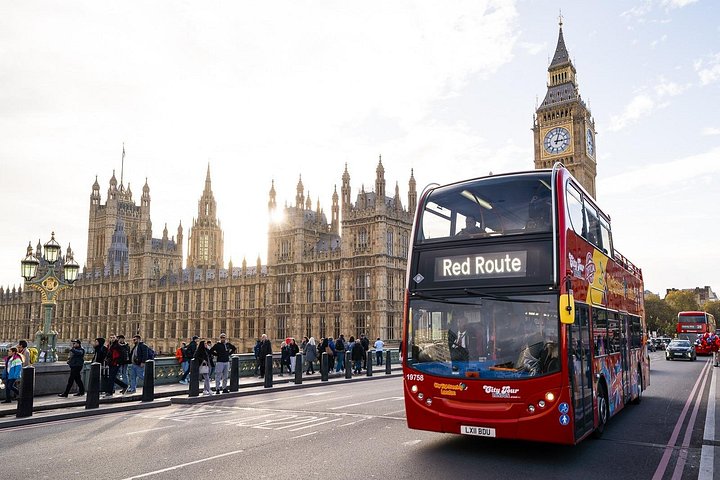
The bus network in London has three routes. The Red Route is a central loop linking Piccadilly, Trafalgar Square, Whitehall, the South Bank, St Paul's, the Tower of London and Westminster, and Buckingham Palace. The Blue Route is a longer loop from Victoria through Hyde Park Corner, Harrods, the South Kensington museums, Kensington Palace, Paddington and Marble Arch, then across the West End to St Paul's, London Bridge and the Tower of London. The Green Link is a short circuit around the Euston, King's Cross and St Pancras area that calls at the British Museum before returning towards the Embankment and Covent Garden.
That is the bus's real strength: it stitches together areas that sit miles apart. A walking tour typically covers one district, such as the Westminster cluster or the City and Tower area, and does it in detail. If your list spans Kensington, the West End and the riverside, no single walk will reach it all.
Commentary and depth
On the bus, the commentary is audio, with a choice of languages that helps mixed-nationality groups. It points out what you are passing, but unlike a live guide it will not answer your questions, so check the ticket page for how the commentary is delivered.
A walking tour usually runs two to three hours with a live guide, who can answer questions, choose side streets, tell the human stories behind a building and adjust to the group's interests. Quality and specialism vary by operator, so themes such as royal history, the medieval City or food can differ a lot. For depth on a single area, the guide wins comfortably; for a quick orientation across the whole city, the bus does the job.
Pace and flexibility
The hop-on hop-off format is self-paced. You board at whichever stop is nearest, ride past what does not interest you and get off where you want to spend time. Stop numbers differ between the timetable, route map and service pages, so go by stop names. Buses on the Red Route run every 15 to 20 minutes and the Blue Route every 20 minutes, so a missed bus is not a disaster.
The full Red Route loop takes about 2 hours 30 minutes, the Blue Route about 3 hours 35 minutes and the Green Link about 70 minutes for one loop. A walking tour has a fixed start and a set rhythm: you keep to the guide's schedule, which suits people who like a plan made for them and frustrates those who want to wander.
Sights each option handles well
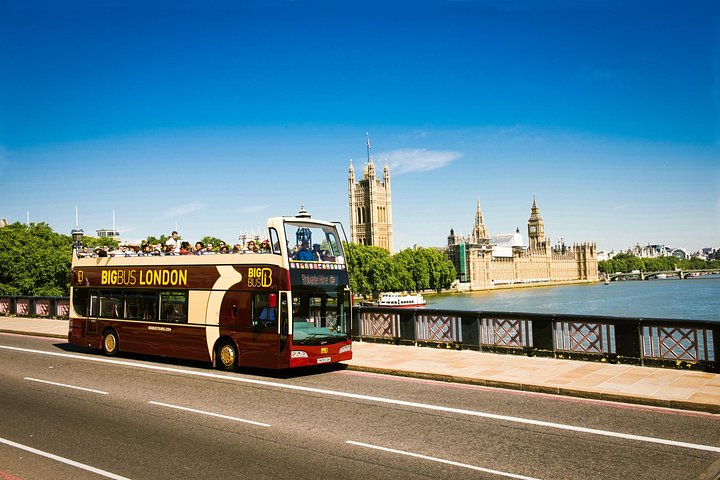
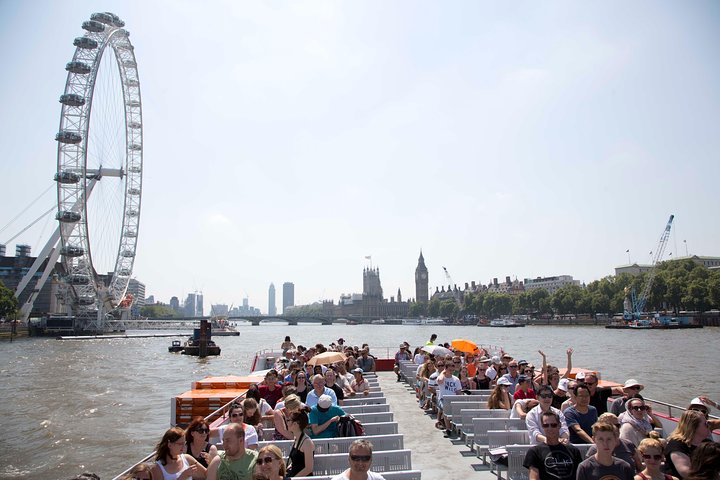
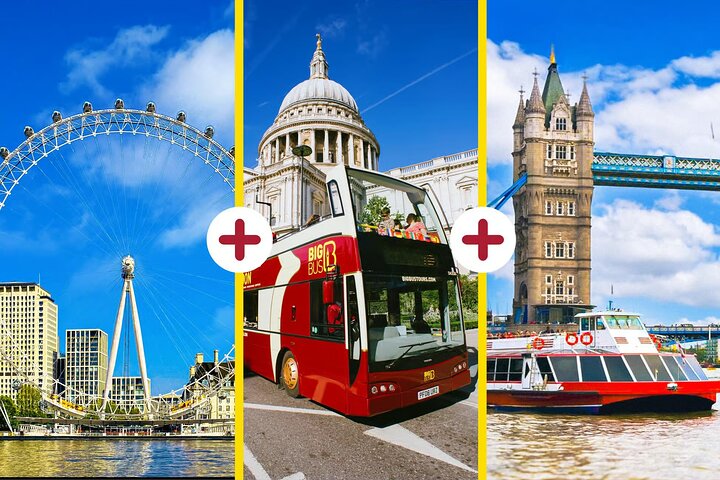
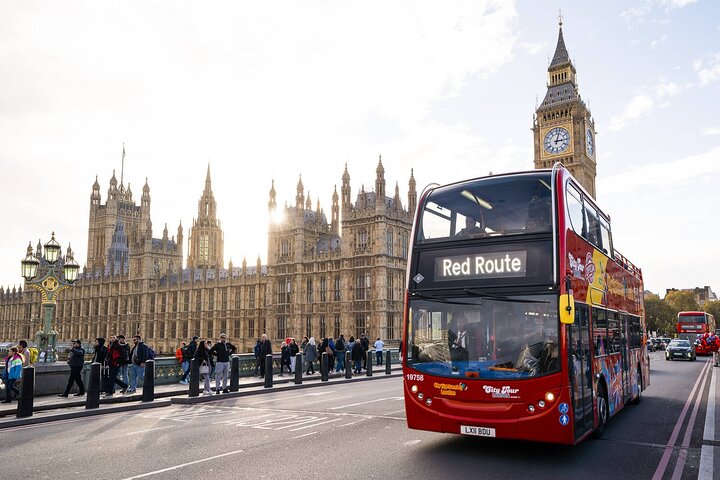
The bus puts you at the door of several big sights. The Red Route stops at St Paul's Cathedral, the Tower of London, the London Eye, Trafalgar Square, Buckingham Palace and Westminster Pier, and the Blue Route also serves St Paul's, the Tower of London, the London Eye and Trafalgar Square. Houses of Parliament and Big Ben are about 150 metres from Westminster Pier, and Westminster Abbey about 400 metres. Tower Bridge is about 300 metres from the Tower of London stop, and Borough Market about 400 metres from London Bridge.
Walking tours shine where sights cluster. One group is the Tower of London, Tower Bridge and Borough Market. Another is the London Eye, Parliament, Westminster, the Abbey and Trafalgar Square along the river. A third is Buckingham Palace and the Changing of the Guard. Each fits a half-day on foot, and a guide can thread you through them with context a bus cannot offer.
Accessibility, weather and group size
Hop-on hop-off suits riders who want to choose a few stops rather than walk between sights, which helps older visitors and families with young children. Accessibility details vary, so check the ticket page before booking. Walking tours demand steady walking and standing for two to three hours, sometimes on uneven pavements and with crowds, so think about stamina honestly.
Weather affects both. London rain can arrive in any month, and a light layer is wise either way. An open top deck is a pleasure in settled weather and less so in a downpour, while a walking group usually keeps going in drizzle, though standing outside while a guide talks is tiring in heavy rain. On size, a bus is a shared, anonymous ride; walking tours are usually small groups, which feels more personal, though numbers differ by operator.
Verdict: who should pick which
First-timers with a day or two should lean on the bus. The Red Route is the usual starting point, giving the best-known central sights in one loop. Families also benefit, since children can get off near the British Museum, the South Kensington museums or the London Eye and rejoin later. Couples wanting an easy overview of the West End, river and the City, with a break at Kensington Palace or Covent Garden, will enjoy it too, as will anyone who prefers to walk less.
Choose a walking tour if you have been before, care about history and stories, enjoy a small group and want to understand a single area, such as Westminster or the City. Many travellers on three days or more do both: a bus loop on arrival to get oriented, then a guided walk in the area that caught their eye.
Route and stops
- Red Route
- Blue Route
- Green Link
Red Route
Show all 25 stops
Blue Route
Show all 33 stops
Green Link
Show all 10 stops
Hop-on hop-off in London




Questions about London sightseeing
Can I combine a bus and a walking tour in one day?
Yes, and it works well in the right order. Ride the bus in the morning to cover distance, then take a guided walk in the afternoon around a cluster such as Westminster or the Tower area. Check the walking tour's meeting point against the bus stop nearest to it before planning the day.
Which is better for a first day in London?
The bus usually gives a better first day because the Red Route gathers the major central sights into one loop and lets you work out what deserves a return visit. A walking tour is better as a second-day step once you know which district appeals. Compare current bus tickets to see what suits your dates.
Does a walking tour reach Kensington Palace or the South Kensington museums?
Typically not, since walking tours stay within one district and most focus on central or historic areas. The Blue Route is the one that passes Kensington Palace and the South Kensington museums, so it is the easier way to include that side of town.
Is the bus or a walking tour better with children?
The bus is usually easier, because children can get off at stops near the British Museum, the South Kensington museums or the London Eye and rejoin later, and the commentary comes in several languages. Walking tours demand sustained attention and walking for two to three hours, which suits older children more than toddlers.
What if it rains on the day I have booked?
A walking tour usually goes ahead in light rain, though policies vary by operator, so bring a waterproof layer. On the bus, the open top deck is the weak point in a downpour, so a flexible plan helps: ride when it is dry and spend wet spells in a museum.
Compare hop-on hop-off tours in London