Marrakech walking tour with official city guide
- 4 hours
- Skip the line
- Free cancellation up to 24h before
- 3 languages
Highlights
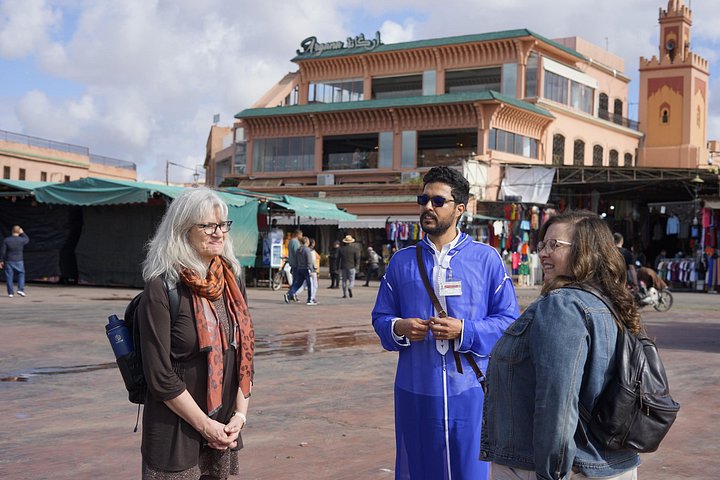
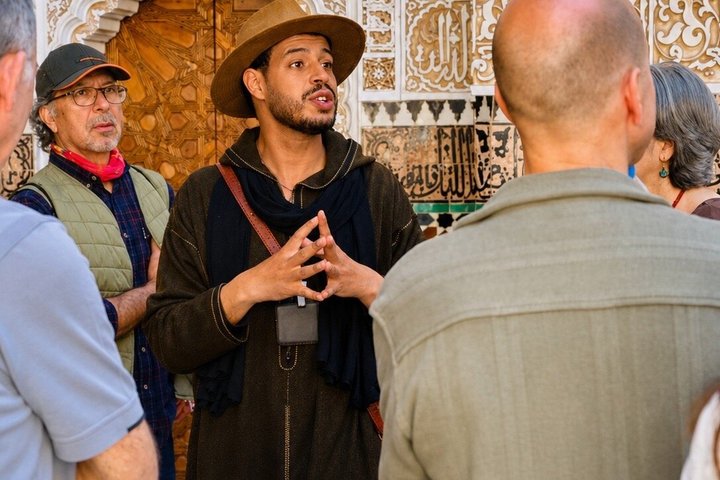
Our guides are professionals and experienced. That makes you see the medina of Marrakech with local eyes and to learn about the Moroccan culture, history and heritage.
Inclusions
What's included
- 4 hours tour with an official guide English/Spanish/French speaking
- Fees to enter to the sites
What's not
- Personal needs
- Meals and drinks
Itinerary
The palace of Bahia (palace of the beautiful, the brilliant) is a nineteenth century palace of eight hectares located in Marrakech. It is one of the masterpieces of Moroccan architecture, one of the major monuments of the country’s cultural heritage and one of the main places of tourism in Morocco. Between 1866 and 1867 the northern part of this vast palace of 8000 m² (the largest and most luxurious palace of Morocco of its time) is built in the south-east of the medina of Marrakech, close to the current royal palace, by the Moroccan architect El Mekki. It is built for Si Moussa, chamberlain of Sultan Hassan I of Morocco. Ahmed ben Moussa (1841-1900, son of Si Moussa, successor to his father as chamberlain) reign over Morocco from 1894 to his demise in 1900 as regent of the young sultan Abd al-Aziz of Morocco. During his reign, Ahmed ben Moussa enlarged the southern part of the official palace and their many children. The powerful Ahmed Ben Moussa would have erected this palace for his favorite mistress, hence the name of Bahia “the beautiful, the brilliant”. At the death of Ben Moussa, Sultan Abd al-Aziz of Morocco takes power and orders the looting of the palace. The latter established the French protectorate in Morocco, under which General Lyautey, then resident general of France in Morocco (future Marshal of France) in fact, from 1912, his personal place of residence and a residence of French officers in there. adding fireplaces, heating and electricity.
Located next to the mosque of the Kasbah, the Saadian tombs are one of the only remains of the Saadian dynasty that reigned over the golden age of Marrakech between 1524 to 1659. In the early 18th century, Sultan Moulay Ismail had indeed decided to remove all traces of the magnificence of this dynasty by demanding the destruction of all remaining vestiges. He dared not, however, commit the sacrilege of destroying their burials and ordered that the entrance to the necropolis should be completed. The secret remained well kept until 1917, date of the rediscovery of the site of the Saadian tombs. Although this royal necropolis was used from the beginning of the 14th century, its splendor dates back to the 16th century with the burial of Prince Mohamed Sheikh in 1557. His son Ahmed El Mansour, also known as Ahmed “the Walleye”, had it enlarged and embellished the site by building the koubba “Lalla Mesouada” from his mother’s name. Lalla Messaouda was buried there in 1591 as well as the 3 successors of the sultan.
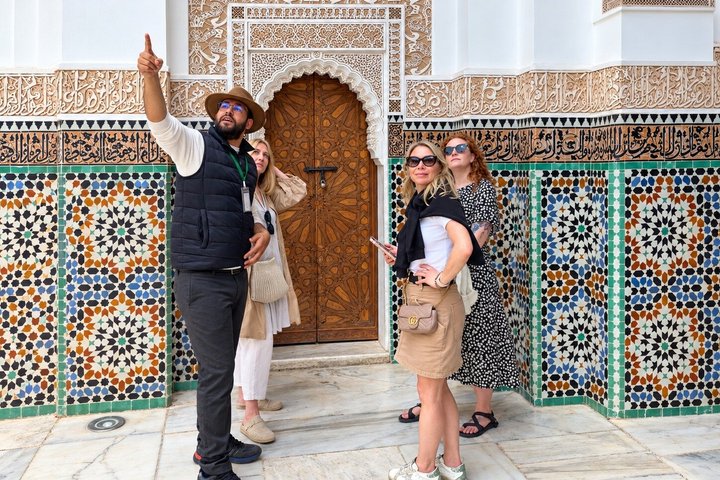
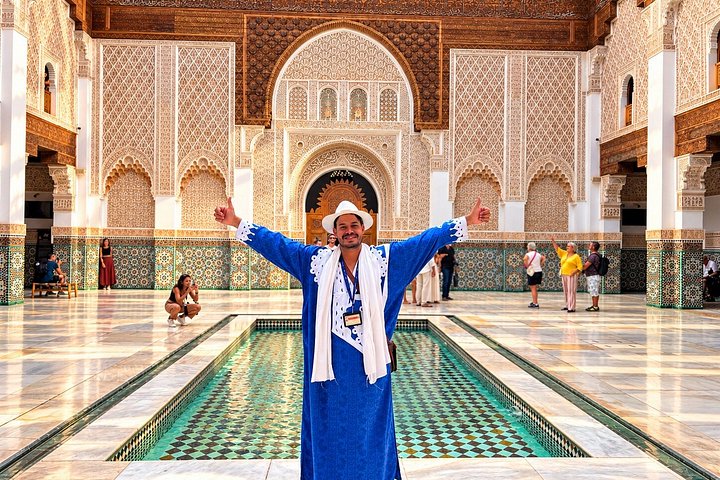
The Koranic school was founded at the beginning of the 14th century by the Moroccan monarch Abu el Hassan. Only with the reign of the Saadians who enlarged and redecorated the building in 1570, Madrasa became the largest Islamic college in the Maghreb. Region. Up to 900 students would have lived there to study law and theology. The monarchy supported them by providing food and lodging – the kitchen, however, had to be done by the students themselves. Madrasa Ben Youssef was transformed into a museum in 1960 and, since its renovation in 1999, it is one of the most popular sites in Marrakech. The bronze doorway at the entrance of the college, adorned with beautiful cedarwood and mosaic carvings, is an impressive masterpiece of its time. Through a passage, you reach the interior with its large, marble patio with a water basin artistically decorated in its center. The entire inner courtyard is lined with beautiful mosaics, and its walls and columns are adorned with exceptional sculptures and stuccoes. Enjoy a fabulous view of this masterpiece of oriental architecture from the second floor where you will also find college student rooms arranged around small courtyards and the large patio. Next, to the patio, there is a prayer room characterized by three marble columns. Looking up, you can see the impressive dome – cleverly crafted from cedar wood with 24 small mosaic windows in it.
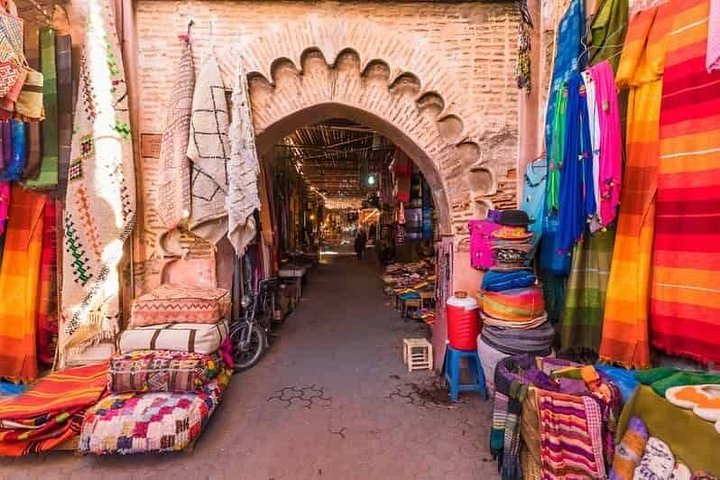
The souks of Marrakech are often a highlight for visitors. Indeed, the bustling atmosphere, the bargains, the thrill of haggling and the assault on the senses is often a big part of the reason for people to take a trip to Morocco’s Red City. A souk is the name given to an Arab market. Traditionally an open-air market that locals relied on for their essential items, a souk would have travelingSitting on important trading routes, people passed through here from the north, south, east and west. Located at the center of ancient commerce networks, goods found their way to Marrakech from all over Morocco, surrounding African countries and farther afield. Merchants often traveled by camel or donkey, usually with a heavily laden caravan. merchants passing through them once a week, once a month or at other infrequent periods. Marrakech’s strategic location at the heart of Morocco, however, meant that many traders came through the city every day.
Cancellation
Free cancellation up to 24 hours before the experience starts, for a full refund.
Reviews
4.5
- 520
- 41
- 30
- 20
- 13
Ratings come from 24 reviews collected by our booking partner. They are travellers' own words, in the order they were written — never reordered to flatter the experience.
Know before you go
- Pickup
- Pickup is offered, or you can meet at the starting point.
- Ticket type
- Mobile or paper ticket accepted
- Group size
- Up to 15 travellers
- Operated by
- Gboo Morocco Tours
- Wheelchair accessible
- Infants and small children can ride in a pram or stroller
- Service animals allowed
- Public transportation options are available nearby
- Infants are required to sit on an adult’s lap
- Specialized infant seats are available
- Transportation options are wheelchair accessible
- All areas and surfaces are wheelchair accessible
How it compares in Marrakech
- Its from-price is 37% above the median of the 7526 experiences we list in Marrakech.
- It is shorter than most of them.
- By number of reviews it ranks 1093 of 7526.
- The operator lists free cancellation on it.
About Marrakech
At the foot of the Atlas Mountains, red-walled Marrakech is famed for its maze-like medina, lively main square and tranquil riads and gardens.
Jemaa el-Fnaa, the great square at the centre of the medina, changes character through the day, from juice sellers and snake charmers in the morning to smoke-wreathed food stalls and musicians after dark. The minaret of the Koutoubia Mosque rises nearby as the city's landmark, and the souks spread north in a warren of lanes selling leather, lanterns, carpets and spices.
Top-ranked sights in Marrakech: Atlas Mountains, Tizi-n'Tichka Pass, Jemaa el-Fna (Djemaa el-Fna).
Special offers in Marrakech
Was/now prices come from the operator, never from us.