Savannah to Charleston Scenic Self-Guided Audio Driving Tour
- 2–3 hours
- Free cancellation up to 24h before
- Guided in English
- Instant confirmation
Highlights
Savannah and Charleston are two of the most historic destinations in the American south, and the road connecting the two cities holds just as much history. This self-guided driving tour dives into the history and scenery of that route. Visit the haunting Old Sheldon Church Ruins, snap photos of the Angel Oak Tree, go birdwatching in the ACE Basin Wildlife Preserve, uncover stories of the Underground Railroad, see historic Drayton Hall, and so much more. Purchase one tour per car, not per person. Everyone listens together! After booking, you can check your email before downloading the Tour Guide App by Action, entering your unique password, and accessing your tour. The preceding steps require good internet/Wi-Fi access. Simply follow the audio instructions and the route from there. New, Lifetime access, no expiry. Use it anytime, on any trip, as many times as you want. This is not an entrance ticket to attractions along the route. Check opening hours before your visit.
Inclusions
What's included
- Just bring your car and phone; the app guides your tour.
- Support is available via chat, email, or phone if you need help.
- Planning tools, route maps, scenic stops, and area previews included.
- Private tour experience for your family, in your own car.
- Lifetime access: use the tour anytime and keep it for future trips.
- Works offline with GPS route guidance and automatic audio stories.
- One purchase covers everyone in your car, not per person.
- Flexible tour: start, stop, and pause anytime during your trip.
- Access your tour in our separate audio tour app after booking.
- Hidden gems and local stories included along the route.
What's not
- No live guide. Entrance fees, parking, food, and car rental are separate.
Itinerary
For any nature lovers in the car, the Savannah National Wildlife Refuge is a must-see. It's a wonderful spot for enjoying unobstructed views of the Lowcountry. Note: The tour is over 100+ Miles long per tour, with more than 100+ audio stories per tour, and takes about 2-3 hours to complete. New, Lifetime access, no expiry. Use it anytime, on any trip, as many times as you want.
Thanks to its proximity to Hilton Head Island and Savannah, the town's population has more than doubled in the last decade.
Indigenous Cusabo tribes occupied the Sea Islands for thousands of years before the first European colonists arrived in the 1500s.
Old Sheldon Church has been through a lot. Not only did it see two wars -- the Revolutionary War and the Civil War -- but it has also been burned to the ground. Scholars are still trying to determine whether the building has seen flames more than once.
The Harriet Tubman Bridge and Combahee River Ferry are part of the Reconstruction Era National Historic Park, a newly created national historic park that preserves sites important during the Reconstruction era, the period following the Civil War when the southern states were forced to end chattel slavery.
Walterboro is known for its signature red rocking chairs and front porches. The town was founded as a summer retreat for plantation owners. Back in the 1800s, plantations along the coasts were breeding grounds for malaria, so owners escaped to higher-elevation areas like Walterboro during the summer months that were less troubled by mosquitoes. Malaria was officially eradicated in the US by 1951, so there is no need to worry today; regardless, Walterboro is still popular with visitors today thanks to its small-town charm and front porch culture.
The ACE Basin is known for its tremendous wildlife diversity. Nearly 300 different species of birds have been spotted on the ACE Basin National Wildlife Refuge so it's a bit of a bird lover's paradise. The refuge lies along the Atlantic Flyway -- a major flyway for migrating birds that starts in Greenland and travels along the Atlantic Coast to the Caribbean and South American countries.
South Carolina. During the Revolutionary War, Jacksonboro temporarily became the capital of South Carolina. That's because the British controlled Charleston, South Carolina's first capital, from 1780 until 1782.
There is one sight I recommend stopping for, though, and that's the ruins of the Pon Pon Chapel. Built around 1754, the Pon Pon Chapel was constructed along a busy stagecoach route that led from Charleston to Savannah. Locals sometimes refer to it as the Burnt Church since it burned in the early 1800s and was rebuilt. It was used for about a decade after that, then abandoned and left to ruin.
The Angel Oak Tree stands 65 feet tall and provides a shaded area of several thousand square feet. Some of the massive oaks branches sit on the ground and smaller trees have begun growing out of the tree's branches.
Today many visitors want to know where enslaved people lived at Drayton Hall. Surprisingly, the staff at Drayton Hall didn't always know. Thanks to the Bowens family, descendants of those who had been enslaved on the property, more clues exist through the oral histories they've shared. It was discovered that some people who worked inside the house lived in the cellar. George, a butler, Affy, who was thought to be a nanny, and Dumplin, a cook, resided in the home.
Now a South Carolina State Park, Charles Towne Landing has a live oak alley, gardens, and a mini-zoo with bears, otters, bison, and other wildlife that ran amok when the first settlers arrived. There's also a replica of a 17th-century vessel, bike rentals, and interpretive programming that can include cannon firings. The park is open daily, except on major holidays.
Cancellation
Free cancellation up to 24 hours before the experience starts, for a full refund.
Reviews
4.2
- 54
- 40
- 30
- 20
- 11
Ratings come from 5 reviews collected by our booking partner. They are travellers' own words, in the order they were written — never reordered to flatter the experience.
Know before you go
- Meeting point
- Start on Spring Street in Charleston, with a car parking lot on your right. Follow the road and merge onto Highway 17 to begin your journey. This is the suggested starting point. We’re not affiliated with nearby businesses. The audio starts automatically—check your email/text for setup.
- Pickup
- Everyone meets at the starting point; there is no pickup.
- Ticket type
- Mobile or paper ticket accepted
- Operated by
- Action Day Trips
- Public transportation options are available nearby
- Suitable for all physical fitness levels
- Easy to use: GPS-triggered audio plays automatically along the route for a hands-free experience.
- Private tour: Explore in your own vehicle without crowded buses or large tour groups.
- At your own pace: Start anytime and pause for hikes, picnics, photos, or scenic stops.
- Works offline: Once downloaded, the tour works using GPS without Wi-Fi or cellular service.
- Good value: One purchase covers everyone in your vehicle, not each person separately.
- More ways to save: Choose a single tour, a nearby bundle, or access to 200+ tours.
How it compares in Savannah
- Its from-price is 54% below the median of the 273 experiences we list in Savannah.
- Its length is typical for the group.
- By number of reviews it ranks 171 of 273.
- The operator lists free cancellation on it.
About Savannah
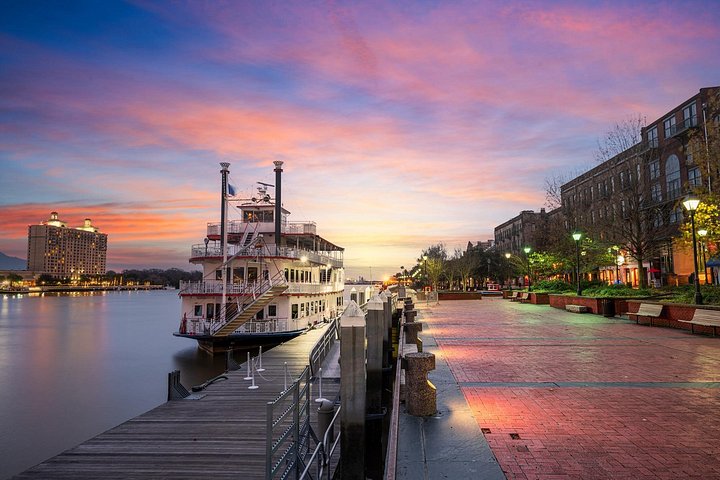
Savannah is a Georgia coastal city of oak-shaded squares, Spanish moss, cobbled riverfront streets and beautifully kept Southern architecture.
Savannah was founded in 1733 by James Oglethorpe as the first city of the colony of Georgia, and he laid it out on a grid built around small public squares. Twenty-two of the squares survive, shaded by live oaks draped in Spanish moss and filled with fountains and monuments. Forsyth Park, with its white fountain, is the largest green space in the historic district, and the Cathedral of St John the Baptist rises with twin spires.
Top-ranked sights in Savannah: Savannah River Street, Cathedral of St. John the Baptist, Forsyth Park.
Special offers in Savannah
Was/now prices come from the operator, never from us.