Private Tour with official guide & Driver for Fez city
- 3–6 hours
- Free cancellation up to 24h before
- 7 languages
- Instant confirmation
Highlights
Our tour guides are very friendly, passionate about their culture and very well educated about the rich history of the city... Our tours are cultural and handicraft
Inclusions
What's included
- Stop at a Local Family for a really Moroccan Mint Tea
- Bottled water
- Private tour
- Driver/guide
- Hotel/port pickup and drop-off
- Transport by private vehicle
What's not
- Food and drinks
- Gratuities
Itinerary
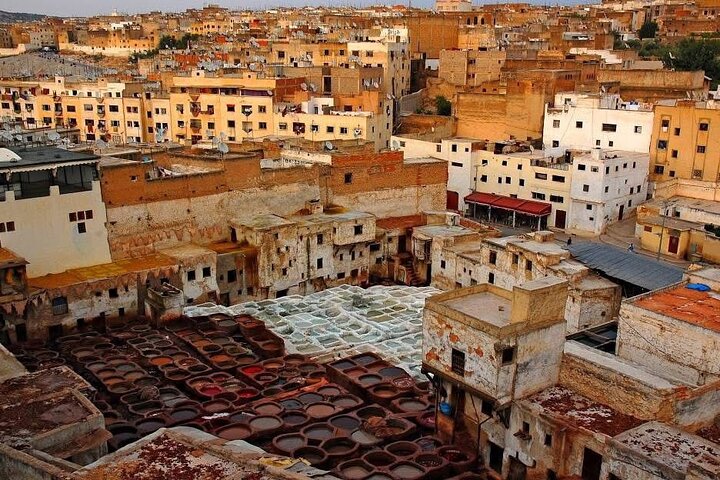
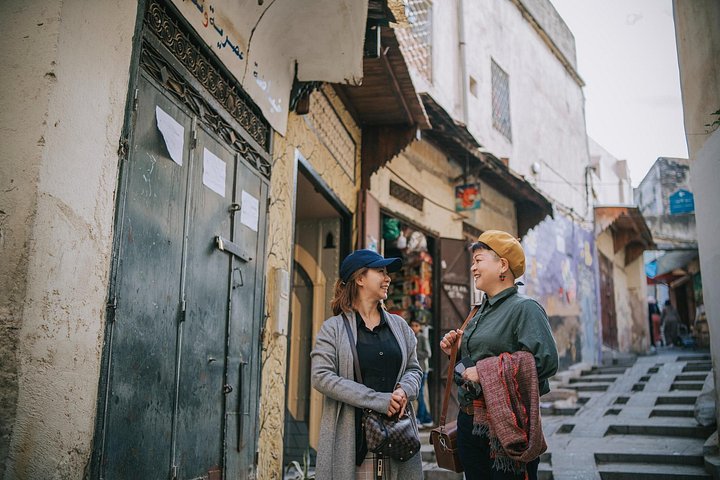
Fes el Bali is the medina area and the city's oldest neighborhood. It's thought to be the largest intact surviving medina in the world.The main gate into the area is Bab Boujloud. As you approach this grand old gate you get wonderful views of the neighborhood's famed landmark the minaret of the Medersa Bou Inania which sits just after the Bab Boujloud gate.Within its walls, the rambling derbs medina alleys spiral out into two distinctly different districts, divided by a meandering river.The left bank is home to the most historic monuments and the majority of the shopping souqs while the right bank may be scruffier but is full of local life and photogenic alleyways.The right bank also has some interesting buildings to search out, including the Al-Andalus Mosque built in 1321 and noted for its prominent green and white minaret which actually dates back to the 10th century.Nearby you'll find a variety of interesting other monuments including an old fondouk and the crumbling Medersa Sahrij
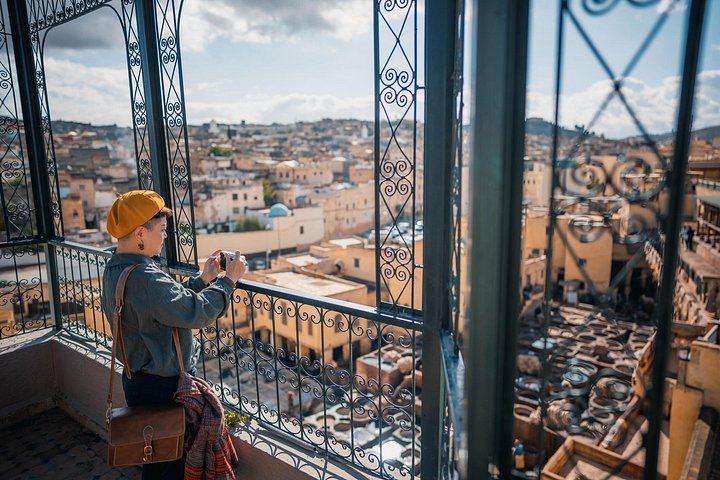
For the best views over Fes el Bali, walk up the steep hill just outside the city ramparts, to the Borj Nord area.Here, you'll find a 16th-century fortress, home to a military museum. The museum is worth a look for its collection of weapons, which includes some extremely rare pieces that represent armory from across the world. Amid the cache is the five-meter-long cannon (with a weight of 12 tons) that was used during the Battle of the Three Kings.After viewing the arms museum, keep heading up the hill to the summit where a scattering of golden-stoned Merenid tombs sits.Although the tombs are in a heavily ruined state today, you're here for the views, which take in the entire walled medina area and out to the green hills beyond
The Merenids built this "New City" in the 13th century, when they realized that Fes el Bali would be too small to contain their palaces.The grand Royal Palace takes center stage here. Its 80 hectares of grounds are not open to the public, though, you can stop and admire its ornately decorated entranceway.There's a tranquil air to this small section of the city, which sits between bustling Fes el Bali and the European-style Ville Nouvelle, and it makes a welcoming, peaceful lull between these two faster-paced worlds.The mellah (Jewish quarter) is in the southern section of this district.
The atmospheric old Mellah (Jewish Quarter) is in Fes el Jedid, just south of the Royal Palace.Throughout this compact district, the lanes are lined with fine (though highly dilapidated) examples of early 20th-century houses, which were once home to the vibrant Jewish community of Fes.Within the district, the small, restored Aben-Danan Synagogue is open for visitors.On the edge of the Mellah is the rambling Jewish cemetery, one of the city's most tranquil spots, and a Jewish Museum housing a collection of objects highlighting Moroccan Jewish life and culture.
The Batha Museum is inside a Hispano-Moorish summer palace built in the late 19th century.The museum collection traipses through a selection of traditional Moroccan craftsmanship, with wood carved doors, wrought-iron work, embroidery, carpets, and jewelry all on display.The centerpiece exhibit of the museum is the ceramics room, where the famous Fassi ceramic collection, colored with cobalt, is displayed.More interesting than the displays themselves is the building's own original decoration and the lovely internal courtyard garden, which is full of shady trees and tall palms and is a true oasis within the city.The Batha Museum is in the southwest corner of the medina.
This square is walled on one side by the grand, horseshoe-arched entrance to the al-Qarawiyyin Library, and centres on a gnarled plane tree.But it’s the sounds, as much as the sights, that make Place Seffarine special, as the rest of square is given over to copperware, a craft that goes back many centuries in Fez.You’ll hear the clang of craftsmen shaping and polishing their wares long before set foot on Place Saffarine.This handmade copperware hangs, glinting in the shopfronts, where you can haggle for buckets, pots, pans, tagines, trays, incense burners, couscous steamers, sieves, kettles, sugar boxes and a lot more besides.
In the middle of the Medina you’ll happen upon a tight passageway beckoning you onto a square in the shade of large old plane trees and the high minaret of the Zaouia Moulay Idriss II.It’s thrilling to think that henna has been sold at this very place for centuries.You’ll see it traded here as leaves, which are dried and ground into a paste.Traditionally this is applied to women’s hands during wedding ceremonies.Stalls here are also laden with antimony (kohl), as well as other traditional cosmetics like rosewater, rhassoul, musk and lavender essence.
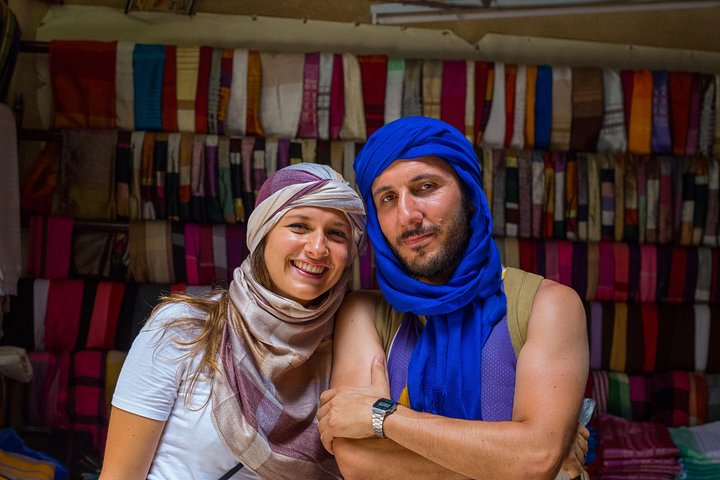
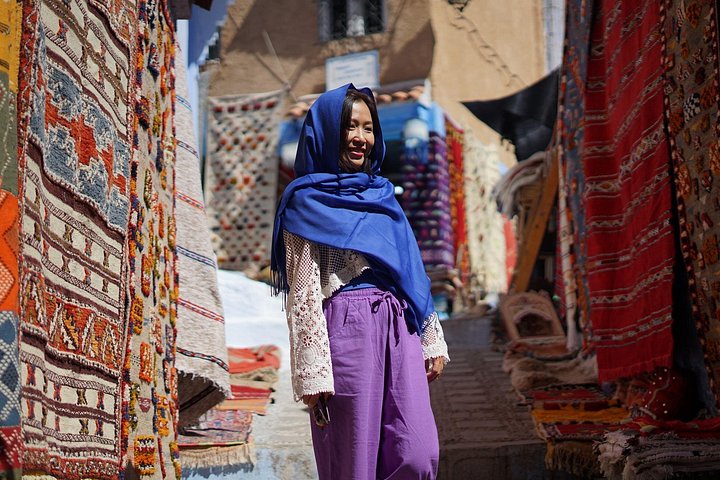
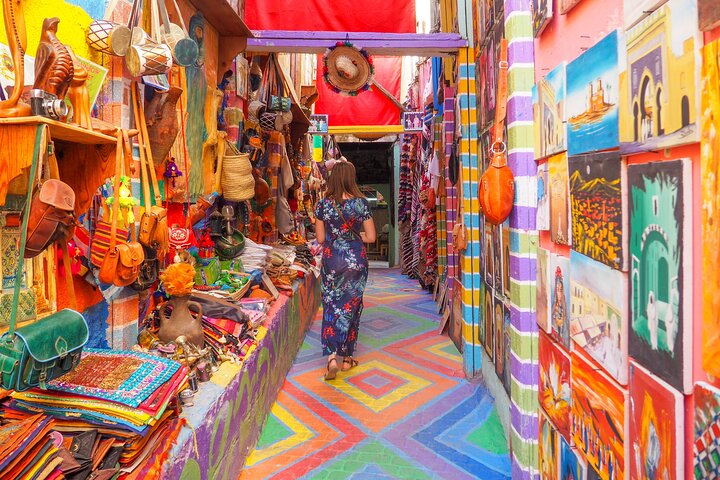
For keen shoppers, the skinny souq (market) lanes of Fes el Bali are one of the major attractions of a Fes stay.Fes is renowned within Morocco for its artisan heritage, and you'll find all types of Moroccan handicrafts here, from leatherwork to metalware and ceramics.The local ceramic tradition (called Fassi ceramics), made from local clay, tends towards blue tones and is usually hand-painted with intricate patterns and recurring motifs.The streets just west of the Qaraouiyine Mosque have the greatest concentration of shopping opportunities.As with Marrakesh, more tourist orientated shops, selling a range of souvenir-style giftware and more mass-produced items, as well as the big carpet emporiums, tend to line main roads in the medina such as Talaa Kebira. Specialty artisan workshops are usually found in smaller lanes.
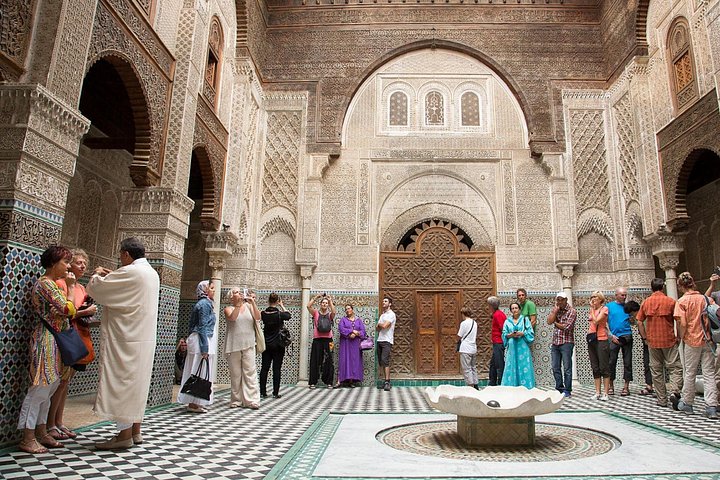
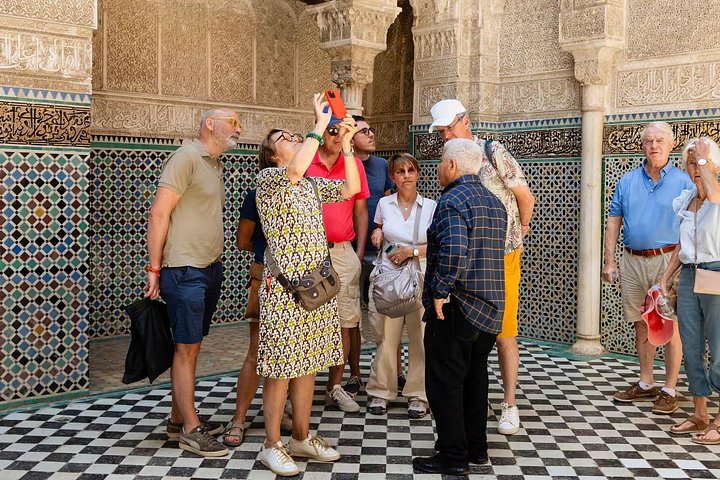
The Medersa Bou Inania was built between 1350 and 1357 by the Merenid sultan Bou Inan.As one of the few religious buildings in the city that non-Muslims may enter, the Medersa (a "madrassa" is an Islamic school of learning) is one of the most popular monuments to visit in Fes and a must-do stop on any tour of the medina.Up until the 1960s, this was still a functioning theological school, and the restoration efforts that were carried out afterwards have carefully returned the medersa to its ornate original state.The carved woodwork and stucco decoration is magnificent and is a tribute to Morocco's master artisans.
This fine example of Merenid-era architecture was built in 1325 by Abu Said.The Medersa el-Attarine's central internal courtyard is a wonderful display of the intricate decoration from this period, with elaborate zellige tile work and cedar wood carvings.The upper floor is made up of a warren of cells that were once home to students studying theology at the neighboring Qaraouiyine Mosque, one of the world's first universities.After admiring the building's interior decoration, make sure to climb up onto the medersa's rooftop from where you can get great views over the surrounding rooftops, including a close-up view of the green tiled roof of the Qaraouiyine Mosque next door.
Karaouiyne Built in AD 857 by Tunisian immigrants from the holy city of Kairouan, the Qaraouiyine Mosque was a thriving center of theological study and one of the medieval period's most distinguished universities.It vies for title of the oldest university in the world with the Al Azhar Mosque in Cairo, Egypt.Today, in its function as a working mosque, it is one of Morocco's largest centers of worship with a prayer hall that can hold 20,000.
Drawing attention at one end of the Najjariyyin Square in the Old Medina is the magnificent five-metre gateway to this 17th-century khan (inn), crowned with an intricate cedar canopy.Over the portal are gossamer geometric and floral patterns, and incredibly detailed tilework.To the side is a 19th-century saqayya, a fountain for caravans, with astonishing zellige tiles and honeycomb plasterwork.The Funduq, commissioned by the Alaouite Sultan Ismail Ibn Sharif, is preserved as a museum for woodwork.You can go in to look up at the three storeys of galleries, and peruse a showcase of artful wood-carving from the city’s past.On display are furniture, doors, musical instruments, canopies and other architectural elements, as well as traditional woodworking tools.
Cancellation
Free cancellation up to 24 hours before the experience starts, for a full refund.
Reviews
5.0
- 51
- 40
- 30
- 20
- 10
Ratings come from 1 reviews collected by our booking partner. They are travellers' own words, in the order they were written — never reordered to flatter the experience.
Know before you go
- Pickup
- Pickup is included for everyone.
- Ticket type
- Mobile or paper ticket accepted
- Operated by
- CHRIF TRANS & TRAVEL
- Infants and small children can ride in a pram or stroller
- Service animals allowed
- Public transportation options are available nearby
- Infants are required to sit on an adult’s lap
- Specialized infant seats are available
- Not recommended for travelers with poor cardiovascular health
- Suitable for all physical fitness levels
How it compares in Fez
- Its from-price is 92% above the median of the 1669 experiences we list in Fez.
- It is shorter than most of them.
- By number of reviews it ranks 944 of 1669.
- The operator lists free cancellation on it.
About Fez
Fez is Morocco's old imperial capital and cultural heart, with a vast walled medina of lanes, souks, tanneries and medieval religious schools.
Fes el-Bali, the old medina, is a UNESCO World Heritage Site and a living medieval city where donkeys and handcarts still carry goods through narrow lanes. Its best-known gateway, the Bab Bou Jeloud with its blue and green tiles, leads into a maze of souks, fountains and old caravanserais.
Top-ranked sights in Fez: Medina of Fez (Fes el-Bali), Bab Bou Jeloud (Bab Boujeloud), Volubilis.
Special offers in Fez
Was/now prices come from the operator, never from us.