Private Custom Tour: Gwalior Half-Day Sightseeing with Guide
- 4 hours
- Free cancellation up to 24h before
- Guided in English
- Instant confirmation
Highlights
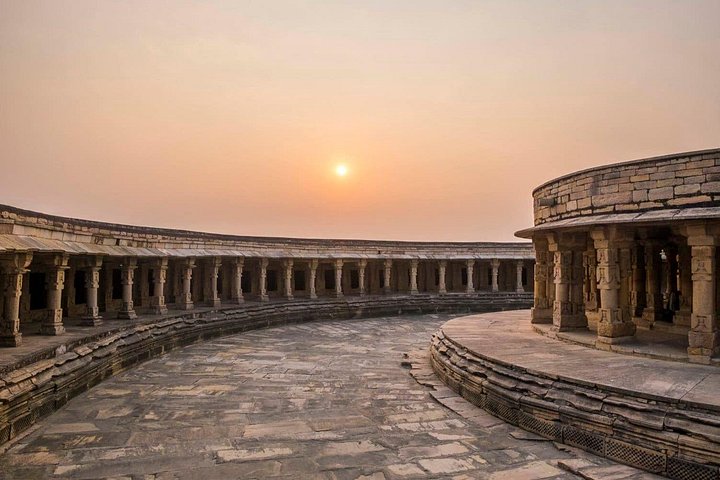
Gwalior is one of the historically rich cities in India. Visit the awe-inspiring structures of this city like the Gwalior fort, which is praised for its stunning architectural design; & Tomb of Gaus Mohammad which is also the Mausoleum of Tansen, who was one of the Navratnas (nine very important ministers) of great ruler Akbar's court, etc. and various other beautiful temples. NOTE: Gujari Mahal Archaeological Museum is closed on Mondays
Inclusions
What's included
- Hotel pickup and drop-off
- Local guide
- Bottled water
- Private tour
- Entrance fee
- Transport by private air-conditioned vehicle
What's not
- Camera charges at monuments
- Gratuities
- Food and drinks
Itinerary
An architectural marvel of the 8th century, the Gwalior Fort is perched on a hilltop. The defensive structure of the fort comprises two main palaces, temples and water tanks. Amongst it, the most acknowledged is the Teli-Ka-Mandir and Man Singh Palace. The former was built in the Dravidian style shrine and its generously sculpted exteriors are highly appreciated. Then there is the Man Singh Palace, built by king Man Singh in the 15th century. The reputed Palace has an amazing design. With blue ceramic tiles at the front façade and an impressive structure the Man Singh Palace reflects the true colours of the Tomar dynasty. To complement the Man Singh Palace, the Gwalior Fort complex also houses the Gujari Mahal. This was built by Raja Man Singh for his beloved queen Mrignayani. Other notable structures in the majestic Gwalior Fortress are the Karan Palace, the Jahangir Mahal and Shahjahan Mahal.
Built in the 15th century by Raja Mansingh Tomar for his Gujar Queen, Mrignayani, Gujari Mahal is a monument of love. According to popular tradition, since none of the eight queens were able to produce an heir for the king, he finally married a milkman’s daughter called “naani”, whom he named “Mrignayani” (meaning beautiful eyes). Mrignayani demanded a separate palace for her with constant water supply from river Ria and hence, Gujari Mahal in Gwalior in India came up. The palace now has an archaeological museum that has a large collection of Hindu and Jain sculptures, archaeological pieces from the 1st and the 2nd century B.C, copies of Bagh cave frescoes and Terracotta items. The statue of Salbhanjika, a marvellous piece in miniature is in the custody of the museum’s curator and can be seen on request. NOTE: Gujari Mahal Archaeological Museum is closed on Mondays
Located in the Gwalior Fort, Teli Ka Mandir dates back to the 9th century and is the highest building in Gwalior (100 ft.). It is a towering structure of about 100 feet and has a unique architectural style. The shape of the roof or Shikhara can be easily discerned as Dravidian and the embellishments are distinctively Indo-Aryan. The decorations are of the Nagara Style, a well-known art form of Northern India. The complex of Teli Ka Mandir, Gwalior is filled with figures of river goddesses, coiled serpents, amorous couples and a flying Garuda, the vehicle of Lord Vishnu.
Cancellation
Free cancellation up to 24 hours before the experience starts, for a full refund.
Know before you go
- Pickup
- Pickup is included for everyone.
- Ticket type
- Mobile or paper ticket accepted
- Operated by
- Delhi Airport Service
- Public transportation options are available nearby
- Infants are required to sit on an adult’s lap
- Travelers should have at least a moderate level of physical fitness
How it compares in Gwalior
- Its from-price is close to the median of the 16 experiences we list in Gwalior.
- It is shorter than most of them.
- The operator lists free cancellation on it.
About Gwalior
Gwalior is a fortress city in northern Madhya Pradesh, crowned by a vast hill fort of palaces and temples, with a grand royal palace and a music tradition.
Gwalior's hill fort rises from a sandstone ridge above the city, enclosed by high walls and holding palaces, temples and reservoirs. The Man Singh Palace, built in the fifteenth century, is decorated with blue tilework, and the Teli ka Mandir is a tall temple of the eighth or ninth century. Jain figures cut into the cliff walls include huge standing sculptures from the fifteenth century. A Sikh gurdwara marks the place where Guru Hargobind was held.
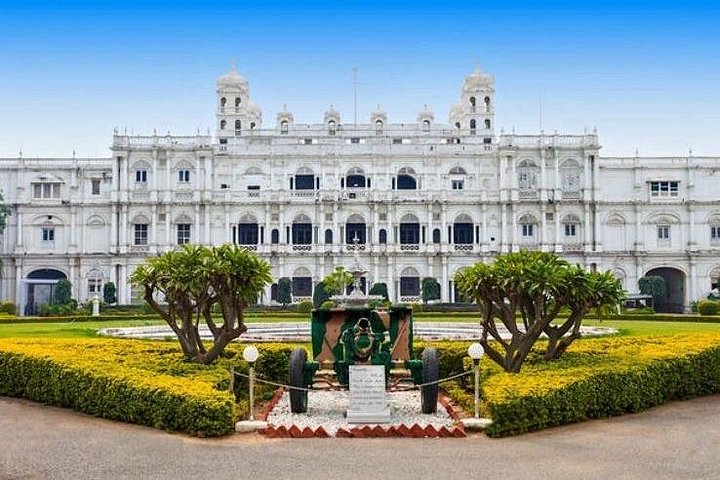
Top-ranked sights in Gwalior: Gwalior Fort, Jai Vilas Mahal (Jai Vilas Palace), Sas-Bahu Temple.