From Arena to Forum: Roman Pula Experience with a History Teacher
- 2 hours
- Free cancellation up to 24h before
- Guided in English
- Instant confirmation
Highlights
This is a private tour led by me, a history teacher, where I’ll guide you through Pula’s Roman past with stories and interesting facts. We’ll visit both famous landmarks and some hidden spots, all at a comfortable pace and friendly atmosphere. It’s perfect if you want to learn about Pula’s history in a relaxed and personal way.
Inclusions
What's included
- Professional guide
- Arena admission ticket included
Itinerary
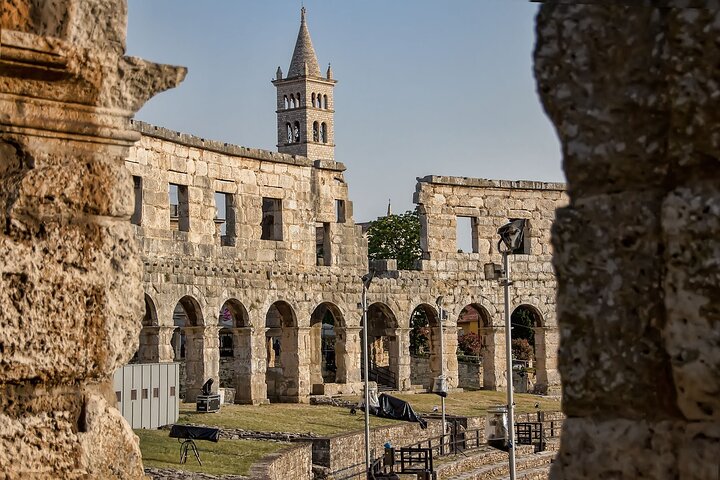
The Pula Arena, located in Pula, Croatia, is one of the most well-preserved Roman amphitheaters in the world. Constructed during the 1st century AD, this ancient amphitheater is a stunning example of Roman architecture and engineering. With a capacity to hold over 20,000 spectators, the Pula Arena was used for gladiatorial contests, battles, and other public spectacles in ancient times. Today, the Pula Arena serves as a major cultural and historical landmark, attracting visitors from around the globe. It hosts various events such as concerts, film festivals, and theatrical performances, blending ancient history with modern entertainment. Visitors can explore the arena's underground passages and chambers, gaining insight into its fascinating past and significance in Roman society. Standing proudly in the heart of Pula, the Pula Arena stands as a testament to the ingenuity and craftsmanship of the ancient Romans, offering visitors a glimpse into the rich history of this remarkable city
This imposing structure once served as a crucial entrance to the city, standing as a testament to Pula’s rich history and architectural prowess
Adorned with a depiction of Hercules’ head, this ancient gate stands as a symbolic entrance to the city, welcoming visitors to explore its historic wonders.
The Punishment of Dirce mosaic in Pula is a well-preserved Roman floor mosaic from the 2nd–3rd century, showing the rare mythological scene of Dirce.
The Temple of Augustus in Pula is one of the best-preserved Roman monuments in Croatia. Built between 2 BC and AD 14, the temple is dedicated to Emperor Augustus. Located on the Forum, this example of Roman architecture with Corinthian columns now serves as a museum.
Cancellation
Free cancellation up to 24 hours before the experience starts, for a full refund.
Know before you go
- Meeting point
- Park Nimfej is a small park located between the Riva and the Karolina parking lot. The park is located to the left of the entrance to the Karolina parking lot.
- Pickup
- Everyone meets at the starting point; there is no pickup.
- Ticket type
- Mobile or paper ticket accepted
- Operated by
- Walking Tour Pula with a local - Augustus Walks
- Infants and small children can ride in a pram or stroller
- Service animals allowed
- Public transportation options are available nearby
- Infants are required to sit on an adult’s lap
- Not recommended for travelers with poor cardiovascular health
- Travelers should have at least a moderate level of physical fitness
How it compares in Pula
- Its from-price is 335% above the median of the 184 experiences we list in Pula.
- It is shorter than most of them.
- The operator lists free cancellation on it.
About Pula
Pula is a port at the southern tip of Istria in Croatia, famous for a well-preserved Roman amphitheatre standing beside the harbour.
Pula's Roman amphitheatre, built in the first century AD, is among the best preserved in the world, with its outer walls standing on all sides, and concerts and film screenings are staged on the sand inside. Nearby stand the Temple of Augustus, the Arch of the Sergii and the Forum, reminders that Pula was an important Roman colony. Austro-Hungarian naval buildings add a later layer, and James Joyce taught English here in 1904 and 1905.
Top-ranked sights in Pula: Pula Arena (Pula Amphitheatre), Zerostrasse.
Special offers in Pula
Was/now prices come from the operator, never from us.