Walking City tour Puno
- 1h 30m
- Free cancellation up to 24h before
- 2 languages
- Instant confirmation
Highlights
This is a culture‑first, story‑rich walk designed for Puno’s altitude and rhythm. We connect architecture, museum pieces, viewpoints, markets, and devotion into one clear narrative—so carvings on the Cathedral make sense at the museum, the hilltop view reframes the city below, and the market’s rituals illuminate the Candelaria story. It’s intimate and unhurried: time for photos, questions, and authentic encounters (always respectful of worship and vendors). Expect real Puno—its art, faith, and everyday life—in one memorable walk.
Inclusions
What's included
- Local guide
What's not
- Carlos Dreyer Museum Tickets - (Cash Only 15 soles p/p)
- Cathedral entrances ticket (Cash only 15 soles p/p)
Itinerary
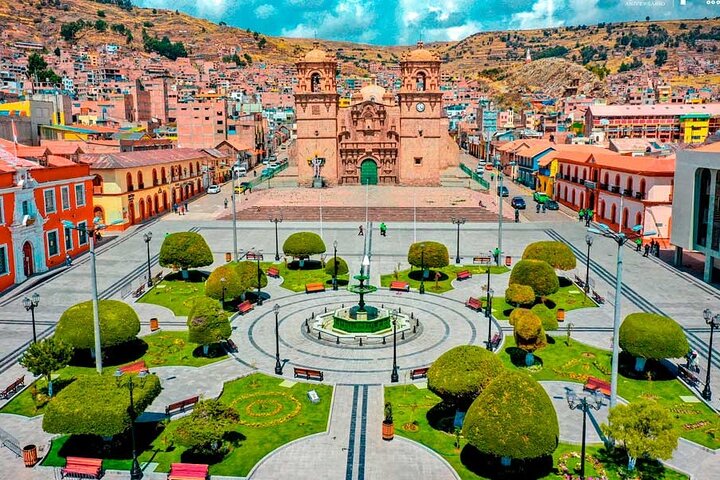
Start in the Plaza de Armas to read the Cathedral’s Andean‑Baroque façade up close. Your guide highlights carved sirens “playing” the charango, native flowers, and faces—symbols that blend Catholic imagery with high‑Andean beliefs. Learn how this 18th‑century temple was executed in stone under the indigenous master builder Simón de Asto and supported by local miners, then step back for wide shots of the twin towers and lively square life. It’s a concise lesson in Puno’s mestizo baroque that sets the tone for the rest of the walk.
Just off the main square, this intimate museum stitches together Puno’s timeline. With your guide, browse pre‑Inca and Inca ceramics and stonework, funerary objects and mummies from the Altiplano, plus a colonial/republican art gallery—including pieces collected by the German artist Carlos Dreyer. You’ll also see models of chullpas (ancient funerary towers), textiles, and metalwork that frame what you’ll encounter around Lake Titicaca. Compact and well‑curated, it delivers deep context without rushing
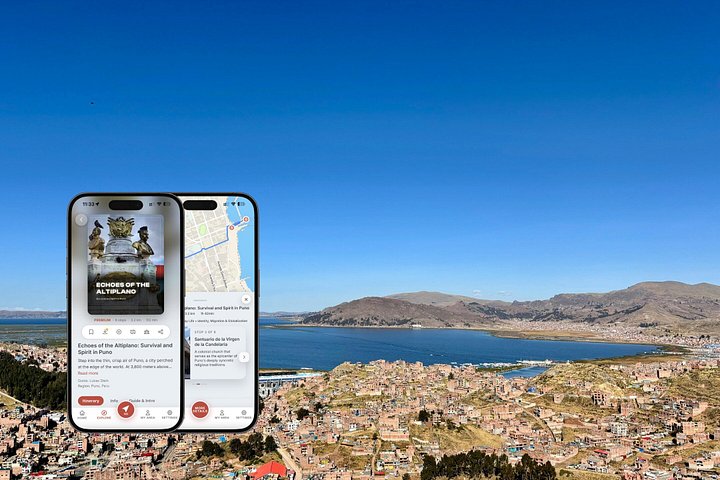
A gentle climb brings us to Huajsapata Hill, crowned by a statue of Manco Cápac, legendary founder of the Inca Empire. From here the city spreads beneath you and Lake Titicaca stretches to the horizon—prime time for panoramas and a short rest.
Meet herbalists and ritual‑goods vendors at the Laykacota “Witches’ Market,” where shelves brim with muña and coca, amulets, and offerings used in Andean folk healing and devotion. This is a respectful, eyes‑open look at living traditions: we discuss how ‘despachos’ to Pachamama fit into daily life and festivities, when to ask before photographing, and how to buy small items ethically if you wish—always supporting local families
Walk to the handsome stone arch of Arco Deustua, built in 1847 to honor the heroes of Peru’s independence after the battles of Junín and Ayacucho. It’s a photogenic pause point where we decode inscriptions and decorative details before continuing along Jirón Lima back toward the center—linking 19th‑century memories with today’s street life.
At the north end of pedestrian Jirón Lima, Parque Pino is Puno’s social living room. Beneath clipped trees stands the monument to Dr. Manuel Pino—local hero of the War of the Pacific—unveiled in 1901. We’ll take a moment to people‑watch, chat about nearby landmarks (like San Juan church and classic facades), and see how this square threads together civic life, history, and devotion.
Across Parque Pino, this church—sanctuary of the Virgen de la Candelaria—pairs an unusual French‑ogival façade with a modest interior holding the city’s most beloved image. Hear how her devotion took root in the 18th century and how February processions transform these streets with music and dance. When doors are open, we enter quietly to appreciate the altars and observe local worship.
Cancellation
Free cancellation up to 24 hours before the experience starts, for a full refund.
Reviews
4.6
- 511
- 42
- 31
- 20
- 11
Ratings come from 15 reviews collected by our booking partner. They are travellers' own words, in the order they were written — never reordered to flatter the experience.
Know before you go
- Meeting point
- We Meet Travelers at the main Cathedral, on the same Plaza de Armas
- Pickup
- Everyone meets at the starting point; there is no pickup.
- Ticket type
- Mobile or paper ticket accepted
- Group size
- Up to 15 travellers
- Operated by
- Inca Lake
- Not recommended for pregnant travelers
- Suitable for all physical fitness levels
How it compares in Puno
- Its from-price is 54% below the median of the 229 experiences we list in Puno.
- It is shorter than most of them.
- By number of reviews it ranks 46 of 229.
- The operator lists free cancellation on it.
About Puno
Puno is a high-altitude Peruvian city on the shore of Lake Titicaca, the base for the floating reed islands of the Uros, Taquile Island and Sillustani.
Puno stands at about 3,800 metres on the shore of Lake Titicaca, in the Altiplano of southern Peru, with its bay filled with reed beds. The Plaza de Armas is framed by a baroque 18th-century cathedral with a carved stone façade, and viewpoints on the surrounding hills give views over the lake. Puno is called the folklore capital of Peru, for its dances, costumes and music.
Top-ranked sights in Puno: Uros Floating Islands (Islas Uros), Taquile Island (Isla Taquile), Lake Titicaca.
Special offers in Puno
Was/now prices come from the operator, never from us.