Shaolin Temple and Longmen Grottoes Tour
- 6–8 hours
- Free cancellation up to 24h before
- Mobile ticket
Highlights
We will pick up from Luoyang, visit the world culture heritage---Longmne Grottoes, the birth place of chinese Kung Fu--Shaolin Temple, 1. Pure sightseeing tour; No tourist traps. 2. The best utilization of time; Visiting Shaolin Temple and The Longmen Grottoes in 1 day 3. Licensed English Speaking Guides and tour vehicles 4. Free drop-off for visitors at Luoyang Longmen High Speed train Station.
Inclusions
What's included
- Bottled water
- Lunch
What's not
- Gratuities
Itinerary
The Longmen Grottoes, located on bothsides of the Yi River to the south of the ancient capital of Luoyang, Henan province, comprise more than 2,300 caves and niches carved into the steep limestone cliffs over a 1km long stretch. These contain almost 110,000 Buddhist stone statues, more than 60 stupas and 2,800 inscriptions carved on steles. Luoyang was the capital during the late Northern Wei Dynasty and early Tang Dynasty, and the most intensive period of carving dates from the end of the 5th century to the mid-8th century. The earliest caves to be carved in the late 5th and early 6th centuries in the West Hill cliffs include Guyangdong and the Three Binyang Caves, all containing large Buddha figures. Yaofangdong Cave contains 140 inscription recording treatments for various diseases and illnesses. Work on the sculpture in this cave continued over a 150 year period, illustrating changes in artistic style. The sculptural styles discovered in the Buddhist caves of the Tang Dynasty in the 7th and 8th centuries, particularly the giant sculptures in the Fengxiansi Cave are the most fully representative examples of the Royal Cave Temples’ art, which has been imitated by artists from various regions. The two sculptural art styles, the earlier “Central China Style” and the later “Great Tang Style” had great influence within the country and throughout the world, and have made important contributions to the development of the sculptural arts in other Asian countries.
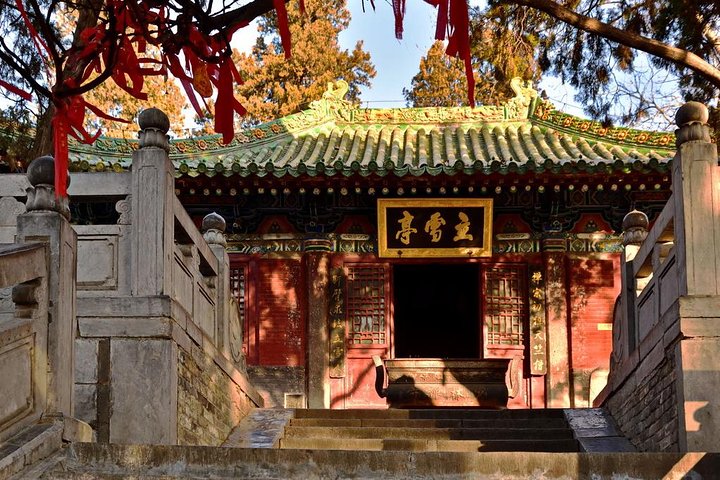
Shaolin Temple was established in 495A.D. at the western foot of Songshan Mountain, 13 kilometers northwest to Dengfeng City, Henan Province. The then-Emperor Xiaowen of the Northern Wei Dynasty (386-557) had the temple built to accommodate the Indian master Batuo (Buddhabhadra). Shaolin Temple literally means “temple in the thick forests of Shaoshi Mountain”. As the first Shaolin abbot, Batuo (Buddhabhadra) devoted himself to translating Buddhist scriptures and preaching doctrines to hundreds of his followers. Later, another Indian monk Bodhidharma arrived at Shaolin Temple, who was said to have crossed the Yangtze River on a reed. He spent nine years meditating in a cave of the Wuru Peak and initiated the Chinese Chan tradition at Shaolin Temple. Thereafter, Bodhidharma was honored as the first Patriarch of Chan Buddhism. As Chinese Kungfu also originated from Shaolin Temple, it has been recognized as the origin of Chan Buddhism and the cradle of Kungfu.
Cancellation
Free cancellation up to 24 hours before the experience starts, for a full refund.
Know before you go
- Pickup
- Pickup is included for everyone.
- Ticket type
- Mobile or paper ticket accepted
- Group size
- Up to 30 travellers
- Operated by
- Henan Tour Max Internatonal Travel Service
- Wheelchair accessible
- Infants and small children can ride in a pram or stroller
- Public transportation options are available nearby
- Infants are required to sit on an adult’s lap
- Transportation options are wheelchair accessible
- All areas and surfaces are wheelchair accessible
- Not recommended for travelers with spinal injuries
- Not recommended for pregnant travelers
How it compares in Zhengzhou
- Its from-price is 42% below the median of the 12 day trips we list in Zhengzhou.
- Its length is typical for the group.
- The operator lists free cancellation on it.
About Zhengzhou
Zhengzhou is the capital of Henan province in central China, a Yellow River rail hub with Shang dynasty walls and the Shaolin Monastery nearby.
On the broad plain of central China, Zhengzhou stands on the south bank of the Yellow River. About 3,500 years ago a Shang dynasty city stood here, and stretches of its rammed-earth wall still rise among the modern streets. The Henan Museum holds the province's bronzes, jades and ceramics, and the city is one of China's busiest rail junctions, where the main north-south and east-west lines cross.
Top-ranked sights in Zhengzhou: Yellow River (Huang He).