Oslo City - Self Guided Audio Tour
- 1–2 hours
- Free cancellation up to 24h before
- 6 languages
- Instant confirmation
Highlights
Experience Oslo like never before with your self-guided audio tour, designed for travelers who want the freedom to explore on their own terms — without missing the stories that bring the city to life. With 58 carefully curated points of interest, the tour covers everything from Oslo’s most iconic landmarks to hidden historical gems. Discover cultural highlights, architectural wonders, and captivating local stories — all with rich audio narration that activates automatically as you approach each location. Using the Guide To Go app, you’ll see a full overview of the city’s historical and cultural sites right on your mobile device. Simply walk through Oslo at your own pace, and as you move within the red circle around each point on the interactive map, the corresponding audio will play. No need to press a button — just walk, look, and listen.
Inclusions
What's included
- Complete Audioguide on your mobile phone over Oslo. 58 Points of interest and stories are included.
- You will receive an access link after you have done your purchase
What's not
- Public transportation
- Entrance fees to the attractions in the Audioguide route are not included.
Itinerary
Norwegians have been a traveling people since the dawn of time. Vikings, traders, explorers, footballers, students and business people have traveled the globe in search of new experiences. And many start their adventure right here where you stand now. Color Line has transported passengers, goods and vehicles out into the wider world since 1872, but then under the name "Kristansands Damskibsselskap". First, they established a fixed route between Kristiansand and Ferdrikshavn in Denmark. Today, the boats go between Norway, Sweden, Denmark and Germany. The "Kiel" ferry is a beloved and well-known route to Europe both with and without a car. Check out the links below for more information and booking.
What do Nelson Mandela, Barack Obama and Malala Yousafzai have in common? They have all received the Nobel Peace Prize, which is awarded here in Oslo at the Town Hall. Here, in front of the converted 1872 train station, you will see the Nobel Peace Center as is the public face of the Nobel Peace Prize. They use the power of the Nobel Peace Prize laureates’ ideas, work and causes, to engage and inspire small and large actions which make the world a more peaceful place. Experince exhibitions, guided tours, events, education programs, and digital content. The center disseminate laureates’ work, build knowledge and skills, and act as a meeting place to facilitate international engagement. The Center also serves as an arena for topical events and discussions related to peace, human rights, and conflict resolution. Visit the centre, or read more and book tickets on the links below.
Now you have arrived at Tjuvholmen, which is connected to Aker Brygge with its two small bridges. Previously, this was an abandoned part of Oslo, but now it has been transformed into a modern and artistic urban area. Here you will find many art galleries, a sculpture park, modern architecture, a five-star hotel and a number of good restaurants and cafes. Here you will also find the Astrup Fearnley Museum, which is a modern art museum located close to the water's edge. Tjuvholmen is a beautiful pearl today, but in the very old days, in the 17th century, the view that met the seafarers was probably a little different. The area was once a haven for the city's stray birds, and we're not talking about pigeons and seagulls. The name Tjuvholmen originates from the time when the city's thieves were taken to the court on the islet and hanged. It was not unusual for the spoils from both small and large robberies to be buried out here, which the police of course quickly caught wind of.
Do you see the long quays with all the beautiful people crowding around the fashionable restaurants and apartment complexes? Now you are at Aker Brygge! In the old days there were no restaurants and no apartments here, but there were just as many people. They didn't have as nice clothes, and the good smell of food was replaced by diesel, burnt steel and old coffee grounds. Aker Brygge is built on what used to be the shipyard, Aker's mechanical workshop. The shipyard was established in the middle of the 19th century and gradually gained a large and central position in the Norwegian industrial environment which lasted for over 140 years. The shipyard was closed in 1982 and the old factory buildings were demolished or converted into modern housing. And suddenly the sounds that had characterized the center for just as long also disappeared.
Here in these beautiful surroundings is the Holocaust Centre, which communicates and conducts research on topics that stand in stark contrast to the surroundings. The center is a research, dissemination and documentation center with a spotlight on the Holocaust and other genocides, anti-Semitism, racism, extremism, conspiracy theories and the conditions of minorities in modern society. 766 Norwegian Jews were killed or perished as a result of the Nazi extermination policy. The Holocaust exhibition gives an insight into the fate of Norwegian Jews and Roma during the Second World War. Through exhibitions and events, the center communicates the stories of the victims and survivors, and reminds us of the importance of learning from the past. Visitors are encouraged to reflect and take action against intolerance and discrimination. The Holocaust Center is a crucial monument to honor the memory and promote human rights and dignity.
Are you ready for an adventure! Then all you have to do is force the revolving doors of perhaps Norway's most famous shopping centre, Oslo City. Five floors of brands, delicious fragrances, great offers and a pulsating environment in safe surroundings await here. The center is connected by a footbridge to the Hotel Oslo Plaza and the Byporten shopping center across the road, and further on to the traffic station Oslo S. Check out opening times and other practical information below.
"It is important that art is not closed in. It must be shown and experienced. We have to learn from it.” The words belonged to Hans Rasmus Astrup, who is the founder of the Astrup Fearnley museum, which today has one of Europe's most extensive collections of international contemporary art. Astrup began buying art in the 1960s, and right from the start he built up a collection where the artistry was at the center rather than historical periods and styles. At the time of his death in 2021, the Astrup Fearnley collection consisted of more than 1,500 works, and it is constantly being expanded with new purchases. The works shown in the exhibition give an insight into one of the Nordic countries' most comprehensive collections of international contemporary art and show Hans Rasmus Astrup's unique contribution to the Norwegian art community. Visit, see, enjoy and learn! More information and booking at the links below.
Do you use sugar in your coffee? They will surely fix that here! Now you have arrived at Sukkerbiten, which means sugar cube in Norwegian, is an artificial island, technically part of the Bjørvikautstikkeren. The name comes from the old administration building for Nyland's workshop that stood there in the old days, and which was a white, fairly square building, yes, almost like a sugar cube. Here you will find the outdoor restaurant with the same name, Sukkerbiten, and there you can lean back in comfortable sunbeds by the water's edge, and enjoy delicious music, a good atmosphere and a relaxing atmosphere that suits both young and old. Tempt it with a sauna and a refreshing dip. Both here and at other places along the harbor promenade you can hire a sauna. Information, prices and booking can be found on the links below.
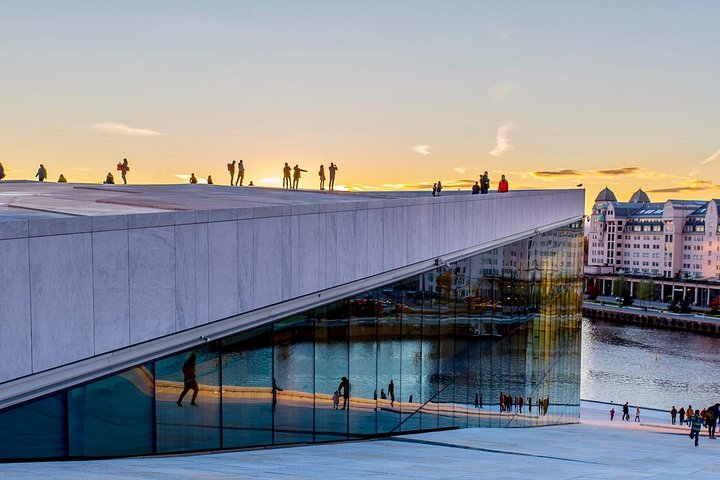
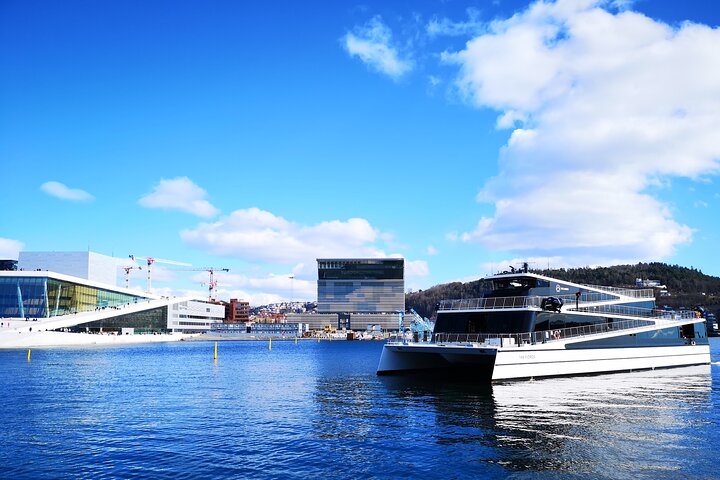
Here starts the harbor promenade from the Opera House to Sørenga, which takes you on an unforgettable trip packed with good experiences and impressions. First you come to the monumental opera roof, before you enter the idyllic Operastranda and the Munch Museum, then the promenade takes you to Sukkerbiten with its saunas and outdoor seating before you stroll across the fjord to the new vibrant district and the outcrop Sørenga with its popular sea bath. Operastranda in particular is suitable for families with children, and don't worry if you've forgotten your swimwear. The opera shop sells crab rope, towels and other nice beach effects.
Now you are standing at Jernbanetorget, midway between the start of Karl Johans gate and Oslo S, the bustling central railway station and transportation hub of Oslo! Oslo S stretces from the building Østbanehallen, up the stairs to Hovedhallen and then around the whole quarter which is as big as a small town. Trains have run here ever since Norway's first railway opened from Kristiania, today's Oslo, to Eidsvoll in 1854. Today, the station has grown and is connected to the entire railway network in Norway, as well as to Sweden and Denmark and further south in Europe. Oslo S is not just a station for trains and buses. There, travelers and others can relax, sleep, get information and explore a diverse range of stores offering fashion, electronics, dining, and more. Head inside, follow the map and check out the links to find more information about destinations, tickets and other information.
Do you like to read? At least the man who originated the building and the library in front of you did, Carl Deichman. He lived in the 18th century and was a real voracious reader. Here at Deichman Bjørvika, which is Oslo's main library, you will find six floors of literature, reading and study spaces, stages, a cinema and workshops for young and old. In 1780, Deichman bequeathed his book collection to Christiania city, today's Oslo, just a few months before he died. He wanted the city's residents to finally have their first public library, and i 1785 the Deichmanske Bibliothek opened its doors for the first time. Today, Deichman has 22 libraries all over Oslo. The collection has grown to over a million books, films, CDs and other material. Carl Deichman's original collection is still intact and is well preserved on the main library's 5th floor.
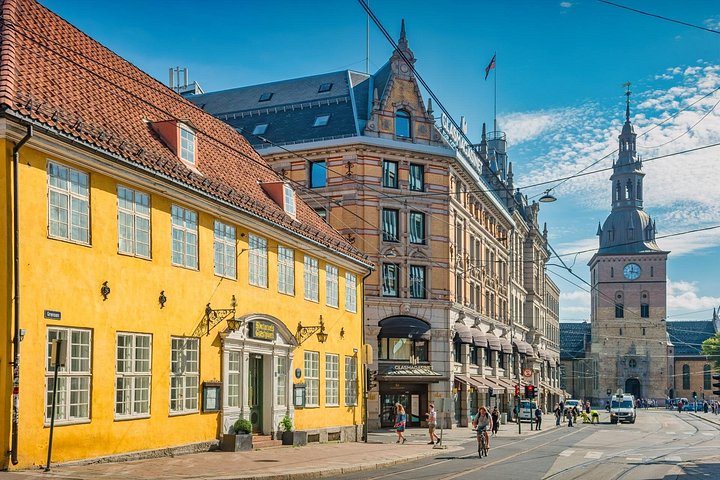
Here, in the middle of the city by Stortorvet, a sacred space opens up. Here is the Cathedral, which is open to the city and people in all their diversity. The doors are open every single day from Monday to Thursday during the daytime, and on Fridays in the evening. Then the visitors can light a candle and make an appointment for a conversation. As you can see, the cathedral is a magnificent building, and even though it is over 300 years old, services and events such as concerts, seminars, lectures and tours are still held throughout the year. Oslo Cathedral brings the city and the whole country together when they need something bigger than themselves. It is the church for the Royal House, the Storting and the Government. Check the links for more information and opening times.
Cancellation
Free cancellation up to 24 hours before the experience starts, for a full refund.
Know before you go
- Meeting point
- Since this tour is a self-guided audio tour, you can choose where to start and finish according to your preference.
- Pickup
- Everyone meets at the starting point; there is no pickup.
- Ticket type
- Mobile or paper ticket accepted
- Operated by
- Guide To Go
- Wheelchair accessible
- Infants and small children can ride in a pram or stroller
- Service animals allowed
- Public transportation options are available nearby
- Transportation options are wheelchair accessible
- All areas and surfaces are wheelchair accessible
- Suitable for all physical fitness levels
How it compares in Oslo
- Its from-price is 91% below the median of the 338 experiences we list in Oslo.
- It is shorter than most of them.
- The operator lists free cancellation on it.
About Oslo
Oslo is Norway's capital at the head of the Oslofjord, a green city of sculpture, Viking ships, polar-ship museums, an opera house and forests for skiing.
Oslo sits at the head of the Oslofjord, surrounded by forested hills and dotted with islands, and it is one of Europe's greenest capitals. The waterfront has the Opera House, a white marble building with a sloping roof that visitors can walk on, and Akershus Fortress, a medieval castle above the harbour. City Hall, a brick building with large murals, is where the Nobel Peace Prize is presented each December.
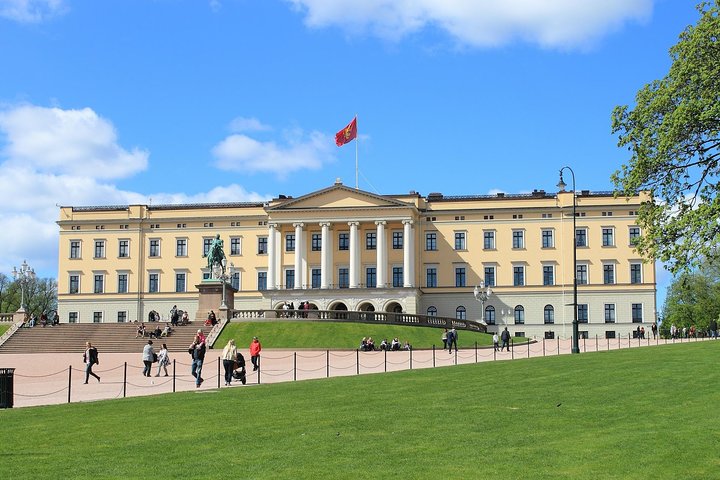
Top-ranked sights in Oslo: Akershus Castle (Akershus Slott), Oslo Royal Palace (Kongelige Slott), Oslo City Hall (Radhuset).
Special offers in Oslo
Was/now prices come from the operator, never from us.