Mexico City Walking Tour with Audioguide on Your Smartphone
- 3 hours
- Free cancellation up to 24h before
- 4 languages
- Instant confirmation
Highlights
Embark on a captivating journey through the significant milestones of Mexico City's history with convenient audio guide on your smartphone. This self-guided tour is designed to allow you to explore the city at your own pace in just 2 hours. Simply follow the route on the app's map to visit all the main attractions. The audio guide provides insights into the lives of the ancient Aztecs, the reasons behind their conquest by the conquistadors, and how their culture has been preserved in contemporary Mexican traditions. You'll have access to 25 points of interest, each accompanied by illustrations and commentary from a professional historian, presented in an accessible, non-academic format. Once you've downloaded the tour, the app operates offline. The audio guide can always be clearly heard through your headphones. Immerse yourself in intriguing stories and legends, moving at your own pace without the need to keep up with a tour group.
Inclusions
What's included
- One-year access to the tour in your preferred language
- Audio guide app for iPhone and Android
- 26 audio recordings narrated by a professional historian
- Illustrations of recognizable landmarks
- Offline map featuring a route for effortless GPS navigation
What's not
- In-person tour guide
- Smartphone and Headphones
- Transportation
- Food and Beverages
Itinerary
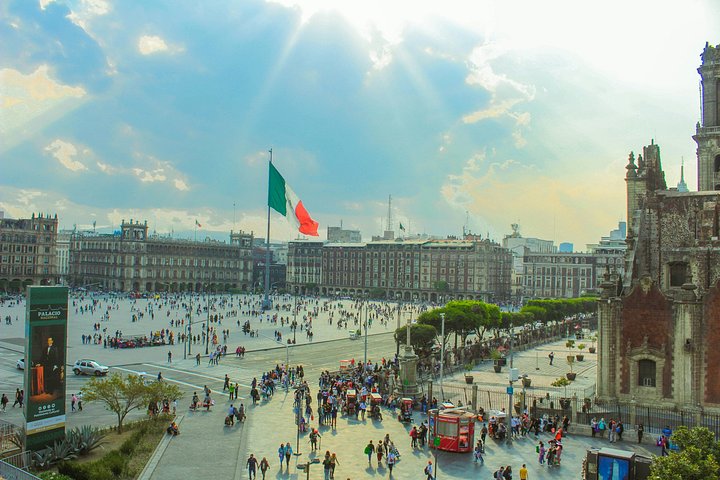
Constitution Square, better known as El Zócalo, is the vast central plaza of Mexico City and one of the largest public squares in the world. Surrounded by historic landmarks like the Metropolitan Cathedral, the National Palace, and colonial arcades, it has been the political and cultural heart of the city since Aztec times, when it was the ceremonial center of Tenochtitlan. Today, it's the stage for national celebrations, protests, festivals, and public life — an enduring symbol of Mexico’s layered history and living democracy.
The National Palace (Palacio Nacional) in Mexico City is a grand symbol of Mexican history and government, stretching along the eastern side of El Zócalo. Built on the ruins of Moctezuma’s palace, it has served as the seat of power since the colonial era. Today, it houses the offices of the President, state archives, and stunning murals by Diego Rivera, which narrate Mexico’s rich and turbulent past. With its red tezontle stone façade and vast courtyards, the palace blends history, politics, and art at the heart of the nation.
The Metropolitan Cathedral of Mexico City is the largest and oldest cathedral in the Americas, standing proudly on El Zócalo. Built over three centuries (from the 16th to 19th), it blends Renaissance, Baroque, and Neoclassical styles, reflecting the evolving identity of colonial Mexico. Constructed atop an Aztec sacred site, its foundations sink slowly into the soft lakebed. Inside, you'll find gilded altars, massive organs, and chapels steeped in history. It's not just a religious center, but a monument to centuries of faith, conquest, and cultural fusion.
The Templo Mayor in Mexico City is the ancient spiritual heart of the Aztec capital Tenochtitlan. Located just steps from the Metropolitan Cathedral and El Zócalo, it was the main temple dedicated to Huitzilopochtli (god of war) and Tlaloc (god of rain and fertility). Though demolished by the Spanish in the 16th century, its ruins were rediscovered in the 1970s and are now part of an open-air archaeological site and museum. Visiting the Templo Mayor reveals the deep, layered history beneath modern Mexico City — a place where ancient gods once ruled the center of an empire.
San Ildefonso College (Antiguo Colegio de San Ildefonso) in Mexico City is a historic former Jesuit school turned cultural center, often called the "cradle of Mexican muralism." Founded in the 16th century, it was one of the most important educational institutions of New Spain. Today, its colonial courtyards and neoclassical halls house impressive murals by Diego Rivera, José Clemente Orozco, and David Alfaro Siqueiros. Located near El Zócalo, it hosts rotating art exhibitions and cultural events, making it a living museum of Mexico’s artistic and intellectual legacy.
The Diego Rivera Mural Museum (Museo Mural Diego Rivera) in Mexico City is home to one of the artist’s most iconic works: “Dream of a Sunday Afternoon in the Alameda Central” (Sueño de una tarde dominical en la Alameda Central). Originally painted in the Hotel del Prado, the mural was saved after the 1985 earthquake and moved to this purpose-built museum. The 15-meter-long fresco captures 400 years of Mexican history in a vivid dreamscape, filled with revolutionaries, aristocrats, and Rivera himself. The museum offers a focused, powerful experience of Rivera’s vision of Mexico’s complex past.
The Palace of the Inquisition (Palacio de la Inquisición) in Mexico City is a striking Baroque building once used by the Holy Office of the Inquisition during colonial times. Completed in the 18th century and located near El Zócalo, it served as a tribunal for religious investigations and trials. Its ornate façade contrasts with the dark history within. Today, it houses the Museum of Mexican Medicine, part of UNAM, featuring exhibits on medical history, anatomy, and traditional healing. The palace stands as a reminder of both scientific progress and the city’s more somber past.
The Casa de la Malinche, also known as the Casa de Hernán Cortés, is a colonial-era building in Mexico City traditionally believed to have been the home of La Malinche — the Indigenous woman who served as interpreter and advisor to Cortés during the Spanish conquest. Though historical evidence linking her directly to the house is debated, the structure near El Zócalo remains symbolically important. With its mix of Indigenous and Spanish elements, it reflects the cultural fusion and controversy surrounding La Malinche’s legacy — as both a historical figure and a national symbol.
The Iturbide Palace (Palacio de Iturbide) in Mexico City is an 18th-century Baroque masterpiece, originally built as a wedding gift for the daughter of Count San Mateo de Valparaíso. It later became the imperial residence of Agustín de Iturbide, Mexico’s first emperor, after independence in 1821. Located on Madero Street, the palace features a richly decorated façade, iron balconies, and an elegant courtyard. Today, it houses the Palacio de Cultura Citibanamex, a cultural space offering free exhibitions on Mexican art, history, and craftsmanship—preserving the grandeur of its imperial past.
The Casa de los Azulejos (“House of Tiles”) is a stunning 18th-century palace in Mexico City, famous for its façade covered in blue and white Talavera tiles from Puebla. Originally the residence of the Count del Valle de Orizaba, it blends Baroque, Churrigueresque, and Moorish styles. Located on Madero Street, the building now houses a historic Sanborns café, retaining its ornate interiors, grand staircase, and stained glass. It’s a beloved cultural icon where architecture, legend, and everyday life come beautifully together in the heart of the city.
The Torre Latinoamericana is one of Mexico City’s most iconic skyscrapers, rising 44 stories above the historic center. Completed in 1956, it was Latin America’s tallest building at the time and a marvel of earthquake-resistant engineering. Located near Palacio de Bellas Artes, it offers a 360° observation deck with sweeping views of the city and surrounding volcanoes. Once a symbol of modern progress, the tower still stands as a proud landmark — blending mid-20th-century optimism with panoramic perspective over Mexico’s sprawling capital.
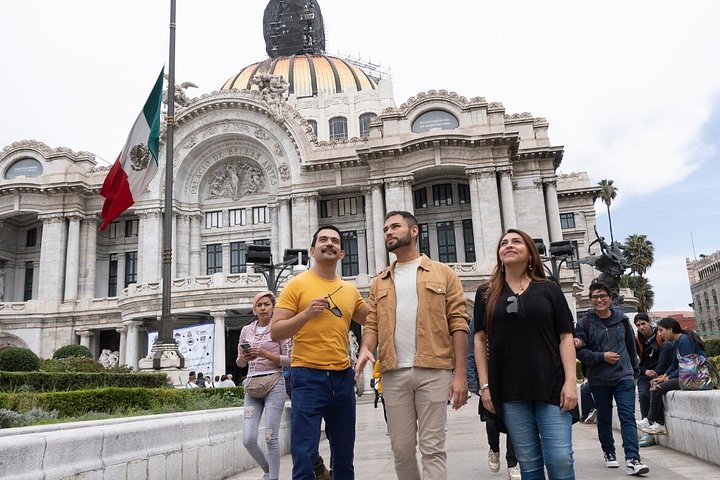
The Palace of Fine Arts (Palacio de Bellas Artes) in Mexico City is a dazzling cultural landmark that blends Art Nouveau and Art Deco styles. Opened in 1934, it hosts opera, ballet, and classical concerts under its iconic Tiffany glass dome. Inside, the marble-clad interior features murals by Diego Rivera, David Alfaro Siqueiros, and Rufino Tamayo, making it both a performance venue and an art museum. Located near the Alameda Central, it’s a national treasure — where architecture, music, and muralism converge in spectacular harmony.
Cancellation
Free cancellation up to 24 hours before the experience starts, for a full refund.
Reviews
5.0
- 51
- 40
- 30
- 20
- 10
Ratings come from 1 reviews collected by our booking partner. They are travellers' own words, in the order they were written — never reordered to flatter the experience.
Know before you go
- Meeting point
- - The tour begins at Constitution Plaza - This is a self-guided tour; there will be no guide at the meeting point - Launch the TouringBee app, initiate the Mexico City Walking Tour, and proceed along the route
- Pickup
- Everyone meets at the starting point; there is no pickup.
- Ticket type
- Mobile or paper ticket accepted
- Group size
- Up to 20 travellers
- Operated by
- TouringBee
- Public transportation options are available nearby
- Suitable for all physical fitness levels
- The audio guide is available through a mobile app for iOS and Android
- Entry tickets to the museums are not included and must be purchased separately in advance
- The tour does not cover all the sights in Mexico City
- This is a self-guided tour, you will need to download the audio guide mobile app, activate your purchase, and follow the route on the app's map (without a human guide)
- The audio guide can be accessed at any time. The date and time provided during checkout are merely approximate
How it compares in Mexico City
- Its from-price is 88% below the median of the 163 city tours we list in Mexico City.
- It is shorter than most of them.
- By number of reviews it ranks 85 of 163.
- The operator lists free cancellation on it.
About Mexico City
Mexico City is a vast, high-altitude capital built over the Aztec city of Tenochtitlan, rich in museums, murals, markets and outstanding food.
The Zócalo, one of the largest squares in the world, is framed by the Metropolitan Cathedral and the National Palace, where Diego Rivera's murals tell the story of Mexico. Beside them, the excavated Templo Mayor reveals the heart of the Aztec capital, and the Palacio de Bellas Artes, with its marble exterior and Art Deco interior, stands a short walk west.
Top-ranked sights in Mexico City: Teotihuacán, Basilica of Our Lady of Guadalupe, Frida Kahlo Museum (Museo Frida Kahlo).
Special offers in Mexico City
Was/now prices come from the operator, never from us.
![Balloon flight + pick up in CDMX + Breakfast in Cave + Teotihuacan]() Likely to sell out6% off
![Hot Air Balloon Ride in Teotihuacan | Pick up CDMX | Breakfast in a cave]() 15% offFree cancellation
![Balloon Flight with Breakfast in a Natural Cave and Transportation from CDMX]() 11% offFree cancellation