Koblenz Private Walking Tour With A Professional Guide
- 2 hours
- Free cancellation up to 24h before
- 2 languages
- Instant confirmation
Highlights
Enjoy Koblenz in the heart of the picturesque region of Rhine and Moselle. Dive into the over 2000 year-old history of this former Roman settlement, one of the oldest cities in Germany. We will take you so view the Deutsches Eck (German corner) from which the city’s Latin name „confluentes – at the merging of the rivers“ is derived. Come with us to get familiar with the German/French past of Koblenz and explore the romantic little streets between Basilica St. Kastor and the Schängel Fountain at the town hall. You will learn about: * Roman Empire * The junction between the Rhine and the Moselle * Teutonic Knights * Holy Roman German Empire * Kaiser Wilhelm I * World War I and II * Reconstruction of the Post War * Modern age You will see: * Rhine and Moselle River * Deutsches Eck * View of Fortress Ehrenbreitstein * Basilica of St. Castor * Old Town * St. Florin’s Market * Liebfrauenkirche * Görresplatz * Jesuitenplatz * Münzplatz * Denkmalzone “Vier Türme”
Inclusions
What's included
- * Possible customizing on tour with your local guide on the spot
- * Local Guide who will be with your group only
- * Private guided Tour
What's not
- * Gratuities
- * Entrance fees
Itinerary
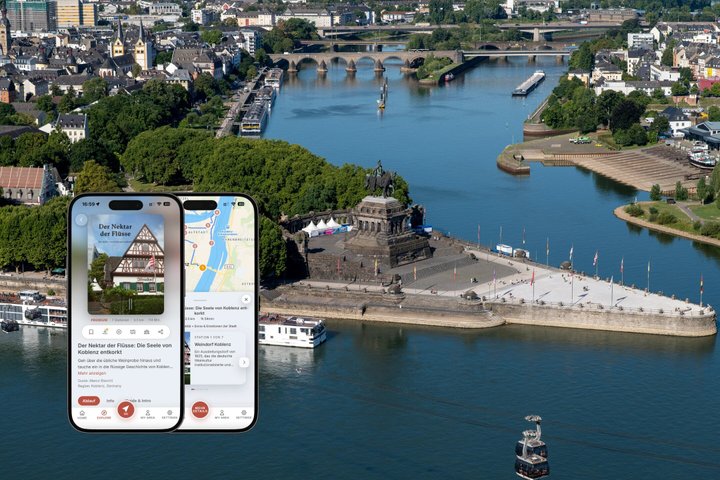
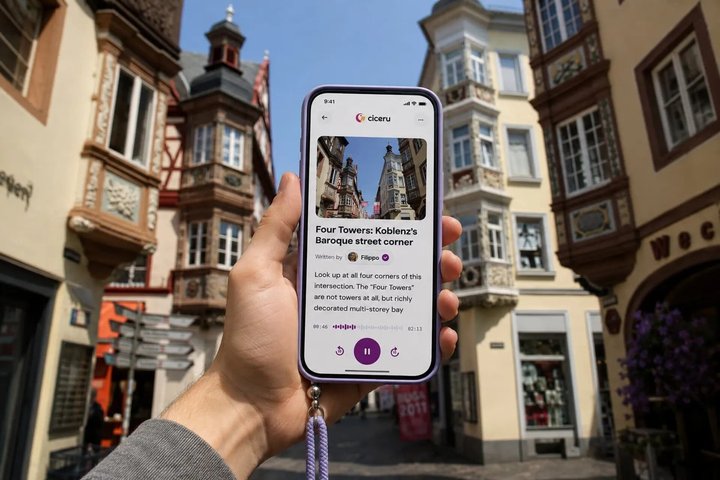
Koblenz is one of the oldest cities in Germany and offers visitors a rich panel of cultural monuments and historic buildings. Start your walking tour at the confluence where Father Rhine and Mother Moselle meet, a long slip of land projecting into the waters like the bow of a ship. The establishment of the Knights of the Teutonic Order in the 13th century at the merging of the rivers gave this historic site its name: Deutsches Eck (German corner). You will be impressed by the giant equestrian statue of German Emperor Wilhelm I. towering the German corner and get a magnificent view of 19th century Fortress Ehrenbreitstein perched 118 metres above the Rhine on the right embankment. Close by you will visit the Basilica of St. Castor, founded in 836 AD and designated a UNESCO World heritage site. Next we will arrive at Görresplatz, once the epicenter of the roman settlement and property of the St. Castor Monastery during the Middle Ages. Later, it became owned by the Jesuit order. This brings us to the next square, the Jesuitenplatz or Jesuit Square. This religious order existed here from the 16th until the 18th century, taking over from an order of Cistercian nuns founded in the 13th century and used it as a convent school. Marvel the palace-like Jesuit school, see its towers and magnificent porches. This square houses the city hall since 1895 (Rathausgebäude I). Continue to the heart of Koblenz, the old town center lovingly restored after WWII. There we will also see the Church of Our Dear Lady, or Liebfrauenkirche, built on the highest part of the city. From the late Middle Ages until the secularization that ensued after the French Revolution and Napoleonic War, it was the main parish church in Koblenz. It was also destroyed during World War II and reconstructed in 1955. It’s onion domes symbolize the old town of Koblenz. On St. Florin’s Market, once the city’s political and commercial centre, owes its name to St. Florin’s church (Florinskirche). This church, the “Kauf und Danzhaus” of the 15th century, Schöffenhaus and Bürresheimer Hof are the most beautiful buildings in the city. Next stop is the Münzplatz, which name is reminiscent of the former electoral coin, or “Münze” in German. Starting with the 11th century, coins of the Electorate of Trier were minted in Koblenz. The mint was originally made up of several buildings, but these were demolished in the 19th century to open space for today’s square. Of these only the Münzmeisterhaus remains, a baroque building with a simple plaster facade. Now he heads to the memorial site of the Four Towers, four historical buildings built in 1608 and fully rebuilt twice, once in the 17th century and after the Second World War. The four buildings have the same facade, hence the name. In the corner of the house “Zum grünen Baum” (The Green Tree) a new passage was built in the 50’s to enable access from the pedestrian area. The house “”Zum heiligen Petrus” (Holy Peter’s) belonged to a farmacy from 1730 until the mid 2000’s. The house with the plants is the only one to have survived the bombardments of Koblenz almost unscaved. The fourth building, called “Hauptwache”, is a reminder of soldiers who took over the police duties in this building until 1848. From here we will return to the city center, next to the Church of our Lady, to finish the tour in an appropriate central place and your better orientation.
Cancellation
Free cancellation up to 24 hours before the experience starts, for a full refund.
Reviews
5.0
- 51
- 40
- 30
- 20
- 10
Ratings come from 1 reviews collected by our booking partner. They are travellers' own words, in the order they were written — never reordered to flatter the experience.
Know before you go
- Meeting point
- Deutsches Eck / Busparking Peter Altmeier Ufer on the Moselle embankment, Peter-Altmeier-Ufer, 56068 Koblenz
- Pickup
- Everyone meets at the starting point; there is no pickup.
- Ticket type
- Mobile or paper ticket accepted
- Operated by
- Global Guide Services
- Wheelchair accessible
- Infants and small children can ride in a pram or stroller
- Public transportation options are available nearby
- Infants are required to sit on an adult’s lap
- All areas and surfaces are wheelchair accessible
- Not recommended for pregnant travelers
- Not recommended for travelers with poor cardiovascular health
- Suitable for all physical fitness levels
How it compares in Koblenz
- Its from-price is 176% above the median of the 36 experiences we list in Koblenz.
- Its length is typical for the group.
- By number of reviews it ranks 17 of 36.
- The operator lists free cancellation on it.
About Koblenz
Koblenz stands where the Moselle meets the Rhine, with a promontory called the German Corner, a hilltop fortress and the gateway to the Rhine castles.
Koblenz lies at the confluence of the Rhine and the Moselle, in Rhineland-Palatinate. The tip of land between the rivers, the Deutsches Eck, or German Corner, is marked by a tall monument topped by an equestrian statue of Kaiser Wilhelm I. A cable car crosses the Rhine to Ehrenbreitstein Fortress, a huge 19th-century Prussian stronghold on a rock, with views of both rivers.
Special offers in Koblenz
Was/now prices come from the operator, never from us.