Gold Juno and Omaha Guided Small Group Tour
- 9h 30m
- 2 languages
- Mobile ticket
Highlights
From Gold to Juno, all the way to Omaha: experience the D-Day landings alongside British, Canadian, and American soldiers. A moving guided tour in the heart of the battlefields that marked the beginning of Europe’s libération—led by a certified expert guide, with lunch and museum entry included.
Inclusions
What's included
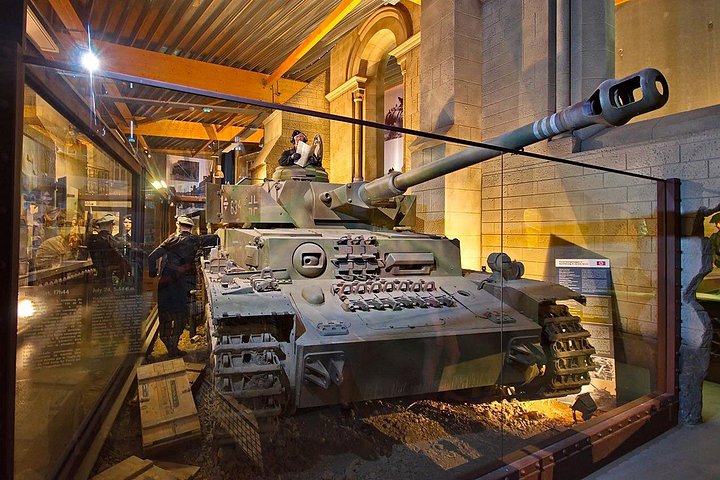
- Entrance ticket to the Memorial de Caen museum - must be used on a different day to the guided tour
- Bottled water
- Lunch
Itinerary
Arromanches-les-Bains played a vital logistical role in the D-Day landings of 1944, not 1941. It was the site of Mulberry B, one of two artificial harbours constructed by the Allies to facilitate rapid offloading of troops, vehicles, and supplies onto the beaches of Normandy. Within days of the landings, this prefabricated port allowed the unloading of thousands of tons of equipment, essential for sustaining the Allied advance into occupied France. Despite harsh weather that damaged other supply points, Mulberry B at Arromanches remained operational and was crucial to the success of the Normandy campaign. Remnants of the harbour are still visible today.
Inaugurated in 2021, this memorial honors the 22,442 British soldiers who died in Normandy between 6 June and 31 August 1944. Located on the heights of the Gold sector, the memorial features a reproduction of the Union Jack flag. During our visit, we provide an introduction onboard the coach, explain the Gold Beach landings on site, and allow time for guests to explore the memorial independently.
Opened in 1961, this cemetery is the final resting place of 2,049 Canadian soldiers. We guide visitors through the site and highlight the graves of several soldiers whose personal stories are known to us.
A significant site of remembrance for Canadians, where 20 soldiers were executed by the 12th SS Panzer Division in the garden. The remains were discovered months later by the property owners, Mrs. Vico and her son.
In World War II, Pointe du Hoc was the location of a series of German bunkers and machine gun posts. Prior to the invasion of Normandy, the German army fortified the area with concrete casemates and gun pits. On D-Day, the United States Army Provisional Ranger Group attacked and captured Pointe du Hoc after scaling the cliffs. United States generals including Dwight D. Eisenhower had determined that the place housed artillery that could slow down nearby beach attacks.
Omaha Beach was one of five beach landing sectors designated for the amphibious assault component of Operation Overlord during the Second World War. On June 6, 1944, the Allies invaded German-occupied France with the Normandy landings. "Omaha" refers to an 8-kilometer (5 mi) section of the coast of Normandy, France, facing the English Channel, from east of Sainte-Honorine-des-Pertes to west of Vierville-sur-Mer on the right bank of the Douve River estuary. Landings here were necessary to link the British landings to the east at Gold with the American landing to the west at Utah, thus providing a continuous lodgement on the Normandy coast of the Bay of the Seine. Taking Omaha was to be the responsibility of United States Army troops, with sea transport, mine sweeping, and a naval bombardment force provided predominantly by the United States Navy and Coast Guard, with contributions from the British, Canadian and Free French navies.
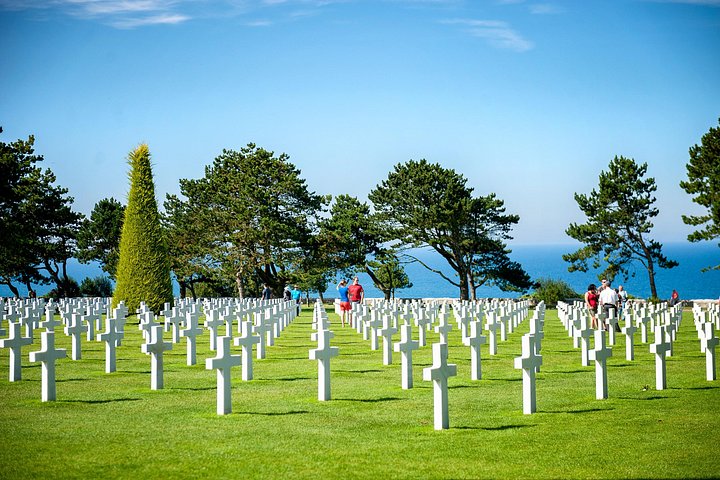
The Normandy American Cemetery and Memorial is a World War II cemetery and memorial that honors American troops who died in Europe during World War II. A memorial in the cemetery includes maps and details of the Normandy landings and military operations that followed. At the memorial's center is Spirit of American Youth Rising from the Waves, a bronze statue. The cemetery also includes two flag poles where, at different times, people gather to watch the American flags being lowered and folded. The cemetery, which was dedicated in 1956, is the most visited cemetery of those maintained by the American Battle Monuments Commission (ABMC), with one million visitors a year. In 2007, the ABMC opened a visitor centre at the cemetery, relating the global significance and meaning of Operation Overlord.
Cancellation
All sales are final. No refund is available for cancellations.
Reviews
4.0
- 50
- 41
- 30
- 20
- 10
Ratings come from 1 reviews collected by our booking partner. They are travellers' own words, in the order they were written — never reordered to flatter the experience.
Know before you go
- Meeting point
- The guide will meet you in the entrance hall of the Mémorial de Caen museum. Please arrive 15 minutes before the tour departure time.
- Pickup
- Everyone meets at the starting point; there is no pickup.
- Tickets
- Tickets are redeemed at a different location from the meeting point.
- Ticket type
- Mobile or paper ticket accepted
- Group size
- Up to 7 travellers
- Operated by
- Memorial de Caen
- Service animals allowed
- Public transportation options are available nearby
- Specialized infant seats are available
- Travelers should have at least a moderate level of physical fitness
How it compares in Caen
- Its from-price is 69% below the median of the 40 day trips we list in Caen.
- Its length is typical for the group.
- By number of reviews it ranks 24 of 40.
About Caen
Caen, in Normandy, is the city of William the Conqueror, with two great abbeys, a hilltop castle and the D-Day beaches within easy reach.
Caen sits on the Orne in Lower Normandy, and William the Conqueror made it a base in the 11th century, building the castle that still dominates the old centre. He is buried in the Abbaye aux Hommes, and his wife Matilda in the Abbaye aux Dames, two Romanesque abbeys on opposite sides of the centre. Much of the city was destroyed in the Battle of Normandy in 1944 and rebuilt in pale Caen stone.
Top-ranked sights in Caen: Honfleur, Caen Memorial Museum (Mémorial de Caen), St. Catherine’s Church (Eglise Sainte-Catherine).
Special offers in Caen
Was/now prices come from the operator, never from us.