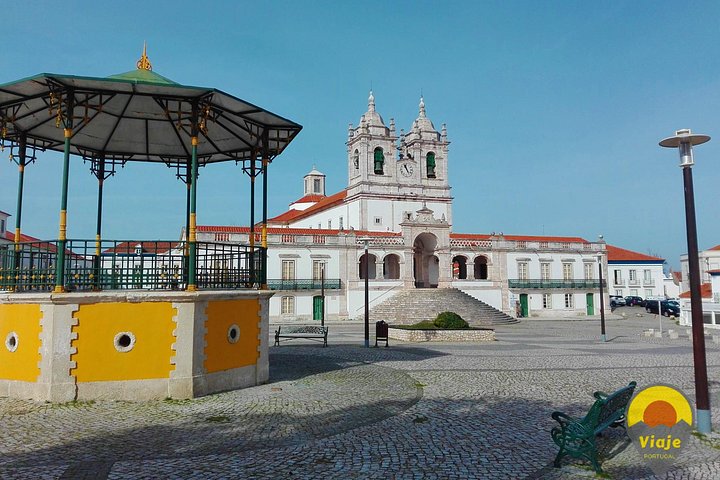
Fátima, Batalha, Nazaré, Óbidos - Minivan, 4x4 or Car
Descriptions come from the operator and are translated automatically.
- 8–9 hours
- Free cancellation up to 24h before
- 4 languages
- Mobile ticket
Highlights
We are natives of the village of Nazaré, we know the West Region, the customs and traditions, in the palm of our hand! Our vehicles depart from this village to the customer, guaranteeing the greatest exclusivity in your tour, allowing travel in a Minivan, for larger groups, in an All-Terrain UMM for the more adventurous (air conditioning subject to the opening of the tarps :D ), an electric car for the environment or one of our classic cars that will bring back memories of the 80s and 90s.
Inclusions
What's included
- Bottled water
- Air-conditioned vehicle
What's not
- Lunch
- Entrances to monuments
Itinerary
The Monastery of Santa Maria da Vitória, also known as the Monastery of Batalha, is undoubtedly one of the most beautiful works of Portuguese and European architecture. This exceptional architectural ensemble resulted from the fulfillment of a promise made by King D. João I, in gratitude for the victory in Aljubarrota, a battle fought on August 14, 1385, which assured him the throne and guaranteed the independence of Portugal. A national monument, it has been on the World Heritage List defined by UNESCO since 1983.
Fátima is a city in central Portugal that houses the Sanctuary of Fatima, a place of Catholic pilgrimage. The Chapel of the Apparitions marks the place where the Virgin Mary was alleged to have appeared in 1917. Other sacred sites include the Basilica of Our Lady of the Rosary with its golden angels and the modern Church of the Holy Trinity. The Museum of Sacred Art and Ethnology exhibits religious artifacts.
The Moeda Caves in São Mamede, Fátima, were discovered in 1971 by two hunters who were chasing a fox. Once inside, in the cave that they found, curiosity led them to explore it in all its extension, soon finding, amazed, a room, "Sala do Pastor", full of the most fantastic limestone formations. For close to two months, the two men continued to excavate the narrow crevices that followed the first cave, gradually revealing the other rooms and galleries that are now included in the Gruta da Moeda. Meanwhile, geologists and other technicians were hired and the cave was used as a tourist attraction, strictly preserving its characteristics and even the mountainous landscape on the surface. The names of the rooms suggest well the image that each one provides to the visitor.
Nazaré beach, with a mild climate and natural beauty, has one of the oldest traditions in Portugal linked to fishing. The long sandy beach in the shape of a crescent, which is also the seafront of the city, is known for its grandeur and for the brightly colored awnings that decorate the white sand beach in contrast to the blue of the water. This is the beach in Portugal where fishing traditions are most colorful and it is not uncommon to come across fishmongers who still wear their seven skirts, as tradition dictates. Facing the sea, on the right side, we see an impressive promontory. This is Sítio, where we have one of the best known panoramic views of the Portuguese coast.
See where the biggest waves in the world are surfed!
The medieval village of Obidos is one of the most picturesque and well preserved in Portugal. Close enough to the capital and situated on a high point near the Atlantic coast, Óbidos had a strategic importance in the territory. Already occupied before the Romans arrived in the Iberian Peninsula, the village became more prosperous from the moment it was chosen by the royal family. Since the king D. Dinis offered it to his wife D. Isabel, in the century. XIII, belonged to the House of the Queens who, throughout the various dynasties, benefited and enriched it. It is one of the main reasons for finding so many churches in this small town. Within walls, we find a well-preserved castle and a labyrinth of streets and white houses that enchant those who walk there. Among Manueline porticoes, flowery windows and small ladders, there are several reasons to visit, good examples of the religious and civil architecture of the golden ages of the village. In Óbidos, we will try the famous Ginja of Óbidos!
Visit to the surf museum, where participants will have the possibility to understand the formation of giant waves, as well as the Nazaré cannon and also learn about the history of the German submarine U-Boat 963 sunk next to the fort.
Cancellation
Free cancellation up to 24 hours before the experience starts, for a full refund.
Reviews
5.0
- 51
- 40
- 30
- 20
- 10
Ratings come from 1 reviews collected by our booking partner. They are travellers' own words, in the order they were written — never reordered to flatter the experience.
Know before you go
- Meeting point
- Participants meet us at the agreed location.
- Pickup
- Pickup is offered, or you can meet at the starting point.
- Ticket type
- Mobile or paper ticket accepted
- Group size
- Up to 8 travellers
- Operated by
- Naturumm
- Infants and small children can ride in a pram or stroller
- Service animals allowed
- Public transportation options are available nearby
- Specialized infant seats are available
- Suitable for all physical fitness levels
- Baby chair available upon request;
How it compares in Nazaré
- Its from-price is 15% below the median of the 15 day trips we list in Nazaré.
- Its length is typical for the group.
- By number of reviews it ranks 4 of 15.
- The operator lists free cancellation on it.
About Nazaré
Nazaré is a fishing town on Portugal's Atlantic coast, with a wide beach, a clifftop quarter and some of the biggest waves in the world in winter.
Nazaré lies on the Atlantic coast of Portugal, north of Lisbon, where a wide beach curves beneath a high cliff. Traditionally, fishermen's wives wore seven layered skirts and dried fish in the sun on racks along the sand, and the town keeps some of those customs alive. The upper quarter, called Sítio, is reached by a funicular and gives a long view over the beach, the harbour and the Atlantic.