e-Scavenger hunt Narbonne: Explore the city at your own pace
- 2–3 hours
- Free cancellation up to 24h before
- 6 languages
- Instant confirmation
Highlights
Go on a discovery tour with our E-scavenger hunt in Narbonne. You go on a search for the city's treasures with your family or friends. Use GPS to get to the right locations. At those location you'll play fun assignments and get interesting facts about the location or the city. Will you set the top score in Narbonne? This E-scavenger hunt is a unique way to discover a city. It will give you a fantastic day in Narbonne. Decide for yourself when you start, pause and end. The E-scavenger hunt is fun to do and also teaches you about the city. No time limits or age limits! Instructions for starting the tour will be given after booking. You can do this tour whenever you choose.
Inclusions
What's included
- 100% tailor-made and unique activity
- e-Scavenger Hunt on your phone for max. 6 persons
- Audio Guide (English, Spanish, French, German, Italian, Dutch)
- Free access to Europe's most played city game
What's not
- Use of smartphone and data
Itinerary
Les Halles de Narbonne is a vibrant and historic market hall in the heart of Narbonne, France. Built in the 19th century, this architectural gem is a bustling hub for local commerce and gastronomy.
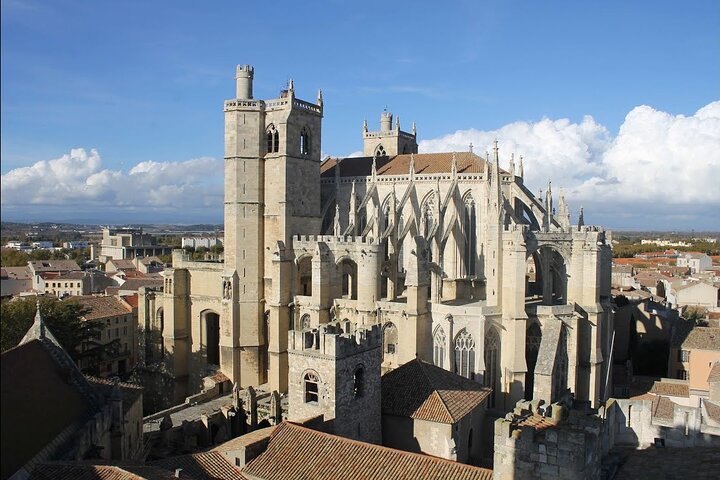
The Narbonne Cathedral, officially known as Cathédrale Saint-Just-et-Saint-Pasteur, is a stunning Gothic masterpiece located in the heart of Narbonne, France. Construction began in 1272, but the cathedral remains unfinished.
The Canal de la Robine is a historic waterway, connecting the Aude River to the Mediterranean Sea. Stretching 32 kilometers, it serves as a lateral branch of the famous Canal du Midi
The Voie Domitienne, or Via Domitia, is an ancient Roman road that passes through Narbonne, France. Built in 118 BCE by the Roman general Cneus Domitius Ahenobarbus, it was the first Roman road in Gaul, connecting Italy to Spain.
The Église Saint-Paul in Narbonne is one of the oldest Gothic churches in southern France. Built in 1180, it stands on the site of an ancient paleochristian cemetery dating back to the 3rd and 4th centuries
Narbonne is a historic city in southern France, located in the Occitanie region. Founded by the Romans in 118 BCE, it was the first Roman colony in Gaul and an important trade hub along the Via Domitia. Today, Narbonne is known for its rich heritage, including the Narbonne Cathedral, the Canal de la Robine, and the bustling Les Halles market
Cancellation
Free cancellation up to 24 hours before the experience starts, for a full refund.
Reviews
4.0
- 50
- 41
- 30
- 20
- 10
Ratings come from 1 reviews collected by our booking partner. They are travellers' own words, in the order they were written — never reordered to flatter the experience.
Know before you go
- Meeting point
- Go to the starting point at Cr Mirabeau, 11100 Narbonne. Open the App and Go!
- Pickup
- Everyone meets at the starting point; there is no pickup.
- Ticket type
- Mobile or paper ticket accepted
- Operated by
- Qula
- Wheelchair accessible
- Infants and small children can ride in a pram or stroller
- Service animals allowed
- Public transportation options are available nearby
- Not recommended for travelers with poor cardiovascular health
- Suitable for all physical fitness levels
How it compares in Narbonne
- Its from-price is 31% below the median of the 15 experiences we list in Narbonne.
- Its length is typical for the group.
- By number of reviews it ranks 8 of 15.
- The operator lists free cancellation on it.
About Narbonne
Narbonne is a canal town in the Aude with a Roman past, an unfinished Gothic cathedral, a covered market and the Mediterranean beaches close by.
Narbonne was the first Roman colony in Gaul, founded in 118 BC, and the capital of a Roman province. A stretch of the Via Domitia, the old Roman road, is preserved in the main square, beside the Archbishops' Palace. Beneath the streets, the Horreum is a network of Roman underground storage galleries. The cathedral of Saint-Just-et-Saint-Pasteur has only its soaring Gothic choir, since the nave was never built.