Capture Old Hong Kong Heritage: Sidecar Mobile Photo Booth
- 1h 30m
- Free cancellation up to 24h before
- 2 languages
- Instant confirmation
Highlights
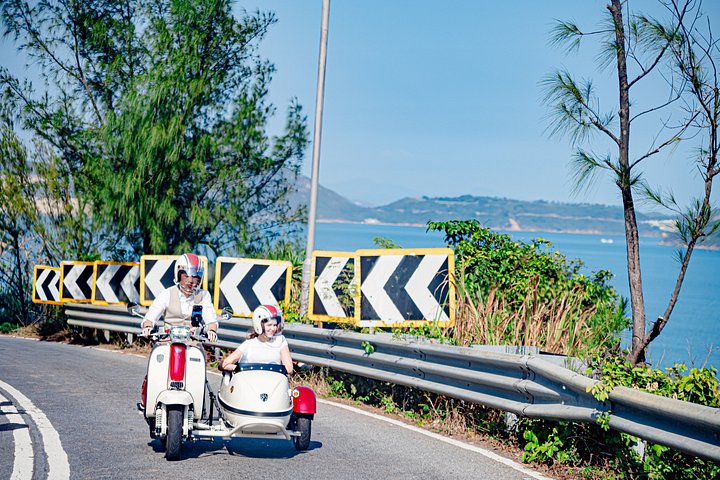
"Time-Travel" Urban Circuit: An itinerary designed for history and architecture lovers, scouting the city’s most significant monuments. Our vintage sidecar serves as the perfect aesthetic anchor blending seamlessly into the heritage background. Unobstructed Exclusive Access: Avoid the glare of taxi windows and the main-road-only routes of buses. We dive into the narrow hidden paths, allowing you to capture the details of colonial facades and tucked-away alleys that are unreachable by big cars. The Ultimate "Street Style" Platform: The low-to-the-ground vantage point is perfect for capturing the grit and glamour of local neighborhoods. East-meets-West Backdrops: From the gothic spires of St. John’s Cathedral to the traditional incense of Man Mo Temple, we curate an impressive cultural contrast for your lens. Effortless Cinematic Coverage: Forget the steep hills and exhausting staircases of Central and Sheung Wan. We cover a 12km circuit that would take hours to navigate on foot.
Inclusions
What's included
- Private transportation
- You'll have to sign a Liability Waiver waiving our legal liability for any accident happened to you.
Itinerary
Built in 1863 by local residents during the Qing dynasty to honor the Northern Emperor and stands as an important early landmark in Wan Chai. The Northern Emperor represents the northern constellations and is traditionally revered as a water deity, reflecting the community’s ties to the sea.
A row of four connected four‑storey tong lau (chinese-style buildings). The site once housed a charitable school (鏡涵義學), and before the war it was the campus of an English school (一中書院). The “Fresh Fish Trader Association” (鮮魚行商會), which organised many community festival rites, also operated here.
Completed in 1913, this is the oldest surviving post office building in Hong Kong. In 1993 it was repurposed by the Environmental Protection Department as the Environmental Resource Centre.
Former British Military Hospital Building: Opened in 1907, this building originally served as the medical facility for the British garrison in Hong Kong. It suffered repeated air raids in 1941 during the Japanese invasion, then returned to military medical use after the war. In 1967 the site was repurposed as the campus of the Hong Kong English Boys’ School; after the school moved out in 1979, the building became government offices.
Built in 1892, this building originally served as the Dairy Farm Company’s warehouse and icehouse. From 1896 through the 1970s it functioned as the company’s headquarters and gradually expanded to include a slaughterhouse, workshops, and cold‑storage facilities. In 1984 the Foreign Correspondents’ Club and the Fringe Club—an organisation dedicated to promoting the arts—moved into the premises, beginning the site’s new life as a cultural and creative hub.
Founded in 1943 in Chongqing to connect overseas correspondents with the then Republic of China government, the club relocated to Hong Kong in 1949. Today it serves as a platform for foreign journalists, media professionals, and those interested in the press to exchange views, host talks, and organise professional events.
Built in 1848, this building originally housed St. Paul’s College, a school established for Chinese students. It served as the college campus from 1849 to 1950, before the school relocated to Bonham Road after World War II. Today the site functions as the office of the Hong Kong Anglican Province, commonly known as Bishop’s House, and remains an important centre of the city’s Anglican heritage.
Queen's Road was the first major road built after Hong Kong was opened to foreign trade and remains a principal thoroughfare on Hong Kong Island. It stretches from Shek Tong Tsui in the Central and Western District eastward to Happy Valley in Wan Chai and is divided into Queen’s Road West, Queen’s Road Central, and Queen’s Road East. Queen’s Road Central was the earliest section to be constructed; it opened in 1842, linking Sai Ying Pun and Central, and is the first major paved road built in Hong Kong.
A street mainly composed of staircases, built between 1841 and 1850 during the early days of Hong Kong's opening to trade. It has a long history and starts from Queen's Road Central, goes up the hillside, passes Upper Lascar Row, Circular Pathway, Hollywood Road, Square Street, Bridges Street, U Lam Terrace, Ladder Street Terrace, and ends at Caine Road, with a total length of 350 meters.
Originally built in 1906 as the Bacteriological Institute to control plague and other infectious diseases, the facility expanded after World War II and was renamed the Pathological Institute. During the 1960s–70s it focused on vaccine research and development. In 1996, the site was repurposed as the Hong Kong Museum of Medical Sciences, preserving its scientific legacy for public education.
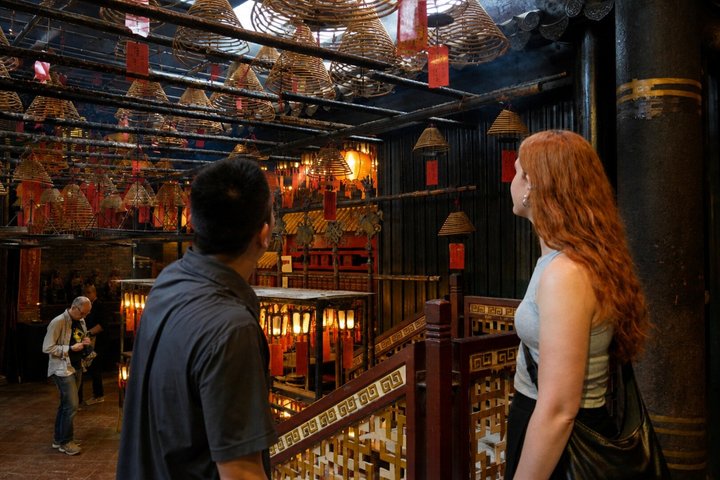
Built between 1847 and 1862, the complex comprises three structures: Man Mo Temple (文武廟), Lit Shing Kung (列聖宮), and the Kung Sor (公所: community office). Man Mo Temple is dedicated to Wenchang (文昌: the God of Literature) and Martial Deity (武帝: the God of War), while Lit Shing Kung houses various gods and venerated saints. The temple holds significant historical and social value, reflecting the social organisation and religious practices of the Chinese community in earlier times.
Construction began as early as 1841 when the British landed on Hong Kong Island. At that time, it was close to the sea. After years of land reclamation, Hollywood Road is now far from the sea. Hollywood Road is believed to have gotten its name from the holly woods that grew in the area in the early years.
Cancellation
Free cancellation up to 24 hours before the experience starts, for a full refund.
Reviews
5.0
- 53
- 40
- 30
- 20
- 10
Ratings come from 3 reviews collected by our booking partner. They are travellers' own words, in the order they were written — never reordered to flatter the experience.
Know before you go
- Meeting point
- Please arrive 15 mins in advance. Take MTR to Wan Chai station and exit via exit A3. You will be on "Johnston Road". Cross to the opposite side of the road and turn right. At the first intersection, turn left on "Tai Yuen Street" and walk to the end.
- Pickup
- Everyone meets at the starting point; there is no pickup.
- Ticket type
- Mobile or paper ticket accepted
- Operated by
- HONG KONG SIDECARS | 香港邊車遊
- Not recommended for travelers with spinal injuries
- Not recommended for travelers with poor cardiovascular health
- Not recommended for pregnant travelers
- Public transportation options are available nearby
- Suitable for all physical fitness levels
How it compares in China, outside the cities
- Its from-price is 81% below the median of the 1009 experiences we list in China, outside the cities.
- It is shorter than most of them.
- By number of reviews it ranks 284 of 1009.
- The operator lists free cancellation on it.
Special offers in China, outside the cities
Was/now prices come from the operator, never from us.



Similar experiences
![Hong Kong's Tin Hau Hidden Gems Food Tour with 7+ Local Tastings]() Likely to sell outFree cancellation