Tokyo Layover Customized Tour from Narita, Licensed Guide
- 8 hours
- Free cancellation up to 24h before
- 2 languages
- Instant confirmation
Highlights
If you would like to enjoy a layover tour of Tokyo from Narita, this tour is for you! Enjoy an efficient, one-day tour of Tokyo accompanied by a government-licensed and experienced English-speaking guide! Your guide will introduce both modern and traditional aspects of this dynamic Japanese capital. Due to the enormous size of Tokyo, one of the largest metropolitan areas in the world, a one-day tour would focus on one area. This is usually about 3 to 4 sights in the city. Let us know what you would like to experience, and we will customize a tour that's best for you! Once your tour is complete, your guide will take you to the nearest station to ride the Narita Express. You can enjoy your ride back to Narita after a fun time in Tokyo!
Inclusions
What's included
- Meet up with guide in Narita International Airport
- Customizable Walking Tour of your choice of 3-4 sites from 'Itinerary' list
- Licensed Local English Speaking Guide
What's not
- Transportation fees, Entrance fees, Lunch, and Other personal expenses
- Private Vehicle
- Narita Express Round Trip Ticket: ¥6,140 for adults, ¥3,060 for Children. Prices vary on destination
- You cannot combine multiple tour groups.
- Guide Entry fees are only covered for sights listed under 'Itinerary' list.
Itinerary
Meet your guide at the Narita international airport(NRT) and head to the world's most exciting city, Tokyo by train. This is a customize tour, please choose 3 to 4 spots from below lists and plan your itinerary with your guide!
**This tour does not include access to the inside of the Imperial Palace** The current Imperial Palace is located on the former site of Edo Castle, a large park area surrounded by moats and massive stone walls in the center of Tokyo, a short walk from Tokyo Station. It is the residence of Japan's Imperial Family. Edo Castle used to be the seat of the Tokugawa shogun who ruled Japan from 1603 until 1867. In 1868, the shogunate was overthrown, and the country's capital and imperial residence were moved from Kyoto to Tokyo. In 1888 construction of a new Imperial Palace was completed. The palace was once destroyed during World War Two, and rebuilt in the same style, afterwards.
Shibuya Crossing is a world famous and iconic busiest intersection in Shibuya, Tokyo.
Explore the old fish market in Tokyo!
Meiji Shrine (明治神宮, Meiji Jingū) is a shrine dedicated to the deified spirits of Emperor Meiji and his consort, Empress Shoken. Located just beside the JR Yamanote Line's busy Harajuku Station, Meiji Shrine and the adjacent Yoyogi Park make up a large forested area within the densely built-up city. The spacious shrine grounds offer walking paths that are great for a relaxing stroll. The shrine was completed and dedicated to the Emperor Meiji and the Empress Shoken in 1920, eight years after the passing of the emperor and six years after the passing of the empress. The shrine was destroyed during the Second World War but was rebuilt shortly thereafter.
This tour will allow you to explore Tokyo more efficiently in one day. Meet at your hotel, then move to anywhere you want.
Koishikawa Korakuen (小石川後楽園, Koishikawa Kōrakuen) is one of Tokyo's oldest and best Japanese gardens. It was built in the early Edo Period (1600-1867) at the Tokyo residence of the Mito branch of the ruling Tokugawa family. Like its namesake in Okayama, the garden was named Korakuen after a poem encouraging a ruler to enjoy pleasure only after achieving happiness for his people. Koishikawa is the district in which the garden is located in.
Hama Rikyu (浜離宮, Hama Rikyū), is a large, attractive landscape garden in central Tokyo. Located alongside Tokyo Bay, Hama Rikyu features seawater ponds which change level with the tides, and a teahouse on an island where visitors can rest and enjoy the scenery. The traditionally styled garden stands in stark contrast to the skyscrapers of the adjacent Shiodome district.
The Tokyo National Museum (東京国立博物館, Tōkyō Kokuritsu Hakubutsukan) is the oldest and largest of Japan's top-level national museums, which also include the Kyoto National Museum, the Nara National Museum and the Kyushu National Museum. It was originally established in 1972 at Yushima Seido Shrine and moved to its current location in Ueno Park a few years later. The Tokyo National Museum features one of the largest and best collections of art and archeological artifacts in Japan, made up of over 110,000 individual items including nearly a hundred national treasures. At any one time, about 4000 different items from the permanent museum collection are on display. In addition, visiting temporary exhibitions are also held regularly. Good English information and audio guides are available.
Akihabara (秋葉原), also called Akiba after a former local shrine, is a district in central Tokyo that is famous for its many electronics shops. In more recent years, Akihabara has gained recognition as the center of Japan's otaku (diehard fan) culture, and many shops and establishments devoted to anime and manga are now dispersed among the electronic stores in the district. On Sundays, Chuo Dori, the main street through the district, is closed to car traffic from 13:00 to 18:00 (until 17:00 from October through March).
Rikugien (六義園) is often considered Tokyo's most beautiful Japanese landscape garden alongside Koishikawa Korakuen. Built around 1700 for the 5th Tokugawa Shogun, Rikugien literally means "six poems garden" and reproduces in miniature 88 scenes from famous poems. The garden is a good example of an Edo Period strolling garden and features a large central pond surrounded by manmade hills and forested areas, all connected by a network of trails.
Yoyogi Park (代々木公園, Yoyogi Kōen) is one of Tokyo's largest city parks, featuring wide lawns, ponds and forested areas. It is a great place for jogging, picnicking and other outdoor activities. Although Yoyogi Park has relatively few cherry trees compared to other sites in Tokyo, it makes for a nice cherry blossom viewing spot in spring. Furthermore, it is known for its ginko tree forest, which turns intensely golden in autumn.
Cancellation
Free cancellation up to 24 hours before the experience starts, for a full refund.
Reviews
4.6
- 54
- 40
- 31
- 20
- 10
Ratings come from 5 reviews collected by our booking partner. They are travellers' own words, in the order they were written — never reordered to flatter the experience.
Know before you go
- Pickup
- Pickup is included for everyone.
- Ticket type
- Mobile or paper ticket accepted
- Operated by
- Japan Guide Agency
- Service animals allowed
- Public transportation options are available nearby
- Infants and small children can ride in a pram or stroller
- Transportation options are wheelchair accessible
- Wheelchair accessible
- Suitable for all physical fitness levels
- For those that have difficulty walking or taking public transportation, we do not suggest this tour.
- This is a walking tour. Pick up is on foot.
How it compares in Narita
- Its from-price is 88% below the median of the 15 city tours we list in Narita.
- It is shorter than most of them.
- By number of reviews it ranks 5 of 15.
- The operator lists free cancellation on it.
About Narita
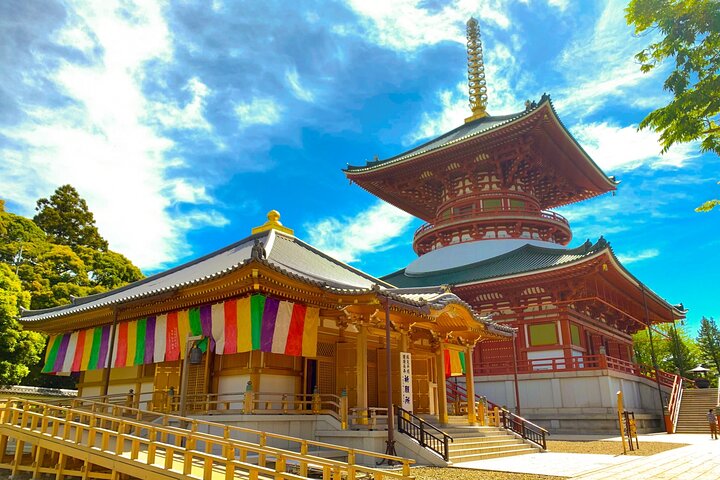
Narita, in Chiba Prefecture east of Tokyo, is a temple town beside the airport, known for the Shinshoji temple and its eel restaurants.
Narita is best known abroad for its international airport, but the town grew around the Naritasan Shinshoji temple, founded in 940, which draws pilgrims in large numbers. A complex of halls, a three-storey pagoda and gardens climbs a wooded hill. The approach from the station, Omotesando, is a street of old wooden shops and restaurants selling eel, pickles and sweets.
Special offers in Narita
Was/now prices come from the operator, never from us.



Similar experiences
![7 Day Private Tokyo to Osaka Japan Tour]()
7 Day Private Tokyo to Osaka Japan Tour
from$8,214