Fukuoka 8 hour Private Tour with Licensed Guide and Vehicle
- 8 hours
- Free cancellation up to 24h before
- 2 languages
- Instant confirmation
Highlights
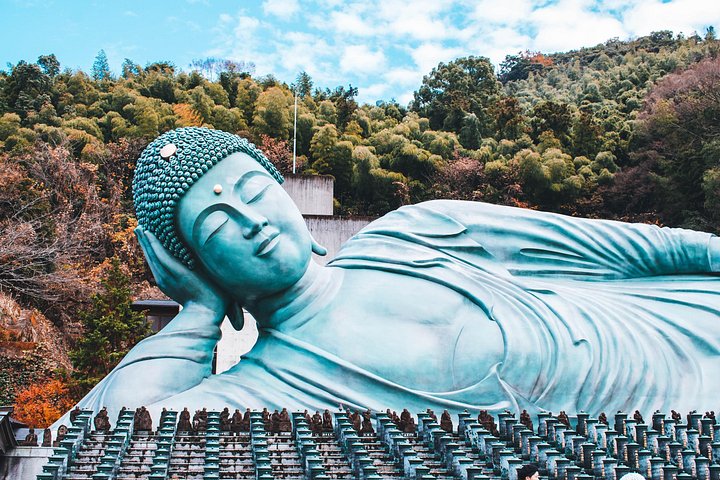
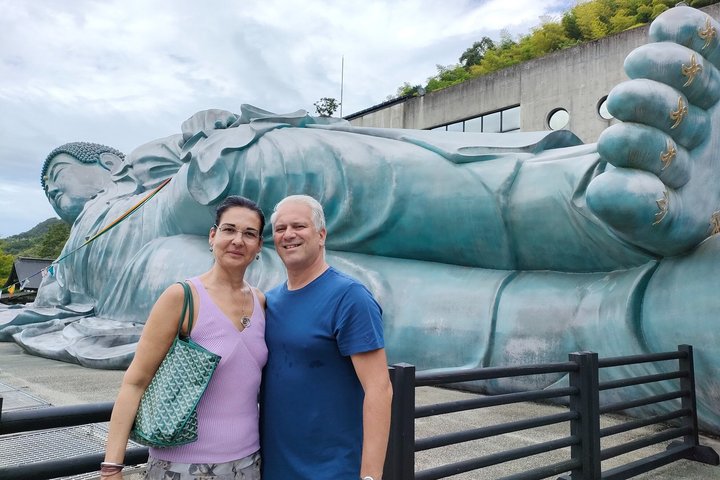
Welcome to Fukuoka, the vibrant gateway to Kyushu and one of Japan's most liveable and delicious cities! Famous for its Hakata ramen, bustling yatai food stalls and warm local hospitality, Fukuoka blends modern energy with deep history. Explore the stone walls of Fukuoka Castle, stroll the peaceful waterside of Ohori Park, and pay your respects at the magnificent Dazaifu Tenmangu, the shrine of learning surrounded by plum trees. With a private vehicle and your own government-licensed guide, you can also reach iconic spots like the giant reclining Buddha of Nanzoin and the riverside shrines of old Hakata at your own pace. Once your reservation is made, a guide will contact you to plan your personalized tour. Choose 3 to 4 spots from 'Tour Details' to visit. Don't know where to go? Ask the guide to send you their recommendations. We hope to guide you soon! Maximum 7 participants per tour. If you have a child or children in your group, please let us know the number and their age.
Inclusions
What's included
- Private vehicle
- Customizable Tour of your choice of 3-4 sites from 'What to expect' list'
- Licensed Local English Speaking Guide
What's not
- You cannot combine multiple tour groups.
- Entrance fees, Lunch, and Other personal expenses
- Guide Entry fees are only covered for sights listed under Itinerary
Itinerary
The castle was once a flourishing place during the Edo period (early 1600) but today, it is mainly the ruins of stone walls, moat and gates. However, the panoramic view of Fukuoka city from Fukusaki Hill is pretty amazing. The best time to visit in order to admire the full beauty of the castle ruins is during the Sakura Festival.
One of the oldest such sites on Kyushu, the Sumiyoshi-jinja Shrine is, like its counterpart in Osaka, dedicated to the protective divinities of seafarers, the last of a series of such shrines sailors would visit before heading out to sea. Particularly impressive is the Main Hall, rebuilt in its current classical style in 1623, along with a number of important national treasures, most notably an ancient sword and a copper axe, along with old manuscripts and documents dating back to the Middle Ages. From the shrine, which is surrounded by a large grove of Japanese cedars and camphor trees, are fine views over the River Naka. Be sure to allow plenty of time to also explore the adjacent Sumiyoshi Park.
Opened in 2005, Kyūshū National Museum (Kyūshū Kokuritsu Hakubutsukan) made headlines not only for its award-winning architectural design, but also as Japan's first new national museum in more than 100 years. Built to house a large publicly owned collection of art and historically important artifacts related to the island's rich history, this state-of-the-art facility can easily occupy visitors for the best part of a day. Highlights include displays of prehistoric relics found in numerous archaeological digs, as well as exhibits tracing the long history of the island's importance as a trading link between Japan and nearby China and Korea.
One of Japan's best known (and Fukuoka's oldest) Shinto shrines, Kushida-jinja was founded in AD 757 and contains many unique features, including exquisite carvings of the Chinese zodiac and a gingko tree said to be more than 1,000 years old. The shrine is also famous for hosting the Hakata Gion Yamakasa each July, a spectacular two-week festival focusing on prayers for good health and prosperity that includes an elaborate race involving teams carrying heavy wooden floats from the temple to various locations around the city.
Tochoji Temple(南岐山 東長寺)is the head temple of Shingon Buddhism Kyushu sect is given the special name Nangakuzan. It is dedicated to a famous monk called Kobo-Daishi (Kukai 空海). This is one of the oldest temples in Japan that Kobo-Daishi set up.
Fukuoka's open air food stands (屋台, Yatai) are possibly the city's best known symbol. Yatai can generally seat about seven or eight people and provide an atmospheric outdoor environment to enjoy various foods that are generally simple and filling. There are dozens of yatai scattered across Fukuoka, but the best place to find them is on the southern end of Nakasu Island. Located in the middle of the city, Nakasu Island has a long row of around 20 yatai that are attractively situated along the water. Please note that yatai usually open in the early evening.
Uminonakamichi Seaside Park (海の中道海濱公園, Uminonakamichi Kaihin Kōen), is a sprawling, family oriented public park located on a narrow peninsula across the bay from central Fukuoka. The park is made up of several different areas including flower gardens, playgrounds, an amusement park with ferris wheel, sports fields, a water park, a zoo and large open spaces and lawns perfect for picnicking.
Ohori Park (大濠公園, Ōhori-kōen) is a pleasant city park in central Fukuoka with a large pond at its center. There is a walking path around the circumference of the pond that is just a little over two kilometers long and is popular for jogging, walking pets and leisurely strolls by the water. Ohori is Japanese for moat, and the pond at the center of the park once served as part of the moat system of the neighboring Fukuoka Castle. The park was constructed between 1926 and 1929 and designed after the classical garden style of the West Lake in China. There are three islands in the middle of the pond that are connected to the mainland and each other by elegant stone bridges.
Shofukuji (聖福寺, Shōfukuji) has the distinction of being the first Zen temple constructed in Japan. It was founded in 1195 by the priest Eisai, who introduced the Rinzai sect of Zen Buddhism from China into Japan. Although the temple buildings cannot be entered, visitors can walk through Shofukuji's attractive temple grounds and observe the buildings from outside. Before Zen's introduction to Japan, Buddhism has already had a long history in Japan dating back to the 500s. The new teachings of Zen, which Eisai amassed during his travels in China, promoted meditation and discipline as the means to enlightenment and became very popular with the samurai class, which was exerting political power through the shogunate government based in Kamakura.
Seaside Momochi (シーサイドももち, Shīsaido Momochi) is Fukuoka's modern waterfront located on reclaimed land along Hakata Bay. The area was originally developed as the site of the 1989 Asia Pacific Expo and was designed with attractive, modern features such as wide, tree lined streets, futuristic buildings, public parks and no phone or electricity lines above ground.
Canal City Hakata (キャナルシティ博多) is a large shopping and entertainment complex, calling itself a "city within the city". Attractions include about 250 shops, cafes and restaurants, a theater, game center, cinemas, two hotels and a canal running through the complex. Visitors, who are planning on shopping, will likely be able to find something of interest in one of Canal City's many stores, whether it be in a shop unique to Japan or a branch of an international company. There is also a wide variety of restaurants, offering Japanese and international food, that generally have reasonably priced menus. The fifth floor consists of the "Ramen Stadium", which has eight ramen shops with noodle dishes from across Japan, including the local specialty Hakata Ramen.
Hakozaki Shrine is known for being one of the most important shrines in this part of Japan. The original was destroyed when it was set on fire during the Mongolian invasion of Fukuoka in 1274 but it was then rebuilt and has been standing in this spot ever since. Some of the sights to look out for here include a stone anchor that would have been used by Mongolian ships and a statue of Nichiren, a prominent Buddhist scholar in Fukuoka who foresaw the Mongolian invasion.
Cancellation
Free cancellation up to 24 hours before the experience starts, for a full refund.
Know before you go
- Pickup
- Pickup is included for everyone.
- Ticket type
- Mobile or paper ticket accepted
- Operated by
- Japan Guide Agency
- Specialized infant seats are available
- Service animals allowed
- Public transportation options are available nearby
- Infants and small children can ride in a pram or stroller
- All areas and surfaces are wheelchair accessible
- Transportation options are wheelchair accessible
- Wheelchair accessible
- Suitable for all physical fitness levels
How it compares in Fukuoka
- Its from-price is 287% above the median of the 156 day trips we list in Fukuoka.
- Its length is typical for the group.
- The operator lists free cancellation on it.
About Fukuoka
Fukuoka, on the north coast of Kyushu, is a relaxed port city of temples, riverside food stalls and ramen, facing Korea across the sea.
Fukuoka is the biggest city on Kyushu, formed from two old towns, the merchant port of Hakata and the castle town of Fukuoka, on either side of the Naka River. Hakata keeps temples such as Tochoji, with a large wooden seated Buddha, and Shofukuji, said to be Japan's first Zen temple, founded in 1195. The ruins of Fukuoka Castle lie beside Ohori Park, with its large lake and walkways.
Top-ranked sights in Fukuoka: Ohori Park, Kushida Shrine, Dazaifu Tenmangu.
Special offers in Fukuoka
Was/now prices come from the operator, never from us.
 7% offFree cancellation
Similar experiences
 Likely to sell outFree cancellation