Day Tour to Aswan from Luxor by Private Car
- 12 hours
- Free cancellation up to 24h before
- 6 languages
- Instant confirmation
Highlights
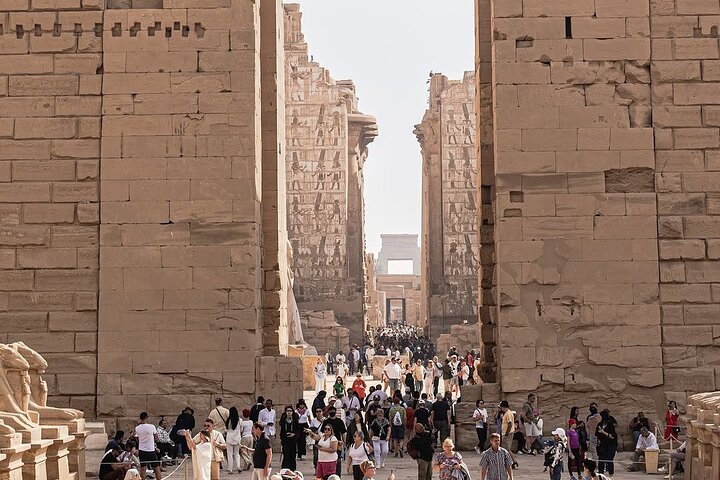
Embark on a captivating day tour from Luxor to Aswan by private car, with a stop at the unique Kom Ombo Temple along the way. Witness the mesmerizing landscapes of Egypt as you journey to Aswan, a city rich in historical significance. Explore the dual sanctuary of Kom Ombo Temple, dedicated to both the crocodile god Sobek and the falcon god Horus. Marvel at its intricate reliefs and architecture that tell ancient tales. Continue your adventure to Aswan, where you'll visit iconic sites like the High Dam, the Unfinished Obelisk, and the magnificent Philae Temple.
Inclusions
What's included
- Lunch at local restaurants (Local Egyptian Food)
- Tour guide
- Hotel pickup and drop-off
- Entry fees
- All Transfers by Private A/C Vehicles Newest Model
- Bottle of water
What's not
- Personal Items
- Tipping
Itinerary
At 6:00 am Pickup from your Hotel or Nile Cruise in Luxor by Licensed Tour guide then you will be transferred by Private A/C Vehicle to Start your tour Around 15:00 pm Transfer you Back to your Hotel in Luxor or in Aswan if Our Customer intends to stay at Aswan instead of Returning back to Luxor
Philae (/ˈfaɪli/; Greek: Φιλαί, Arabic: فيله Egyptian Arabic: [fiːlæ], Egyptian: p3-jw-rķ' or 'pA-jw-rq; Coptic: ⲡⲓⲗⲁⲕ, ⲡⲓⲗⲁⲕⲭ[1]) is an island in the reservoir of the Aswan Low Dam, downstream of the Aswan Dam and Lake Nasser, Egypt. Philae was originally located near the expansive First Cataract of the Nile in Upper Egypt and was the site of an Egyptian temple complex. These rapids and the surrounding area have been variously flooded since the initial construction of the Aswan Low Dam in 1902.[2] The temple complex was dismantled and moved to nearby Agilkia Island as part of the UNESCO Nubia Campaign project, protecting this and other complexes before the 1970 completion of the Aswan High Dam.[3] The hieroglyphic reliefs of the temple complex are being studied and published by the Philae Temple Text Project of the Austrian Academy of Sciences, Vienna (Institute OREA).
The Aswan Dam, or more specifically since the 1960s, the Aswan High Dam, is an embankment dam built across the Nile in Aswan, Egypt, between 1960 and 1970. Its significance largely eclipsed the previous Aswan Low Dam initially completed in 1902 downstream. Based on the success of the Low Dam, then at its maximum utilization, construction of the High Dam became a key objective of the government following the Egyptian Revolution of 1952; with its ability to better control flooding, provide increased water storage for irrigation and generate hydroelectricity the dam was seen as pivotal to Egypt's planned industrialization. Like the earlier implementation, the High Dam has had a significant effect on the economy and culture of Egypt.
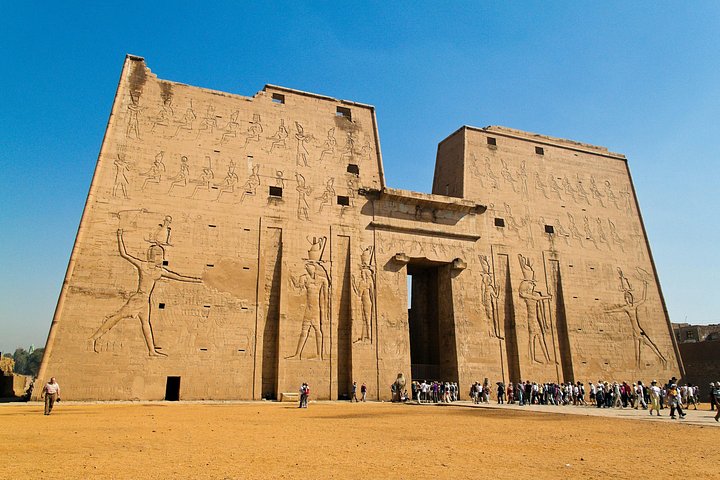
The Temple of Edfu is an Egyptian temple located on the west bank of the Nile in Edfu, Upper Egypt. The city was known in the Hellenistic period as Koinē Greek: Ἀπόλλωνος πόλις and Latin Apollonopolis Magna, after the chief god Horus, who was identified as Apollo under the interpretatio graeca. It is one of the best preserved shrines in Egypt. The temple was built in the Ptolemaic Kingdom between 237 and 57 BC. The inscriptions on its walls provide important information on language, myth and religion during the Hellenistic period in Egypt. In particular, the Temple's inscribed building texts "provide details [both] of its construction, and also preserve information about the mythical interpretation of this and all other temples as the Island of Creation." There are also "important scenes and inscriptions of the Sacred Drama which related the age-old conflict between Horus and Seth." They are translated by the German Edfu-Project.
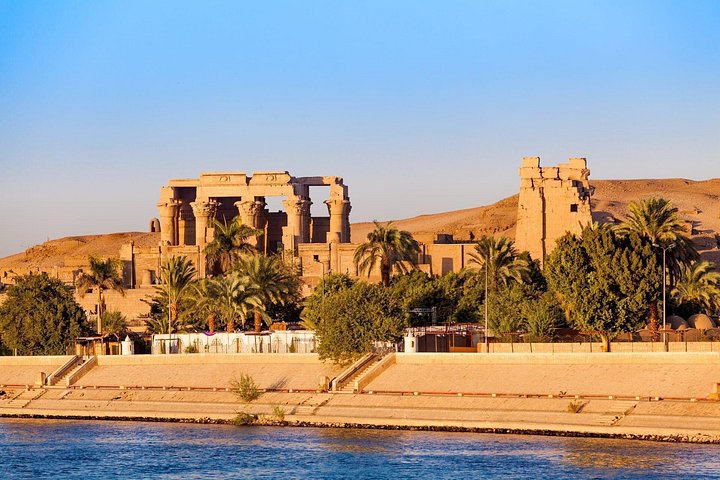
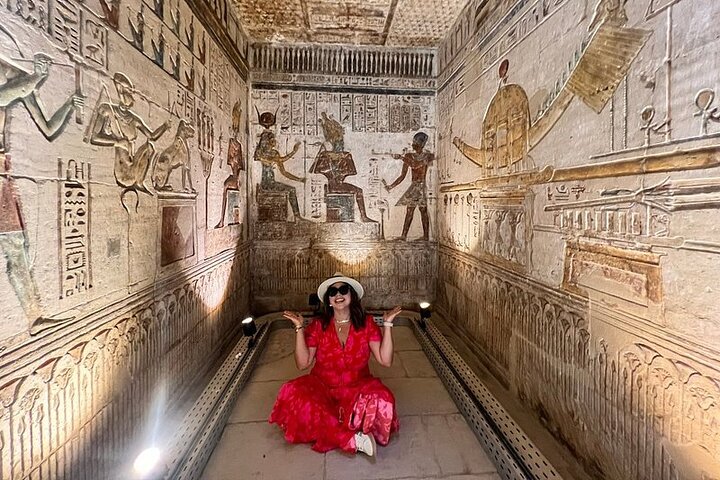
The Temple of Kom Ombo is an unusual double temple in the town of Kom Ombo in Aswan Governorate, Upper Egypt. It was constructed during the Ptolemaic dynasty, 180–47 BC.Some additions to it were later made during the Roman period. The building is unique because its 'double' design meant that there were courts, halls, sanctuaries and rooms duplicated for two sets of gods.The southern half of the temple was dedicated to the crocodile god Sobek, god of fertility and creator of the world with Hathor and Khonsu. Meanwhile, the northern part of the temple was dedicated to the falcon god Haroeris ("Horus the Elder"), along "with Tasenetnofret (the Good Sister, a special form of Hathor or Tefnet/Tefnut and Panebtawy (Lord of the Two Lands)." The temple is atypical because everything is perfectly symmetrical along the main axis. The texts and reliefs in the temple refer to cultic liturgies which were similar to those from that time period.
Cancellation
Free cancellation up to 24 hours before the experience starts, for a full refund.
Reviews
4.6
- 518
- 43
- 32
- 21
- 10
Ratings come from 24 reviews collected by our booking partner. They are travellers' own words, in the order they were written — never reordered to flatter the experience.
Know before you go
- Meeting point
- Luxor
- Pickup
- Pickup is offered, or you can meet at the starting point.
- Ticket type
- Mobile or paper ticket accepted
- Operated by
- Emo Tours Egypt
- Public transportation options are available nearby
- Specialized infant seats are available
- Not recommended for travelers with spinal injuries
- Not recommended for pregnant travelers
- Not recommended for travelers with poor cardiovascular health
- Suitable for all physical fitness levels
- Entrance fees -Depending on the Tour Options Chosen
How it compares in Luxor
- Its from-price is 60% above the median of the 501 day trips we list in Luxor.
- It is longer than most of them.
- By number of reviews it ranks 39 of 501.
- The operator lists free cancellation on it.
About Luxor
Luxor stands on the site of ancient Thebes, with vast temples on the Nile's east bank and the royal tombs of the Valley of the Kings across the river.
On the east bank, the Karnak temple complex spreads across acres of pylons, obelisks and the forest of columns in its Great Hypostyle Hall. An avenue of sphinxes links it to Luxor Temple in the town centre, which is especially atmospheric when lit up in the evening. The Luxor Museum and the Mummification Museum sit along the riverside corniche.
Top-ranked sights in Luxor: Valley of the Kings, Temple of Hatshepsut (at Deir el-Bahari), Colossi of Memnon.
Special offers in Luxor
Was/now prices come from the operator, never from us.