Yokohama & Kamakura in 1 Day Tour with Licensed Local Guide
- 6 hours
- Free cancellation up to 24h before
- 2 languages
- Instant confirmation
Highlights
Enjoy an efficient, one-day walking tour of Yokohama or Kamakura accompanied by a government-licensed and experienced English-speaking guide! For options to experience both modern and traditional sides of Japan outside of Tokyo, the cities of Yokohama and Kamakura are great. Let us know which city you would like to experience and we will customize a six-hour tour that's best for you! Note*1: You cannot visit all the sites on the itinerary. You will be able to visit about 3 sites, with a maximum of 4, in the time provided. Note*2: The National Government Licensed Guide Interpreter certification is issued by the Japanese government requires a good knowledge and understanding of Japanese culture and history.
Inclusions
What's included
- Meet up with guide on foot within designated area of Yokohama/Kamakura
- Customizable Tour of your choice of 3-4 sites from 'Itinerary' list
- Licensed Local English Speaking Guide
What's not
- Transportation fees, Entrance fees, Lunch, and Other personal expenses
- Private transportation
- You cannot combine multiple tour groups.
- Guide Entry fees are only covered for sights listed under What to Expect.
Itinerary
The shrine is dedicated to Hachiman, the patron god of the Minamoto family and of the samurai in general. The deified spirits of the ancient Emperor Ojin who has been identified with Hachiman, Hime-gami and Empress Jingu are enshrined at Tsurugaoka Hachimangu Shrine.
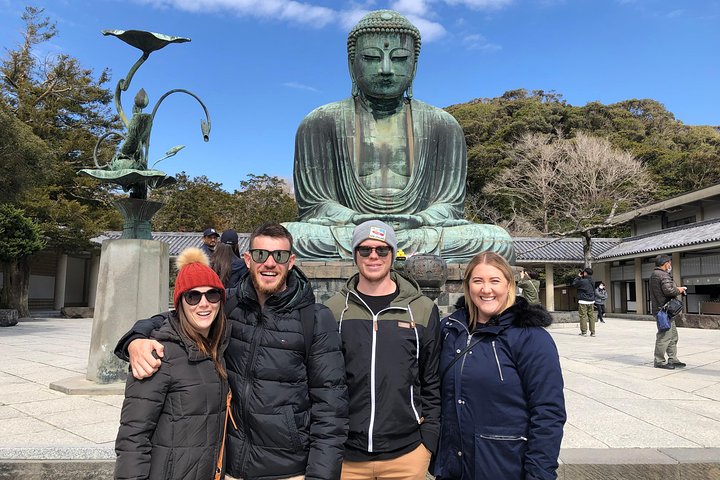
The Great Buddha of Kamakura (鎌倉大仏, Kamakura Daibutsu) is a bronze statue of Amida Buddha, which stands on the grounds of Kotokuin Temple. With a height of 11.4 meters, it has long been the second tallest bronze Buddha statue in Japan, surpassed only by the statue in Nara's Todaiji Temple and some recent creations.
Hasedera (長谷寺) is a temple of the Jodo sect, famous for its eleven-headed statue of Kannon, the goddess of mercy. The 9.18 meter tall, gilded wooden statue is regarded as one of the largest wooden sculpture in Japan and can be viewed in the temple's main building, the Kannon-do Hall
Hokokuji Temple is best known for the beautiful, small bamboo grove found behind the temple's main hall, which lies thick with over 2000 dark green bamboo stalks. A few narrow pathways lead through the bamboo to a tea house where, for a small fee, you can sit and enjoy a cup of matcha tea while enjoying views into the bamboo grove. Also located behind the temple are a series of shallow caves carved into the hillsides, which are believed to hold the ashes of some of the later Ashikaga lords.
Only a short train ride west of Kamakura, Enoshima (江の島) is a pleasantly touristy island just off the coast but connected by bridge with the mainland. The island offers a variety of attractions, including a shrine, park, observation tower and caves. Views of Mount Fuji can be enjoyed on days with good visibility. Enoshima is divided into a yacht harbor accessible to motorized traffic and a forested hill which can only be explored on foot (and paid escalators) and contains most of the sights. Several shrine buildings, collectively known as Enoshima Shrine, are found around the island and are dedicated to Benten, a popular goddess of good fortune, wealth, music and knowledge. Benten is believed to have created Enoshima before subduing a five headed dragon that had been terrorizing the area.
ngakuji (円覚寺) is one of the leading Zen temples in Eastern Japan and the number two of Kamakura's five great Zen temples. Engakuji was founded by the ruling regent Hojo Tokimune in the year 1282, one year after the second invasion attempt by the Mongols had been reverted. One purpose of the new temple was to pay respect to the fallen Japanese and Mongolian soldiers. Engakuji is built into the slopes of Kita-Kamakura's forested hills. The first main structure encountered upon entering the temple grounds is the Sanmon main gate, which dates from 1783. Behind it stands the temple's main hall, the Butsuden, which displays a wooden statue of the Shaka Buddha. The Butsuden was rebuilt relatively recently in 1964 after the former building was lost in an earthquake.
Kenchoji (建長寺, Kenchōji) is the number one of Kamakura's five great Zen temples. The oldest Zen temple in Kamakura, Kenchoji was founded by the ruling regent Hojo Tokiyori in 1253 during the Kencho Era after which it was named. Its first head priest was Rankei Doryu, a Zen priest from China. Although considerably smaller than during its heydays, Kenchoji still consists of a large number of temple buildings and subtemples, and stretches from the entrance gate at the bottom of the valley far into the forested hills behind. After passing through the Sanmon main gate, visitors will see Kenchoji's temple bell (Bonsho), designated a national treasure, on their right.
Zeniarai Benten Shrine (銭洗弁天) is a popular shrine in western Kamakura, which people visit to wash their money (zeniarai means "coin washing"). It is said that money washed in the shrine's spring, will double. Minamoto Yoritomo, the founder of the Kamakura government, ordered the shrine's construction after a god appeared in his dream and recommended him to build the shrine in order to bring peace to the country. Because the dream occurred on the day of the snake, in the month of the snake of the year of the snake, the shrine was later also dedicated to Benten, a Buddhist goddess associated with snakes.
Meigetsuin Temple (明月院) is a temple of the Rinzai Zen Sect founded in 1160 in Kamakura. It is also known as Ajisaidera ("Hydrangea Temple") because hydrangea bloom in abundance on the temple grounds during the rainy season around June. 95% of the hydrangea here are of the Hime Ajisai ("Princess Hydrangea") variety; they are thus named because of their pretty blue colors. The temple was originally a repose built by a son in memory of his father who had died in the struggle for power between the Taira and Minamoto clans in the late Heian Period. It later became part of a larger temple complex called Zenkoji, which was abolished during anti-Buddhist movements soon after the Meiji Restoration, leaving only Meigetsuin to remain as an individual temple today.
Ankokuronji (安国論寺) is one of several temples of the Nichiren sect of Japanese Buddhism along the hills in the southeast of Kamakura. Nichiren himself founded Ankokuronji around 1253 when he first came to Kamakura, and he is said to have lived at the temple for several years. Visitors can walk along a short hiking trail through the wooded hills around the temple buildings. A nice view of the city of Kamakura can be enjoyed underway. Some of the trail's passages are quite steep and should only be explored with good walking shoes and during dry weather.
Jomyoji Temple (浄妙寺, Jōmyōji) is a Zen temple in the hills of eastern Kamakura. Ranked fifth among the five great Zen temples of Kamakura, Jomyoji was founded by the influential Ashikaga family and at its peak was made up of seven buildings and several pagodas. Over the centuries, however, many of the structures were destroyed by fire, and only its historic main hall, reception hall, main gate and warehouse remain today. The main hall sits at the end of a garden and houses a statue of Shaka Nyorai, the historical Buddha. Jomyoji Temple also has a restored teahouse where visitors can sit and enjoy a cup of tea for a small fee while enjoying the view of a nice dry garden. On the hillside behind the main hall is the temple's spacious cemetery, while a path leads up the hill to a small western-style restaurant. The restaurant is operated by the temple and offers good views out over Kamakura from its patio.
Zuisenji (瑞泉寺) is a beautiful Zen temple in the far east of Kamakura, in the back of a narrow valley and surrounded by wooded hills. It is a branch temple of the Engakuji Temple. Zuisenji was founded by Muso Kokushi, a leading Zen master of his time and one of Japan's most famous garden designers. The temple is known for its pure Zen rock garden behind the temple's main hall, designed by Muso himself. The temple furthermore attracts with its many flowers and blooming trees in the other parts of the temple grounds, including a large number of plum trees.
Cancellation
Free cancellation up to 24 hours before the experience starts, for a full refund.
Reviews
4.8
- 527
- 42
- 30
- 20
- 11
Ratings come from 30 reviews collected by our booking partner. They are travellers' own words, in the order they were written — never reordered to flatter the experience.
Showing reviews written in English.
5Awesome local guide tour from Yokohama Japan, outside of Tokyo
I booked a tour with Takako, a local guide with JGA. It was incredible and beyond expectation! She took us to see the giant Buddha, Hasedera Temple, Hokokuji Temple including a small bamboo forest, and a visit of Kamakura. She met us at the cruise terminal and guided us through multiple trains so that we could complete everything and get back to the ship within six hours. We had local snacks including candies and fish cakes on a stick cooked over a grill. We finished with a local beer from Yokohama at the terminal. We could have never managed this on our own. She was kind and knowledgeable and awesome! Thank you so much Takako for this very special experience and sharing your country with us.
5Wonderful tour of Kamakura
Our guide Masa did a wonderful job of showing us all of the sights in and around Kamakura. We also enjoyed a delicious lunch with him there. He also gave us important information about using the public transportation. And he gave excellent suggestions for seeing sights in Yokohama after our tour of Kamakura ended.
5Japan Guide Agency 6 hour tour of kamakura and Yokohama
This was a great tour. Our guide Shinji from Japan Guide Agency was very professional, friendly and knew where to take us. We took the train, subway and walked at a pace that suited us.
5The Natural Beauty of Kamakura
Our guide, Sam, was very knowledgeable about the are and guided us to several temples using public transportation. We stopped for a traditional Japanese lunch and saw some of the specialty wood carvings from the area. Our guide enjoyed the beauty of nature and his enthusiasm helped us to pay attention to the natural beauty as well.
5Awesome day at Kamakura
. It’s our first time in Japan and our first stop was Yokohama. Yoshi our guide to Kamakura was 30 mins early and speaks great English. He is very knowledgeable, first we learned how to navigate the public transportation train system. Next we learned everything about the countries religions , traveled 2 Buddhist temples and 3 shrines. We walked several miles and learned about everything along the way. our guide to Kamakura was 30 mins early and speaks great English. He is very knowledgeable, first we learned how to navigate the public transportation train system. Next we learned everything about the countries religions , traveled 2 Buddhist temples and 3 shrines. We walked several miles and learned about everything along the way.
5Grateful for our Beautiful day
Mami was a great guide, and so kind to meet us right at hotel, get us taxi, IC card, + trains. She catered tour to what we wanted to see personally, and shared history, Japanese culture, and beliefs, stories that helped us greatly appreciate Enoshima, Kamakura, and Japan.
Know before you go
- Pickup
- Pickup is included for everyone.
- Ticket type
- Mobile or paper ticket accepted
- Operated by
- Japan Guide Agency
- Service animals allowed
- Public transportation options are available nearby
- Infants and small children can ride in a pram or stroller
- All areas and surfaces are wheelchair accessible
- Transportation options are wheelchair accessible
- Wheelchair accessible
- Suitable for all physical fitness levels
- Travel time between Yokohama and Kamakura is about 30 minutes one way.
How it compares in Yokohama
- Its from-price is close to the median of the 46 city tours we list in Yokohama.
- Its length is typical for the group.
- By number of reviews it ranks 7 of 46.
- The operator lists free cancellation on it.
About Yokohama
Yokohama is Japan's second-largest city, a port south of Tokyo with a modern waterfront, the country's biggest Chinatown and hillside foreign quarters.
Yokohama grew from a fishing village into a treaty port after 1859, and its harbour still defines the city. Minato Mirai 21, the waterfront district, has the Landmark Tower, a Ferris wheel and a promenade with views over the bay. The Red Brick Warehouse buildings are now shops and event halls, and Yamashita Park runs along the water beside the Hikawa Maru, a retired ocean liner.
Special offers in Yokohama
Was/now prices come from the operator, never from us.