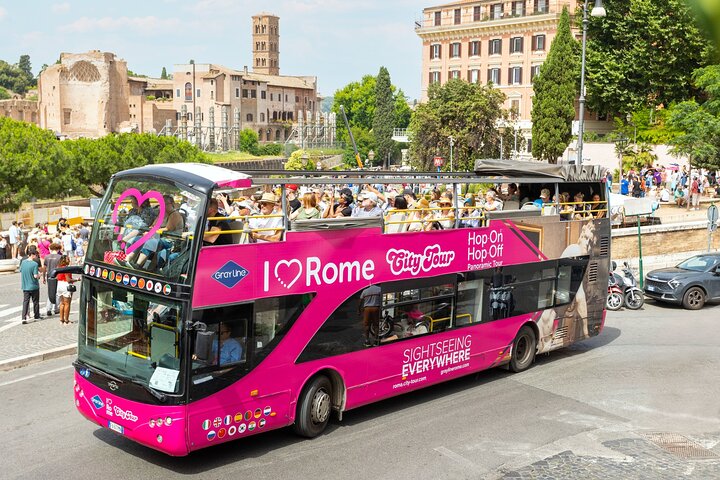
Rome Colosseum, Ancient Rome Exclusive Private Tour & Entry Pass
- 3h 10m
- Skip the line
- 7 languages
- Private tour
Highlights
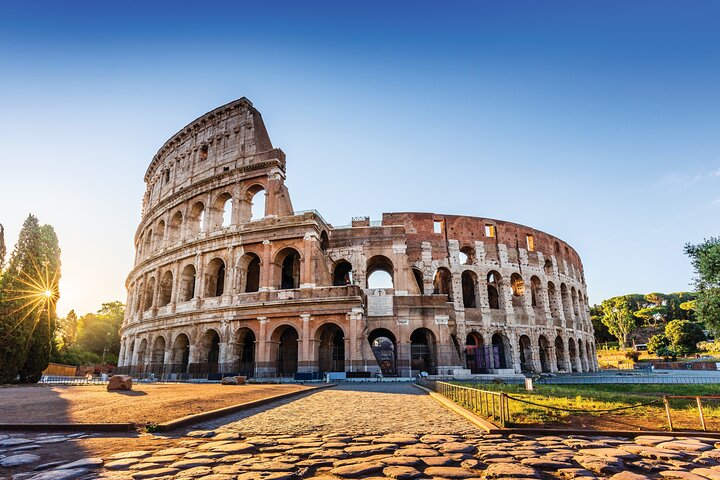
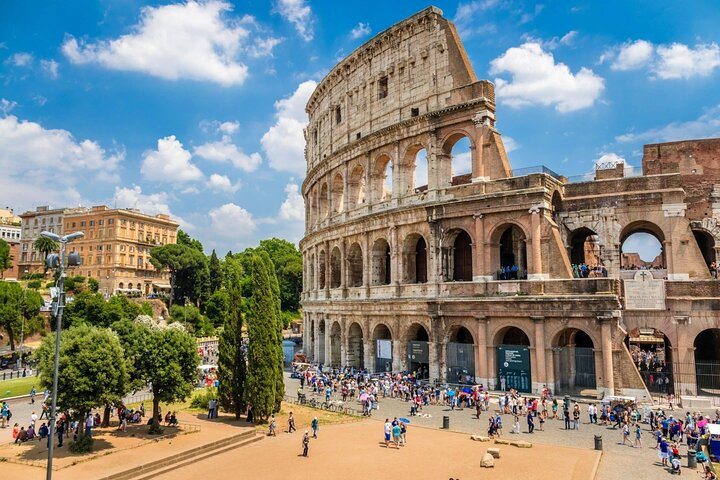
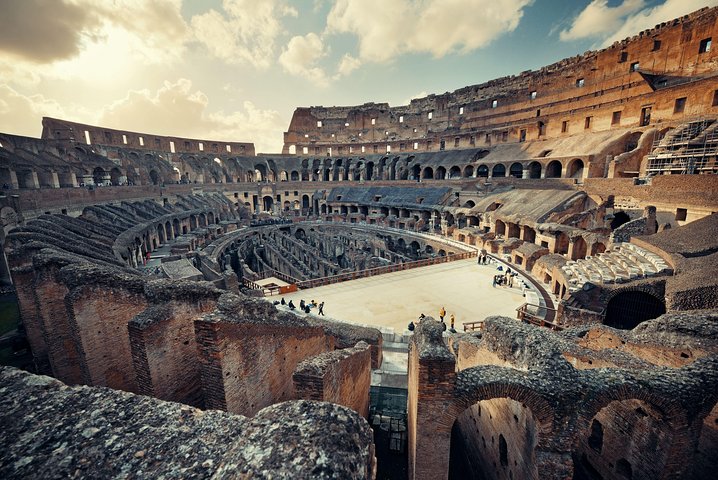
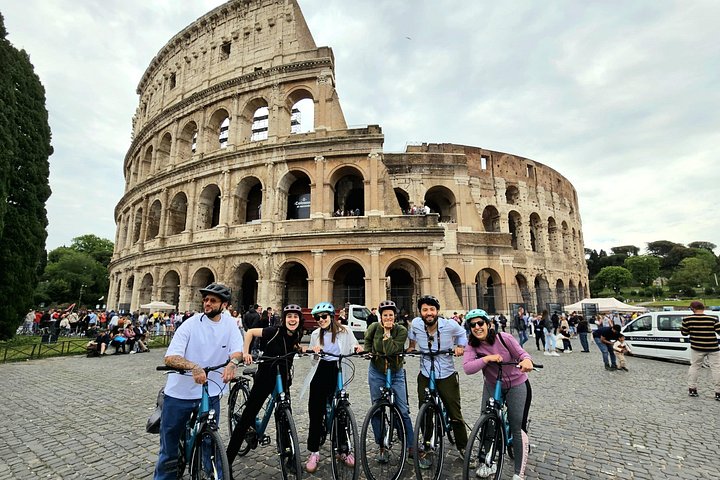
Enjoy our unique private guided 3-hour Tour of the Colosseum, Palatine Hill, and Roman Forum in Rome. Save time waiting in ticket lines with this tour that includes Colosseum admission. Visit the Colosseum and wander the fulcrum of ancient Rome at your leisure while listening to stories told by your expert tour guide about the gladiators, wild beasts, and sea battles that entertained up to 60,000 spectators. Explore the first and second tiers for great views. Then walk through the ruins of Palatine Hill and the Roman Forum with your guide, an art and archaeology expert. With this tour, you can maximize your time enjoying this excellent experience. The tour is suitable for families with kids, small groups, and couples.
Inclusions
What's included
- Official Professional Licensed Local Blue Badge Tour Guide
- Colosseum entrance ticket (valued at €18 per person)
- Colosseum reservation fee (valued at €2 per person)
- Assistance on site and from the office
- 3-hrs Colosseum, Roman Forum and Palatine Hill private tour
- Please note: Colosseum fees as above. The remaining cost of the experience covers other services.
What's not
- Food and drinks
- Gratuities
- Hotel pickup
- Hotel drop-off
Itinerary
Visit Rome's symbolic monument In the comfort of a private group (your party size), that makes it easy and fun for all ages. Explore the first and second tiers for great views. Learn about the amphitheater's history from a guide with an art and archaeology background.
Walk through Palatine Hill, explore the site of an older settlement from the 9th century BC. Admire the first settlements of the city of Rome and the Hippodrome, an elliptical sunken garden from the Palace of Domitian. Here, enjoy an impressive view of the Circus Maximus and the valley of the Roman Forum. Learn about the legend of Romulus and Remus, the abandoned brothers raised by a wolf who fought each other for power and control.
You will then, visit the Roman Forum. This is one of the most important archaeological areas in the world with some of Ancient Rome's most evocative ruins, including the Temple of Julius Caesar, Arch of Titus, House of the Vestal Virgins, Senate House and Basilica of Maxentius. Admire the Roman Forum's Sacred Way, the triumphal road where the Centurions of Caesar marched after their return from countless battles and conquests.
The Arch of Constantine (Italian: Arco di Costantino) is a triumphal arch in Rome dedicated to the emperor Constantine the Great. The arch was commissioned by the Roman Senate to commemorate Constantine's victory over Maxentius at the Battle of Milvian Bridge in AD 312. Situated between the Colosseum and the Palatine Hill, the arch spans the Via triumphalis, the route taken by victorious military leaders when they entered the city in a triumphal procession. [a] Dedicated in 315, it is the largest Roman triumphal arch, with overall dimensions of[1] 21 m (69 ft) high, 25.9 m (85 ft) wide and 7.4 m (24 ft) deep. It has three bays, the central one being 11.5 m (38 ft) high and 6.5 m (21 ft) wide and the laterals 7.4 m (24 ft) by 3.4 m (11 ft) each.
The Arch of Titus (Italian: Arco di Tito; Latin: Arcus Titi) is a 1st-century AD honorific arch,[1] located on the Via Sacra, Rome, just to the south-east of the Roman Forum. It was constructed in c. 81 AD by Emperor Domitian shortly after the death of his older brother Titus to commemorate Titus's official deification or consecration and the victory of Titus together with their father, Vespasian, over the Jewish rebellion in Judaea.[2] The arch contains panels depicting the triumphal procession celebrated in 71 AD after the Roman victory culminating in the fall of Jerusalem,[2] and provides one of the few contemporary depictions of artefacts of Herod's Temple.[citation needed] It became a symbol of the Jewish diaspora, and the menorah depicted on the arch served as the model for the menorah used as the emblem of the state of Israel.[3]
The Basilica of Maxentius and Constantine (Italian: Basilica di Massenzio), sometimes known as the Basilica Nova—meaning "new basilica"—or Basilica of Maxentius, is an ancient building in the Roman Forum, Rome, Italy. It was the largest building in the Forum, and the last Roman basilica built in the city.
The Temple of Venus and Roma (Latin: Templum Veneris et Romae) is thought to have been the largest temple in Ancient Rome. Located on the Velian Hill, between the eastern edge of the Forum Romanum and the Colosseum, in Rome, it was dedicated to the goddesses Venus Felix ("Venus the Bringer of Good Fortune") and Roma Aeterna ("Eternal Rome"). The building was the creation of the emperor Hadrian and construction began in 121. It was officially inaugurated by Hadrian in 135 and finished in 141 under Antoninus Pius. Damaged by fire in 307,[1] it was restored with alterations by the emperor Maxentius.
The Curia Julia (Latin: Curia Iulia, Italian: Curia Iulia) is the third named curia, or senate house, in the ancient city of Rome. It was built in 44 BC, when Julius Caesar replaced Faustus Cornelius Sulla's reconstructed Curia Cornelia, which itself had replaced the Curia Hostilia. Caesar did so to redesign both spaces within the Comitium and the Roman Forum. The alterations within the Comitium reduced the prominence of the Senate and cleared the original space. The work, however, was interrupted by Caesar's assassination at the Theatre of Pompey, where the Senate had been meeting temporarily while the work was completed. The Curia Julia is one of a handful of Roman structures that survive mostly intact. This is due to its conversion into the basilica of Sant'Adriano al Foro in the 7th century and several later restorations. However, the roof, the upper elevations of the sidewalls and the rear façade are modern and date from the remodelling of the deconsecrated church, in the 1930s.
The Capitolium or Capitoline Hill (/ˈkæpɪtəlaɪn, kəˈpɪt-/ KAP-it-ə-lyne, kə-PIT-;talian: Campidoglio [kampiˈdɔʎʎo]; Latin: Mons Capitolinus [ˈmõːs kapɪtoːˈliːnʊs]), between the Forum and the Campus Martius, is one of the Seven Hills of Rome. The hill was earlier known as Mons Saturnius, dedicated to the god Saturn.[citation needed] The word Capitolium first meant the temple of Jupiter Optimus Maximus later built here, and afterwards, it was used for the whole hill (and even other temples of Jupiter on other hills), thus Mons Capitolinus (the adjective-noun of Capitolium). In an etymological myth, ancient sources connect the name to caput ("head", "summit") and the tale was that when laying the foundations for the temple, the head of a man was found, some sources even saying it was the head of some Tolus or Olus. The Capitolium was regarded by the Romans as indestructible and was adopted as a symbol of eternity.
Cancellation
All sales are final. No refund is available for cancellations.
Reviews
4.7
- 510
- 41
- 30
- 21
- 10
Ratings come from 12 reviews collected by our booking partner. They are travellers' own words, in the order they were written — never reordered to flatter the experience.
Know before you go
- Meeting point
- The meeting point is at Via Labicana 96, our agency office (Tour in the City) The guide and the staff will be there waiting for you. The meeting time is 20 minutes before the selected time.
- Pickup
- Everyone meets at the starting point; there is no pickup.
- Tickets
- Tickets are redeemed at a different location from the meeting point.
- Ticket type
- Mobile or paper ticket accepted
- Operated by
- Tour In Rome by Tour in the City
- Public transportation options are available nearby
- Suitable for all physical fitness levels
- Customers have a mandatory meeting time stated 15 minutes prior to the scheduled departure time due to managing and organizational reasons.
- Please provide the full names of all travelers when booking. Failure to provide all travelers' full names at the ticket office prior to entry may result in denied entry to the Colosseum and Roman Forum.
- The order in which the sites are visited during the tour can vary depending on admission availability (the tour may start at the Palatine Hill and Roman Forum before the Colosseum)
- You must have a valid photo ID to enter the Colosseum (student's ID, Driver License, Passport or State ID all work.) You will be asked to also provide your name, last name and date of birth (at the beginning of the tour, if not provided beforehand.) Security will prevent you from entering the site if the information provided is not accurate and/or don't match the one on your ID.
- Discount for children can be applied only with a valid ID card
- Please note that for safety reasons the Coliseum can accommodate up to 3.000 people at once.This could lead to delays in access to the site, even for pre-booked visitors
How it compares in Rome
- Its from-price is 78% above the median of the 8352 experiences we list in Rome.
- Its length is typical for the group.
- By number of reviews it ranks 2172 of 8352.
About Rome
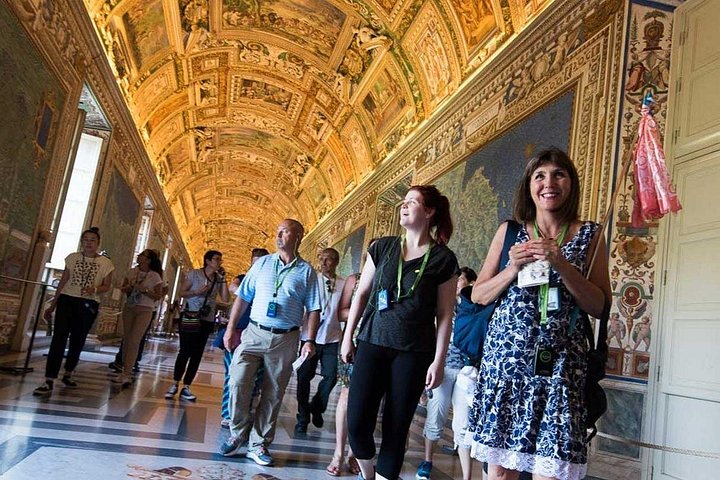
Rome layers nearly three thousand years of history into one walkable city, from the Colosseum and Forum to Baroque piazzas and Vatican art.
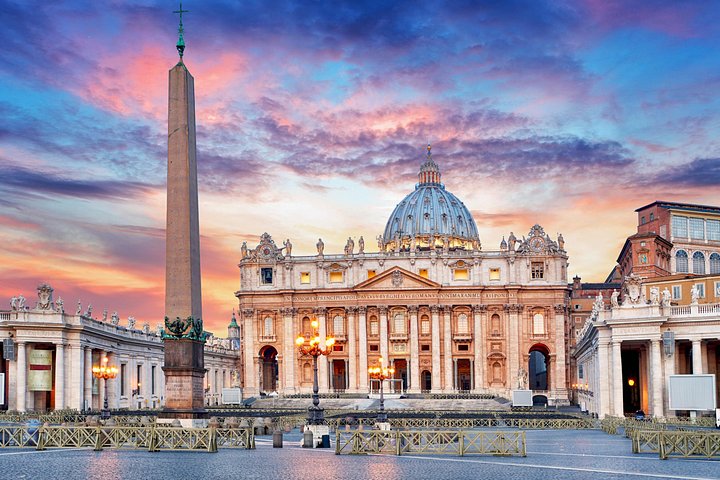
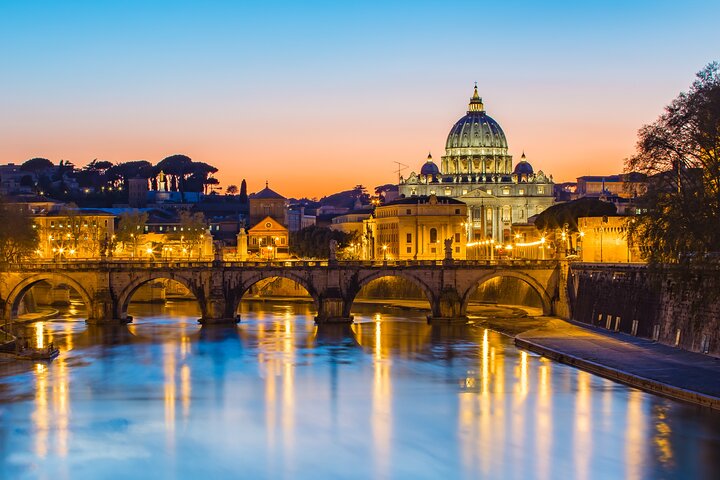
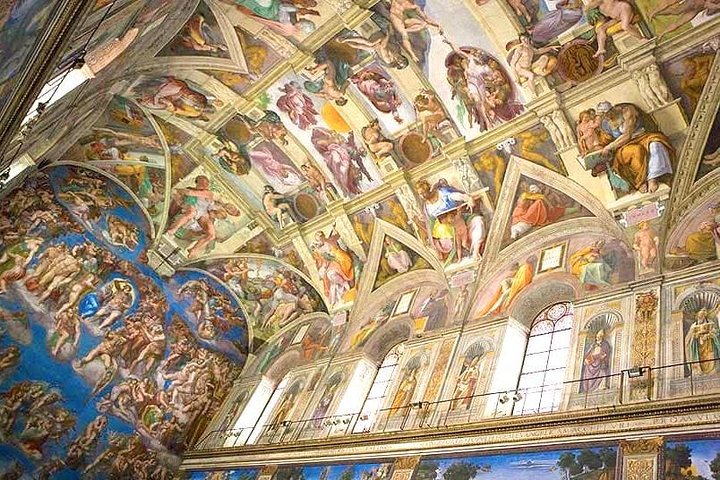
Ancient Rome is still in plain sight. The Colosseum, the Roman Forum and the Palatine Hill sit together at the city's heart, the Pantheon still stands with its open oculus, and fragments of temples and aqueducts turn up between apartment blocks. Across the Tiber, Vatican City holds St Peter's Basilica, the Vatican Museums and Michelangelo's Sistine Chapel ceiling.
Top-ranked sights in Rome: Colosseum, Vatican Museums, Sistine Chapel.
Special offers in Rome
Was/now prices come from the operator, never from us.
 Likely to sell out20% off
Similar experiences
 Free cancellationSkip the line
![Vatican Museums, Sistine Chapel and St. Peter's Basilica Tour]() Likely to sell outFree cancellation
![Skip-the-Line Vatican, Sistine Chapel & St. Peter's | Small Group]() Likely to sell outFree cancellation