Historic Charleston Walking & Storytelling Tour
- 2 hours
- Free cancellation up to 24h before
- Guided in English
- Instant confirmation
Highlights
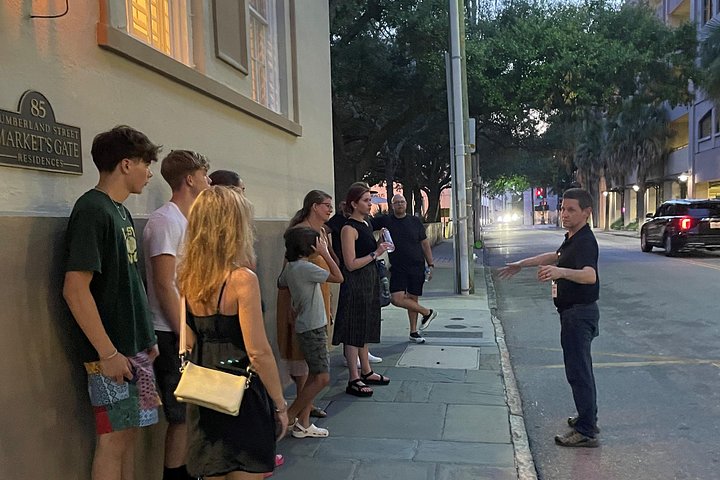
This tour is an exploration of Charleston that highlights the women and men who helped found Charleston and the United States. Did you know, without the pirates and patriots of Charleston, the United States may not exist today? We start our experience in front of the Old Exchange and Provost Dungeon, one of Charleston’s oldest and most historical buildings. Learn about George Washington’s visit in 1791, and the dungeon’s prisoners who met their fate. Next, we venture down East Bay Street, passing Rainbow Row. Behold gorgeous mansions, and witness breathtaking views of the Charleston Harbor and White Point Garden. Walk in the footsteps of pirates and their captors. Next, we turn inward and walk through Charleston’s South of Broad neighborhood. Learn about the man George Washington and Thomas Jefferson said was the true father of America. Last, we venture back to our starting point, passing by the Four Corners of the Law and the shops and residences on Broad Street.
Inclusions
What's included
- Museum entry fee for the Philip Simmons House at 30-1/2 Blake Street.
- Entry fee for the Halsey Gallery of Contemporary Art at 161 Calhoun Street.
Itinerary
Built in 1771 as a commercial exchange and custom house, the Old Exchange and Provost Dungeon has been a Charleston landmark for nearly 250 years. Today, it is a non-profit historic site that focuses on the American Revolution and colonial Charleston.
Rainbow Row is the name for a series of thirteen colorful historic houses in Charleston, South Carolina. It represents the longest cluster of Georgian row houses in the United States. The houses are located north of Tradd St. and south of Elliott St. on East Bay Street, that is, 79 to 107 East Bay Street. The name Rainbow Row was coined after the pastel colors they were painted as they were restored in the 1930s and 1940s.
The house is built on the foundation ruins of Fort Mechanic that was at this location in the later part of the eighteenth century. Shipping merchant Charles Edmondston, a Scottish immigrant from the Shetland Islands, had purchased the low sandy lot in 1817. The unstable soggy land was unfit for residential construction until a sea wall was built. Charleston city officials built one in 1820 and Edmondston then started the construction of the house. The antebellum modified Charleston single house (side-hall) was constructed between 1820 and 1828. Edmondston had built the house originally in the English Regency style architecture.
White Point Garden is a 5.7 acre public park located in peninsular Charleston, South Carolina, at the tip of the peninsula. It is the southern terminus for the Battery, a defensive seawall and promenade. It is bounded by East Battery (to the east), Murray Blvd. (to the south), King St. (to the west), and South Battery (to the north).
The 24,000-square-foot house has thirty main rooms and many more smaller rooms. The main hall is 50 feet long and 14 feet wide. The house has a ballroom with a 45-foot-high ceiling.
The Nathaniel Russell House is a historic house at 51 Meeting Street in Charleston, South Carolina, United States. Built by slave trader and wealthy merchant Nathaniel Russell in 1808, it is recognized as one of America's most important Neoclassical houses. It was designated a National Historic Landmark in 1973.
The Four Corners of Law is a term commonly used to refer to the intersection of Meeting and Broad Streets. It was coined in the 1930s by Robert Ripley, creator of Ripley's Believe it or Not! and refers to the buildings occupying the four corners of the intersection: St. Michael's Anglican Church (Charleston, South Carolina), constructed between 1752 and 1761, stands on the southeast corner of the intersection. On the northeast corner of the Four Corners is Charleston City Hall, constructed in the Adamesque style between 1800 and 1804. Across the street, on the northwest corner, stands the Charleston County Courthouse. Originally constructed in 1753 as South Carolina's provincial capital, the building was rebuilt in 1792 for use as a courthouse. On the southwest corner is the United States Post Office and Federal Courthouse, built in 1896.
Cancellation
Free cancellation up to 24 hours before the experience starts, for a full refund.
Reviews
4.8
- 524
- 41
- 30
- 20
- 11
Ratings come from 26 reviews collected by our booking partner. They are travellers' own words, in the order they were written — never reordered to flatter the experience.
Know before you go
- Meeting point
- We will meet next to the Old Exchange Building at 122 East Bay Street.
- Pickup
- Everyone meets at the starting point; there is no pickup.
- Ticket type
- Mobile or paper ticket accepted
- Group size
- Up to 20 travellers
- Operated by
- Holy City History Tours
- Wheelchair accessible
- Infants and small children can ride in a pram or stroller
- Service animals allowed
- Public transportation options are available nearby
- Transportation options are wheelchair accessible
- All areas and surfaces are wheelchair accessible
- Suitable for all physical fitness levels
How it compares in Charleston
- Its from-price is 35% below the median of the 319 experiences we list in Charleston.
- Its length is typical for the group.
- By number of reviews it ranks 137 of 319.
- The operator lists free cancellation on it.
About Charleston
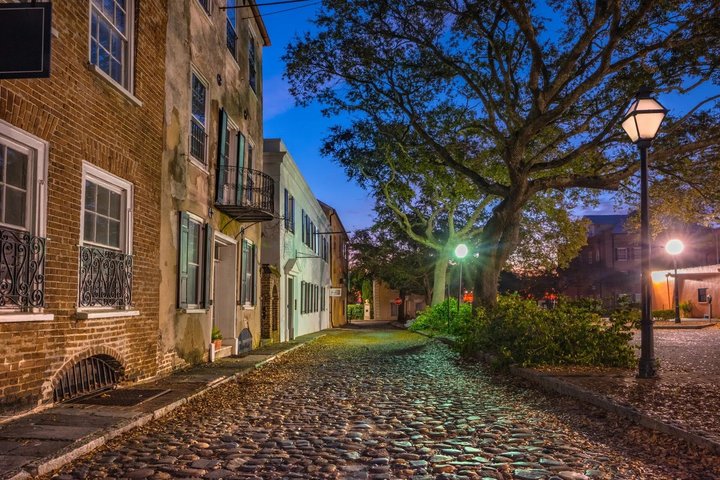
Charleston is a South Carolina port city of pastel row houses, cobbled lanes, church steeples, Gullah culture and Lowcountry cooking.
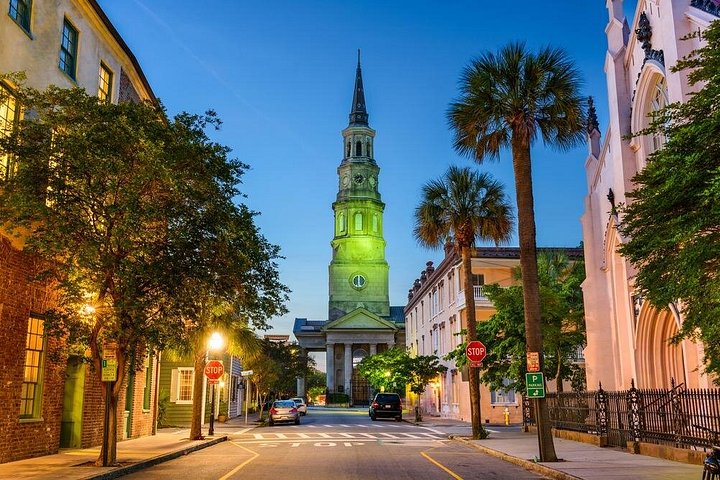
Charleston was settled in 1670 and grew on a peninsula between the Ashley and Cooper rivers, and it is one of the best-preserved colonial-era cities in the United States. Rainbow Row, thirteen pastel Georgian houses on East Bay Street, is the best-known sight. The Battery, a seafront promenade with old cannon and oak-shaded White Point Garden, looks out to Fort Sumter, where the first shots of the Civil War were fired in 1861. The city is nicknamed the Holy City for its many church steeples.
Top-ranked sights in Charleston: Charleston City Market, Rainbow Row, Old Exchange & Provost Dungeon.
Special offers in Charleston
Was/now prices come from the operator, never from us.


Similar experiences
![Undiscovered Charleston: Half Day Food, Wine & History Tour with Cooking Class]() Likely to sell outFree cancellation