Fukushima Hope Tour from Tokyo by Car with Licensed Guide
- 13 hours
- Free cancellation up to 24h before
- 2 languages
- Instant confirmation
Highlights
On this tour, you can visit the ruins of the Great East Japan Earthquake with a local licensed guide. On March 11 th 2011, the magnitude-9.0 earthquake occurred in Japan’s Tohoku region. Many people in Fukushima lost their lives to this earthquake and the subsequent large tsunami, and scores of homes were destroyed. In addition, the Fukushima Daiichi Nuclear Power Station Disaster resulted in leaving many people with no choice but to evacuate their homes. The effects of these multiple disasters remain to this day. This tour offers you the opportunity to see the places where the effects of the earthquake and nuclear disaster remain, as well as the places where revitalization efforts are taking place. *The radiation level of places you will visit on this tour does not exceed 0.05 mSv per hour. *All tour sales go to donations for the affected areas. *You are not allowed to enter the Fukushima Daiichi Nuclear Power Station.
Inclusions
What's included
- Private Vehicle
- Customizable Tour of your choice of 3-4 sites from 'What to expect' list'
- Licensed Local English Speaking Guide
- Donation fee: tour sales go to donation for the the disaster-affected areas
What's not
- Entrance fees, Lunch, and Other personal expenses
- You cannot combine multiple tour groups.
- Guide Entry fees are only covered for sights listed under 'What to Expect.'
- You are not allowed to enter the Fukushima Daiichi Nuclear Power Station
Itinerary
You will meet your driver at Tokyo Station or your preffered place near Tokyo Station. You will meet yout guide in Fukushima. It takes about three and a half hours from Tokyo to Fukushima Hama-dori (coastal) area. *no guide on the way.
National Route 6: In addition to seeing landscapes of untouched buildings in areas where evacuation orders designated as the Difficult-to-return Zone have been lifted, there are areas where decontamination and demolition work is progressing and one can feel the spirit of rebuilding in the local communities. ※Partially through the Difficult-to-return Zone
Managed by TEPCO, this information dissemination facility uses video and diorama displays to provide a record of the project and allow visitors to learn about the ongoing progress of the decommissioning effort.
This roadside station was built as a symbol of the town’s revitalization. It is a facility that supports people’s daily lives, where they can shop, eat and rest. In addition to a range of vegetables and seafood, visitors can also have a taste of the local cuisine.
Namie Town-run Ohirayama Cemetery This communal cemetery is located on high ground about 2 kilometres from the coast. The view of Ukedo district and the Pacific Ocean conveys the huge extent of the tsunami’s devastation. This place, where the children of Ukedo Elementary School were evacuated to immediately following the earthquake, was an expanse of fields at that time. Afterwards, in response to the wishes of the local residents, the Ohirayama Cemetery was built on the site to house the graves of those who were lost in the disaster. Together with a memorial monument built as a requiem for the victims and as a warning to future generations, the cemetery continues to convey the memory of the disaster.
Ukedo Elementary School is located about 200 metres from the coast. The school building was engulfed and partially destroyed by the tsunami, but miraculously no lives were lost thanks to fast thinking and evacuation. The school is preserved in the same condition as it was in at the time of the disaster in order to demonstrate the threat and lessons of the disaster, to pass on the memories and records of the area to future generations, and to raise awareness of disaster prevention. The classrooms and gymnasium on the first floor, which were most severely damaged by the tsunami, are almost entirely as they were at the time of the disaster, and the site has been prepared so that visitors can observe the conditions. On the second floor, there are panels showing the extent of the damage and details of the evacuation following the nuclear accident, as well as messages of support and so on written by visitors on blackboards that have been preserved.
This facility is truly the entry point for Hope Tourism. A wealth of resources, including images and exhibits, give visitors a complete picture of the events and revitalization efforts from the immediate aftermath of the earthquake and nuclear accident to the present day.
JR Futaba Station area: The town’s former Special Zones for Reconstruction and Revitalization (part of the Difficult-to-Return Zone of restricted residence, where it is hoped that evacuation orders will be lifted in future) centred around JR Futaba Station. Even after the evacuation order has been lifted, buildings from the immediate aftermath of the earthquake remain untouched, while hopeful murals adorn the area, giving a sense that the
After the tour, your driver will take you back to Tokyo. you and your guide part at JR Futaba station in Fukushima. It takes about three and a half hours from Futaba Station to Tokyo. *no guide on the way back.
Cancellation
Free cancellation up to 24 hours before the experience starts, for a full refund.
Know before you go
- Pickup
- Pickup is included for everyone.
- Ticket type
- Mobile or paper ticket accepted
- Operated by
- Japan Guide Agency
- Wheelchair accessible
- Infants and small children can ride in a pram or stroller
- Service animals allowed
- Transportation options are wheelchair accessible
- All areas and surfaces are wheelchair accessible
- Not recommended for pregnant travelers
- Suitable for all physical fitness levels
- There are only a limited number of car seats and booster seats. Rear-facing car seats are not available. You must contact us directly if you need them.
How it compares in Tokyo
- Its from-price is 190% above the median of the 893 day trips we list in Tokyo.
- It is longer than most of them.
- The operator lists free cancellation on it.
About Tokyo
Neon-lit districts, quiet shrines, superb food and distinct neighbourhoods make up Tokyo, a vast, orderly metropolis linked by punctual trains.
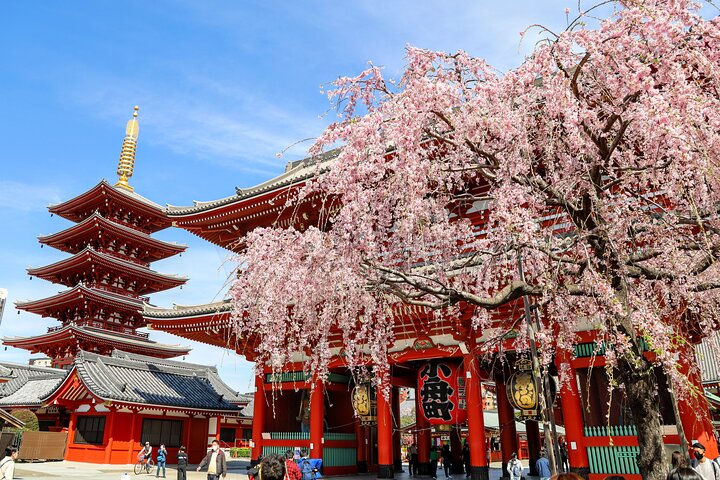
Every district feels like its own city. Shibuya's famous scramble crossing and Shinjuku's towers, bars and Golden Gai alleys pulse with energy, while Harajuku mixes youth fashion with the forested calm of the Meiji Jingu shrine. In Asakusa, the Sensō-ji temple and its market street keep an older Tokyo alive, and Ginza offers polished department stores and galleries.
Top-ranked sights in Tokyo: Senso-ji Temple (Asakusa Temple), Tokyo Imperial Palace, Meiji Shrine (Meiji Jingu).
Special offers in Tokyo
Was/now prices come from the operator, never from us.
 15% offFree cancellation