Cascia and Spoleto from Rome: A Day Trip to Discover Umbria
- 10 hours
- Free cancellation up to 24h before
- 5 languages
- Instant confirmation
Highlights
Experience the beauty and spirituality of Umbria, a region of rolling hills, charming villages, and sacred history. Visit the Basilica of Santa Rita of Cascia, built in 1937 and consecrated in 1947, and explore the nearby monastery where she lived for forty years, now home to the Augustinian nuns. Learn about her life, her miracles, and the symbols of roses and figs that are associated with her devotion. Enjoy some free time for lunch (not included) or a moment of personal reflection in this serene setting. The journey continues to Spoleto, a stunning medieval hilltop town, where Etruscan and Roman remains, including a theatre and amphitheatre, rise amid charming streets and historic squares. Discover the art, history, and timeless charm of Umbria, combining spirituality, culture, and breathtaking scenery in one unforgettable day
Inclusions
What's included
- Free transfer offered by Welcome Italy in air conditioning Minivan
- Explore Spoleto, UNESCO World Heritage-listed town
- Visit The Cathedral of Spoleto
- Tour Assistant during the whole trip
- Visit Roccaporena, was born Santa Rita da Cascia
- Visit the Basilica and Monastery of St. Rita of Cascia
- Pick up and drop-off at hotel (inside the city center)
What's not
- Lunch
- Tips
Itinerary
First stop of the tour for breakfast and and quick visit to the Roman underground aqueduct
Roccaporena is a hamlet of the municipality of Cascia (from which it is about 6 kilometres), located more than 700 metres high and set in a splendid natural setting. For years it has been a pilgrimage destination, since it is here that Saint Rita was born in 1381, whose life and works are celebrated here in many places and in many different ways. Here you can learn about the house where she was born, the church where she got married, the rock of Santa Rita, the place where she prayed.
Visit the Basilica and Monastery of St. Rita of Cascia , St. Rita was one of the most popular saints of the Catholic Church, with her related symbols being roses and figs. The Basilica was built in 1937 and consecrated in 1947, and the monastery where she lived for forty years was rebuilt in the 18th Century and houses the nuns of the Augustinian community.
An important fortified center of the Umbrians, it was a Roman colony and then a municipality (90 BC). After the fall of the Roman Empire it was garrisoned first by Theodoric, king of the Visigoths, and then by the Byzantine Belisarius. Conquered by Totila, it was rebuilt by the Byzantine Narses. In the early medieval period it was the capital of the Lombard Duchy. In 1155 it was conquered and destroyed by Federico Barbarossa and, after a series of fights between Guelphs and Ghibellines, it was reconquered by Cardinal Albornoz who secured it for the Church and made it an important center of the Papal State. The city's major monument is the Cathedral. Built in Romanesque style in the 12th century, the façade is adorned with a large Byzantine-style mosaic (1207). Inside there is a fresco with the Madonna and Saints by Pinturicchio, the bronze bust of Urban VIII by Bernini and an extraordinary cycle of frescoes by Filippo Lippi.
Rocca Alborziana a medieval fortress, located on the top of the Sant'Elia hill overlooking the city of Spoleto. It is the main bastion of the fortification system built by Pope Innocent VI, to strengthen the Church's authority in the territories of central Italy militarily and make it clearer, in view of the now imminent return of the papal seat to Rome after the seventies years of stay in Avignon.
The Duomo is the most important monument in the city. Built in Romanesque style in the 12th century, the façade is adorned with a large Byzantine-style mosaic (1207): inside there is a fresco with the Madonna and Saints by Pinturicchio, the bronze bust of Urban VIII by Bernini and an extraordinary cycle of frescoes by Filippo Lippi. The church of Sant'Eufemia dates back to the 12th century, an interesting Romanesque building whose apse area overlooks the staircase leading to Piazza Duomo, the church of Santi Giovanni e Paolo and the abbey of San Ponziano, while the church of San Ponziano dates back to the 13th century. Domenico, the church of San Nicolò and the Town Hall. Of great interest are the church of San Paolo inter vineas (10th century), with an important cycle of frescoes from the 1200s, and the church of San Pietro, whose origins date back to the 5th century, with a splendid Romanesque façade sculpted with extraordinary bas-reliefs.
The Roman Theater was built in the second half of the 1st century BC. immediately inside the city walls, and remained in use until the 4th century. In Roman times a deep crack opened in the steps, perhaps due to an earthquake. During the Early Middle Ages, the church of S. Agata and the palace of the Corvi family were built on the scene. In 1320 four hundred Guelphs were locked up, and after two years killed, in the corridors of the theatre, used as a prison. In 1395 the Benedictine nuns settled in Palazzo Corvi and the theatre, now underground, became the cloister of the monastery.
Spoleto, medieval city is remained well preserved until today. Admire the intact Roman gates ruins around the city . Porta San Pietro or Porta Monterone, at the end of the street of the same name, still well preserved, it has a double arch and is adorned with four high-reliefs, the coats of arms of the city.
Cancellation
Free cancellation up to 24 hours before the experience starts, for a full refund.
Reviews
5.0
- 51
- 40
- 30
- 20
- 10
Ratings come from 1 reviews collected by our booking partner. They are travellers' own words, in the order they were written — never reordered to flatter the experience.
Know before you go
- Pickup
- Pickup is included for everyone.
- Ticket type
- Mobile or paper ticket accepted
- Operated by
- Welcome Italy
- Infants and small children can ride in a pram or stroller
- Specialized infant seats are available
- Not recommended for travelers with poor cardiovascular health
- Travelers should have at least a moderate level of physical fitness
- A dress code is required to enter places of worship and selected museums. No shorts or sleeveless tops allowed. Knees and shoulders MUST be covered for both men and women. You may risk refused entry if you fail to comply with these dress requirements
- Provide the Correct address of your accommodation , hotel, B&B
- Pickup service only in the city center inside the Aurelian Walls
- Provide the correct phone number with international country code
How it compares in Rome
- Its from-price is 71% above the median of the 8352 experiences we list in Rome.
- It is longer than most of them.
- By number of reviews it ranks 5244 of 8352.
- The operator lists free cancellation on it.
About Rome
Rome layers nearly three thousand years of history into one walkable city, from the Colosseum and Forum to Baroque piazzas and Vatican art.
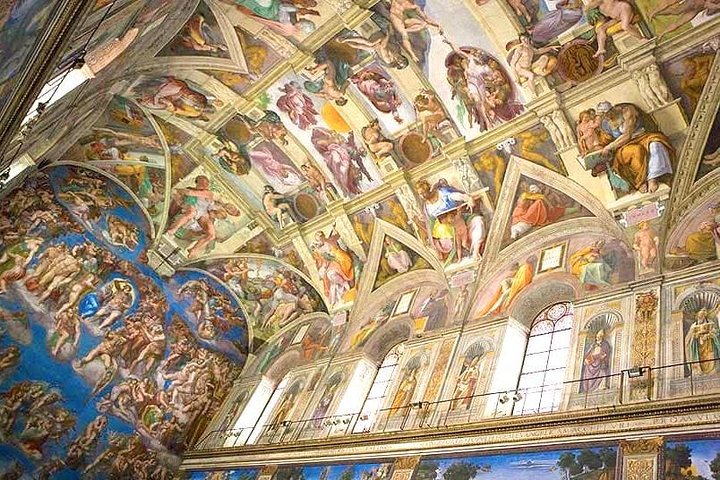
Ancient Rome is still in plain sight. The Colosseum, the Roman Forum and the Palatine Hill sit together at the city's heart, the Pantheon still stands with its open oculus, and fragments of temples and aqueducts turn up between apartment blocks. Across the Tiber, Vatican City holds St Peter's Basilica, the Vatican Museums and Michelangelo's Sistine Chapel ceiling.
Top-ranked sights in Rome: Colosseum, Vatican Museums, Sistine Chapel.
Special offers in Rome
Was/now prices come from the operator, never from us.
 Likely to sell out20% off
![Skip the Line: Vatican Museums, Sistine Chapel Tour & St. Peter's]() Likely to sell out10% off
Similar experiences
 Free cancellationSkip the line
![Vatican Museums, Sistine Chapel and St. Peter's Basilica Tour]() Likely to sell outFree cancellation
![Skip-the-Line Vatican, Sistine Chapel & St. Peter's | Small Group]() Likely to sell outFree cancellation