Self Guided E-Bike Tour among the Palladian Villas of Vicenza
Descriptions come from the operator and are translated automatically.
- 7–8 hours
- 3 languages
- Instant confirmation
- Private tour
Highlights
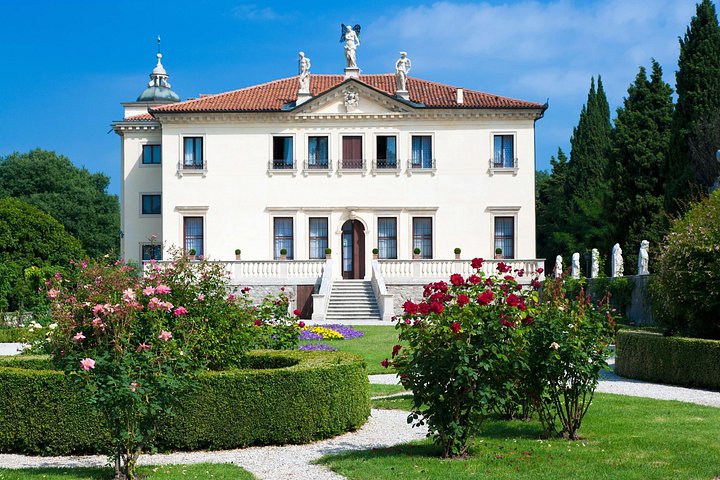
The unique and original E-Bike tour of the Palladian Villas explores the surroundings of Vicenza passing through 11 Villas, of which 7 are Unesco Palladian Heritage Sites. The experience includes the rental of a luxurious Palladian E-Bike extremely comfortable and performing (bag and padlocks included), a special navigation system and a traveling voice narration: the guiding voice will be the spirit of Andrea Palladio, who traces his story through the evolution of his villas (entrance fees excluded) and immersion in his landscapes. The network of Palladian Villa owners invites you to immerse yourself in the history and landscapes of the other half of our UNESCO World Heritage Site in an original, active and sustainable way. Deep in the Vicenza countryside, sumptuous residences follow one another as far as the eye can see in a widespread eco-museum, architectural forms in continuous evolution until the gemstone of the world-famous Palladian Villa, thanks to the genius of a modest and prodigious stonemason.
Inclusions
What's included
- Audio narration with the guiding voice of the spirit of Andrea Palladio
- Use of luxury E-Bikes, specially designed for maximum comfort and performance
- Large waterproof bag, padlocks and any basket if required
- Navigation system for a complete self-guided experience
What's not
- Palladian Picnic Gourmet (€ 25.00)
- Helmet for adults (€ 2,00), not mandatory in Italy - cost included instead for minors
- Child seat (€ 3.00)
- Villa La Rotonda by Andrea Palladio (€ 12,00) when open to the public. On other days we can possibly book a private opening
- Villa Caldogno (€ 8,00) when open to the public. On other days we can possibly book a private opening
- Tour Leader (cost depending on the number of participants)
- Villa Palladiana where you can have your own picnic, price depending on the number of participants
Itinerary
Splendid Venetian villa registered as a World Heritage Site since 1994, which belonged to the family of Giangiorgio Trissino, who inspired Palladio (note: time to reach stage and stop) Accessible from the outside
Extraordinary Palladian work commissioned by the great architect by the Caldogno counts (note: time to reach stage and stop)
Monumental and splendid, its attribution to Palladio is controversial, but certain is its belonging to that Golden Age of Vicenza which dotted the city and its countryside with architectural pearls recognized as a World Heritage Site (note: time to reach stage and stop) Accessible from the outside
Imposing eighteenth-century villa that testifies to the longevity of the Palladian legacy, the living and germinating force of the Italian Neoclassical (note: time to reach stage and stop).
Unmistakable Palladian original among the first works of the architect, also included in the UNESCO World Heritage (note: time to reach stage and stop). Accessible from the outside
Another pearl between Giulio Romano and Palladio (note: time to reach stage and stop). Accessible from the outside
Even the two Villas of Quinto, the sixteenth-century Villa Thiene and the eighteenth-century Villa Tacchi, dialogue in the suburban landscape, giving us a precious testimony of how Palladio's legacy has been able to survive strongly in the Vicenza countryside, continuing over the centuries to contribute in painting the face of the territory (note: time to reach stage and stop). Accessible from the outside
A UNESCO World Heritage Site since 1994, the villa owned by the Curti family is a fine example of the eternity of the works of Palladian production, inspiration and legacy. Restored to its former glory, it now houses an agricultural and tourist activity as it did then (note: time to reach stage and stop). Accessible from the outside
Villa Gazzotti is a Venetian villa located in Vicenza in the Bertesina area designed by Andrea Palladio between 1542 and 1543. Subjected over time to various tampering related to agricultural use and uninhabited for years, this work appears to be in a state of deterioration and needs an overall restoration (note: time to reach stage and stop). Accessible from the outside
This breathtaking tour could only end with the work that consecrated Palladio's genius revealing his genius (note: time to reach stage and stop).
Cancellation
All sales are final. No refund is available for cancellations.
Reviews
4.9
- 550
- 44
- 30
- 20
- 10
Ratings come from 54 reviews collected by our booking partner. They are travellers' own words, in the order they were written — never reordered to flatter the experience.
Know before you go
- Meeting point
- First door on the left once you enter the entrance of Palazzo Valmarana Braga.
- Pickup
- Everyone meets at the starting point; there is no pickup.
- Ticket type
- Mobile or paper ticket accepted
- Operated by
- Palladian Routes
- Specialized infant seats are available
- Public transportation options are available nearby
- Suitable for all physical fitness levels
- The tour is not available for children between the ages of 5 and 12
- The price does not include entrance fees to the villas
- You will need to bring your mobile phone, USB charging cable and earphones if you have them
- The tour is not recommended for people less than 150 cm or more than 190 cm tall
- Entrance inside the monuments is not foreseen (not listed in the exclusions)
How it compares in Vicenza
- Its from-price is close to the median of the 47 experiences we list in Vicenza.
- It is longer than most of them.
- By number of reviews it ranks 5 of 47.
About Vicenza
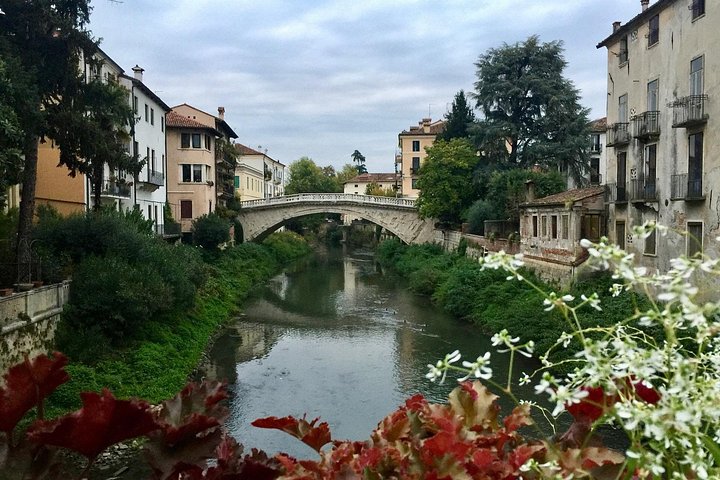
Vicenza is a Veneto city shaped by the Renaissance architect Andrea Palladio, with arcaded palaces, a Palladian theatre and villas in the hills.
Vicenza lies between Verona and Padua, on the plain below the Berici hills, and its centre is a World Heritage site for the buildings Palladio designed in the sixteenth century. The Basilica Palladiana, with two storeys of arched loggias, overlooks the main square, Piazza dei Signori, and the palaces along Corso Palladio, such as Palazzo Thiene and Palazzo Barbaran da Porto, show how he adapted Roman ideas to the city.