Rotterdam Self-Guided Walking Tour Cube Houses, Audio and Quiz
- 2–2.5 hours
- Free cancellation up to 24h before
- 7 languages
- Instant confirmation
Highlights
Rotterdam is the one Dutch city with no old town, and fifteen minutes on the afternoon of 14 May 1940 explain why. This self-guided walking tour traces what the city built in its place, running from Rotterdam Centraal to the Erasmus Bridge past the last medieval church, the tilted Cube Houses, the Markthal and Zadkine's Destroyed City. Everything runs from your smartphone, with no app to download. Each of the 9 stops comes with a map, walking directions and a short audio story, plus an interactive quiz to test what you have just heard. Audio and text are available in 7 languages. Start whenever you like, pause for a coffee, and take as long as you want. No group, no schedule and no guide waiting on you: just the city and the story, at your own pace.
Inclusions
What's included
- Self-guided tour on your smartphone, APP not needed!
- Audioguide with quizzes about each point of interest along the tour
What's not
- A physical guide (the tour is accessible on your smartphone)
- Access offline. Internet needed on your phone
Itinerary
Your walk starts on Stationsplein, the car-free square outside Rotterdam Centraal, where the station's steel canopy points straight into a skyline of glass towers and there is no medieval centre in sight.
On Stadhuisplein, in front of the 1920 City Hall, stand Mari Andriessen's four bronze figures commemorating the people of Rotterdam killed between 1940 and 1945. The plinth carries the city motto Stronger through struggle.
On Coolsingel stands the low modernist Beurs, which opened for trading in May 1940 and survived the bombardment that flattened everything around it. A sea-green glass tower was later built straight on top of it.
The late Gothic Grote of Sint-Laurenskerk is the only medieval building left in the city centre. Gutted by fire in 1940, it was rebuilt over sixteen years rather than left as a ruin, and Erasmus stands in bronze outside.
This long open square is the filled-in bed of the river Rotte, the waterway the city is named after. Rail tracks and a metro station now run beneath it, and market stalls fill it on Tuesdays and Saturdays.
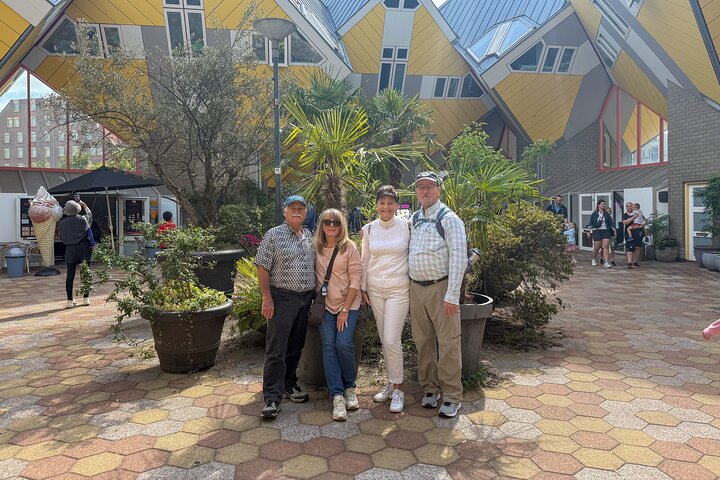
Piet Blom's Blaakse Bos: thirty-eight yellow cubes tilted at forty-five degrees on hexagonal pillars, built in the early 1980s as a way to carry housing over a busy road. One cube is open to visitors as a show home.
A horseshoe-shaped market hall with 228 apartments folded over it. Inside, the vaulted ceiling carries the vast Horn of Plenty artwork, and glass end walls flex in the wind. Food stalls fill the floor below.
Ossip Zadkine's six-metre bronze at the head of the Leuvehaven, made after the war with a hole torn through its chest. It is Rotterdam's principal memorial to the bombing of 14 May 1940 and to the civilians killed.
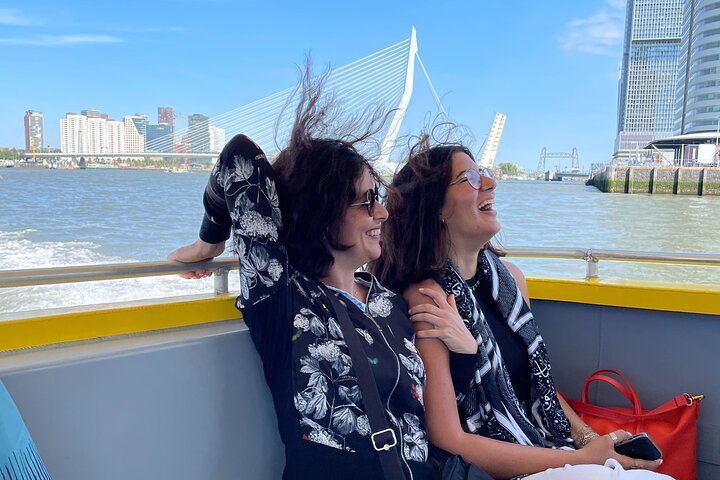
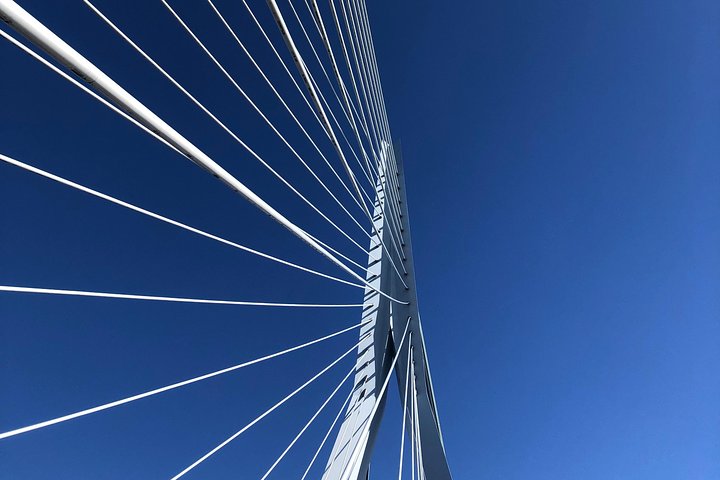
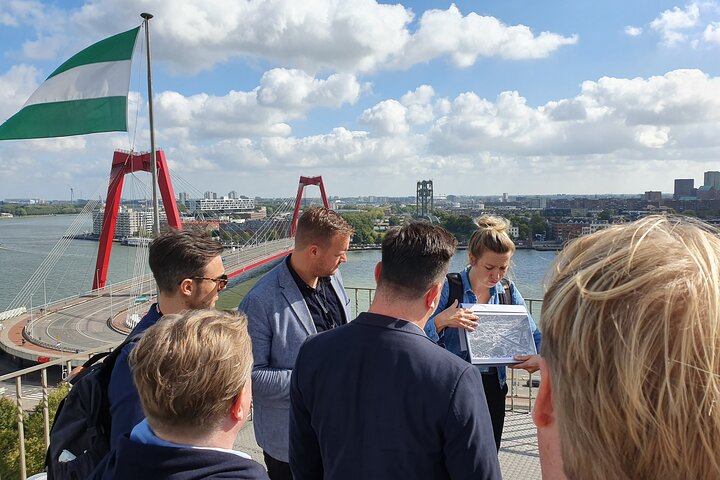
The walk ends at the Erasmusbrug, the 800-metre cable-stayed bridge nicknamed the Swan for its angled white pylon. Opened in 1996, it links the old centre to the redeveloped south bank and now appears in the city's logo.
Cancellation
Free cancellation up to 24 hours before the experience starts, for a full refund.
Know before you go
- Meeting point
- Start your self-guided tour at the entrance of Rotterdam Centraal station, on Stationsplein. Open your Ciceru experience nearby and follow the route on your smartphone.
- Pickup
- Everyone meets at the starting point; there is no pickup.
- Ticket type
- Mobile or paper ticket accepted
- Operated by
- Ciceru
- Service animals allowed
- Public transportation options are available nearby
- Not recommended for travelers with spinal injuries
- Not recommended for pregnant travelers
- Not recommended for travelers with poor cardiovascular health
- Suitable for all physical fitness levels
How it compares in Rotterdam
- Its from-price is 95% below the median of the 239 experiences we list in Rotterdam.
- Its length is typical for the group.
- The operator lists free cancellation on it.
About Rotterdam
Rotterdam is a modern Dutch port city rebuilt after 1940, known for bold architecture, a huge harbour, the Cube Houses, a market hall and waterfront views.
Rotterdam was bombed in May 1940 and rebuilt in a modern style, so it is unlike the old canal towns of the Netherlands: glass towers, bridges and daring architecture line the Nieuwe Maas river, which is crossed by the white Erasmus Bridge. It has Europe's largest seaport, and the harbour can be toured by boat. Delfshaven, a small quarter of old canals that survived the bombs, is where the Pilgrim Fathers left in 1620.
Top-ranked sights in Rotterdam: Markthal (Market Hall) , Church of St. Lawrence (Sint Laurenskerk), Erasmusbrug (Erasmus Bridge).
Special offers in Rotterdam
Was/now prices come from the operator, never from us.

Similar experiences
 Free cancellation