Private Skip-the-line Pompeii & Herculaneum Tour from Naples
- 8 hours
- Free cancellation up to 24h before
- 5 languages
- Instant confirmation
Highlights
Travel in comfort and uncover two extraordinary archaeological treasures in one unforgettable day — the legendary ruins of Pompeii and the remarkably preserved seaside town of Herculaneum. With round-trip private transportation from your accommodation in Naples, skip the lines and enjoy personalized guided tours at both sites. Walk ancient streets, marvel at colorful frescoes and mosaics, and discover the stories, secrets, and final moments of daily life frozen in time by the eruption of Mount Vesuvius. A powerful blend of history, art, and archaeology — all at your own pace, with an expert by your side.
Inclusions
What's included
- Priority Access to Pompeii and Herculaneum
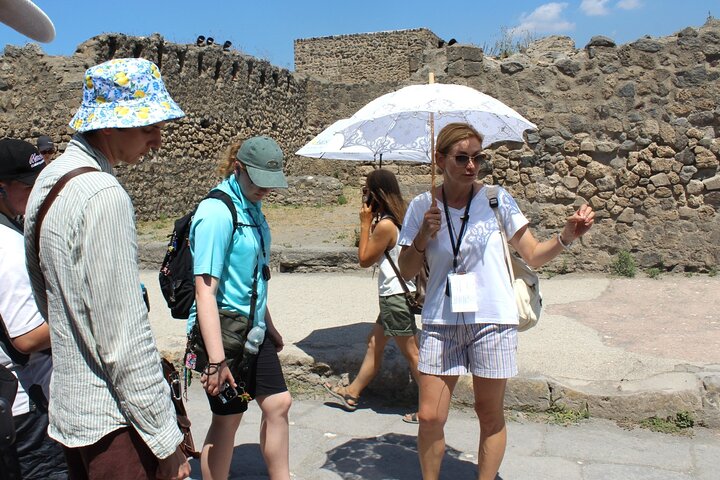
- Licensed expert guide for both sites
- Hotel Pick-up and Drop-off
- Private transportation with English-speaking driver
- Private walking tours at each archaeological site
What's not
- Food and beverages
Itinerary
Pickup from your hotel in Naples by private air-conditioned vehicle
The Pompeii Archaeological Park is one of the most significant UNESCO World Heritage sites in the world, preserving a Roman city frozen in time by the eruption of Mount Vesuvius in 79 AD. Spanning over 66 hectares, the park offers an unparalleled look at ancient urban life, where volcanic ash acted as a preservative for everything from grand villas and public baths to everyday household items and carbonized bread. It is a vast open-air museum that continues to reveal new discoveries through ongoing excavations, bridging the gap between modern history and the ancient Roman Empire.
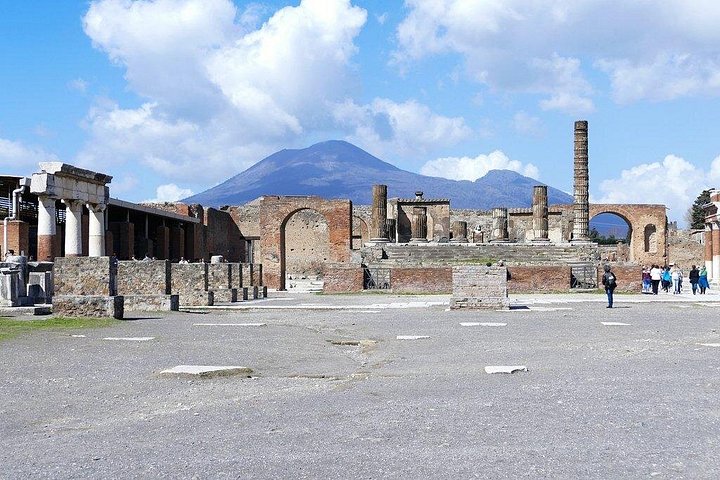
The Forum was the beating heart of Pompeii, serving as the city's main piazza and the center of all political, religious, and economic life. Surrounded by a majestic two-story colonnade, this vast open space was strictly pedestrian and hosted the city's most important public buildings, including the Basilica and the Temple of Jupiter. Framed by the dramatic silhouette of Mount Vesuvius in the background, it remains the most iconic spot in the ruins, where citizens once gathered for elections, markets, and sacred sacrifices.
The Temple of Jupiter (Tempio di Giove) stands as the dominant religious landmark of the Pompeii Forum, situated at its northern end. Originally dedicated solely to Jupiter, it was later transformed into a Capitolium to honor the "Capitoline Triad" of Jupiter, Juno, and Minerva, symbolizing Rome’s supreme authority over the colony. Its high podium and dramatic position against the backdrop of Mount Vesuvius made it the city's most symbolic structure for state religion, and even today, its weathered columns remain one of the most photographed sights in the entire archaeological park
The Macellum was Pompeii’s central covered market, located in the northeast corner of the Forum. This bustling commercial complex specialized in the sale of meat and fish, featuring a circular tholos in the center where fish were cleaned and sold. The surrounding portico housed various shops, while the walls are decorated with elegant Fourth Style frescoes depicting mythological scenes and local food products, illustrating the high quality of Mediterranean life before the eruption
Via dell'Abbondanza is the main commercial artery of Pompeii, stretching from the Forum to the Sarno Gate. As the city's longest thoroughfare, it offers a vivid glimpse into ancient daily life through its well-preserved shops, workshops, and vibrant electoral graffiti. Walking its basalt stones today, you can still see the iconic raised stepping stones and grand facades that once defined the heartbeat of this Roman city.
The Stabian Baths (Terme Stabiane) are the oldest and largest public bathing complex in Pompeii, located at the intersection of Via dell'Abbondanza. They represent a masterpiece of Roman engineering, featuring a sophisticated underfloor heating system known as a hypocaust and distinct sections for men and women. Visitors can still admire the elegant stucco decorations, the open-air gymnasium (palaestra), and the large swimming pool that made this site the ultimate social and wellness hub of the city
The Lupanar is the most famous official brothel of Pompeii, located in a narrow side street near the heart of the city. This small, two-story stone building is unique for its purpose-built design, featuring five small rooms on the ground floor with built-in masonry beds. It is world-renowned for its well-preserved erotic frescoes displayed above the doors, which likely served as a visual "menu" of services, and for the hundreds of graffiti left by visitors, providing a raw and fascinating look into the social life and language of ancient Roman plebeians
The House of the Faun (Casa del Fauno) is one of the largest and most luxurious private residences in Pompeii, occupying an entire city block. Named after the iconic bronze statue of a dancing faun found in its main atrium, the house is a masterpiece of Roman architecture and Hellenistic influence. It is most famous for housing the magnificent Alexander Mosaic, which depicts the battle between Alexander the Great and Darius III of Persia. With its two peristyle gardens and intricate floor mosaics, it remains a powerful symbol of the immense wealth and sophisticated taste of the city's elite
The Teatro Grande is a majestic horseshoe-shaped auditorium built into a natural hillside, designed to hold roughly 5,000 spectators. Dating back to the 2nd century BC, it was the first Greek-style stone theater in Pompeii and served as the city's primary venue for comedies, tragedies, and pantomimes. The theater features a grand tiered seating area and a large stage background (scenae frons), offering a spectacular look at how the Roman elite and commoners alike enjoyed large-scale public entertainment.
The Basilica is one of the most significant buildings in Pompeii, located at the southwest corner of the Forum. Constructed in the 2nd century BC, it served as the city’s primary center for legal and commercial activities, acting as both a courthouse and a place for business transactions. Its monumental interior featured a central nave surrounded by towering columns and a raised tribunal where judges presided over hearings. As the oldest building of its kind in the Roman world, it stands as a fundamental example of pre-imperial civic architecture
The Herculaneum Archaeological Park offers a unique and intimate glimpse into Roman life, distinguished from Pompeii by its extraordinary state of preservation. Buried by pyroclastic surges that sealed the city under nearly 20 meters of volcanic material, it features remarkably intact carbonized wood, textiles, and upper floors, revealing a vertical dimension of ancient architecture rarely seen elsewhere. As a smaller, wealthier residential retreat, the site is characterized by luxurious villas and vibrant mosaics, providing a sophisticated portrait of a Roman seaside town frozen in time.
Cancellation
Free cancellation up to 24 hours before the experience starts, for a full refund.
Reviews
4.0
- 53
- 40
- 30
- 20
- 11
Ratings come from 4 reviews collected by our booking partner. They are travellers' own words, in the order they were written — never reordered to flatter the experience.
Know before you go
- Pickup
- Pickup is included for everyone.
- Ticket type
- Mobile or paper ticket accepted
- Operated by
- IAMME IA! - Gray Line Amalfi Coast
- Public transportation options are available nearby
- Specialized infant seats are available
- Not recommended for travelers with spinal injuries
- Travelers should have at least a moderate level of physical fitness
How it compares in Naples
- Its from-price is 109% above the median of the 1168 day trips we list in Naples.
- Its length is typical for the group.
- By number of reviews it ranks 458 of 1168.
- The operator lists free cancellation on it.
About Naples
Passionate and chaotic beneath Vesuvius, Naples is the birthplace of pizza and the gateway to Pompeii, Capri and the Amalfi Coast.
The historic centre, a dense grid of streets laid out by the ancient Greeks, is a world of churches, street shrines and laundry strung between balconies. Spaccanapoli cuts straight through it, Via San Gregorio Armeno is lined with nativity-scene workshops, and the Sansevero Chapel holds the astonishing Veiled Christ. Underground, tunnels and cisterns reveal the Greek and Roman city below.
Top-ranked sights in Naples: Mt. Vesuvius (Monte Vesuvio), Via dei Tribunali, Naples Historic Center (Napoli Centro Storico).
Special offers in Naples
Was/now prices come from the operator, never from us.
![Private Capri Island and Blue Grotto Day Tour from Naples or Sorrento]() 5% offFree cancellation