Malacca Day Tour from Kuala Lumpur
- 8 hours
- Free cancellation up to 24h before
- Guided in English
- Instant confirmation
Highlights
Melaka’s history began in 1403 with the arrival of Parameswara, an exiled Hindu Prince from the Kingdom of Sri Vijaya in Sumatra. He assumed the title of Raja Iskandar when he embraced Islam and became the first ruler of this new kingdom which marked the early beginnings of the Sultanate of Melaka. In time, Melaka gained prominence as a vibrant maritime trading centre and was coveted by several foreign powers. The Portugese led by Alfonso’d Albuquerque conquered Melaka in 1511 and colonized it for 130 years. The Dutch then came in 1641 and ruled for 154 years. They were followed by the British in 1824 who ruled until the country gained its independence.
Inclusions
What's included
- Bottled water
- Lunch
What's not
- Alcoholic Beverages
Itinerary
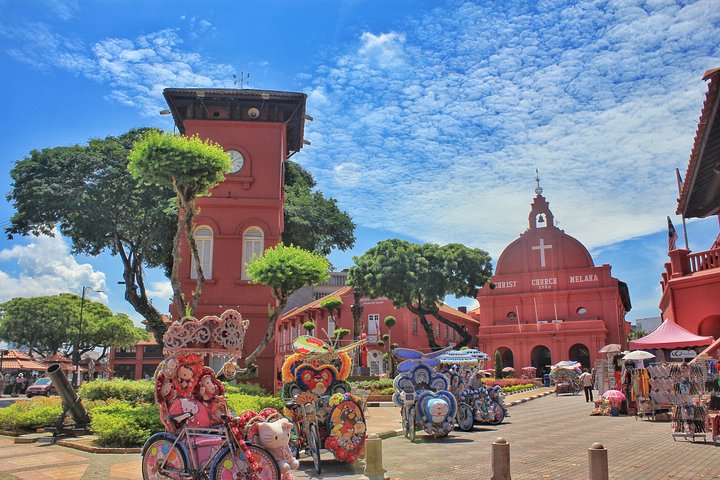
St Peter’s Church in Melaka is the oldest functioning Roman Catholic church in Malaysia. From 1511 until 1641, while under Portuguese rule, Malacca was described as a Christian town with a Roman Catholic church or chapel in every street. In 1618, there were 7,400 Christians in Malacca with 14 churches and two chapels. In 1641, Malacca fell to the Dutch who, being predominantly Protestant and anti-Catholic, set about demolishing Portuguese churches and persecuting the Catholic population of the city. Priests were forbidden to preach. What must the local Malay population here have thought about these two groups of Europeans who were so mean to each other despite being strangers in a foreign land so far from home, and both professing to belong to a superior culture? During the War of the Spanish Succession (1701-1714), Holland and Portugal found themselves fighting on the same side as part of the Grand Alliance. As a result the Dutch eased up on their persecution of Catholics in Malacca and a Dutch Catholic called Franz Amboer was given permission to donate land for the construction of St Peter’s Church which, as the date on the bell tower suggests, was finished around 1710.
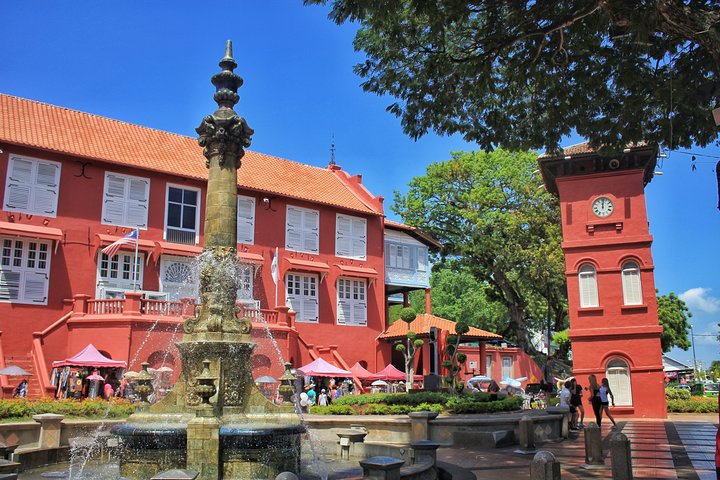
The brick buildings are definitely a sight to see. They stand majestic as they look over the square and the largest structure; the Stadthuys. This building was built to be the town hall when the Dutch ruled and was used as the residence for the Governor at the time as well as his deputy. The Christ Church has been standing in this square since 1753 and this is the oldest protestant church in Malaysia. It definitely is a great church to visit; considering how antique and unique this church is. The beam of the church is its notable feature because each of its pillars is made from a single tree and they all stand over 15 m high. Also a highlight when in the Red Square is to visit the Malaysia Youth Museum and Art Gallery. Here, in this building that was built in the late 1700s is where you will find the best of art from the younger generation. The building however was designed to be the Dutch Administrative complex back in the day when the Dutch ruled the land but it was then renovated and used as a post office to serve the nearby villages before being transformed to become a museum.
"Porta de Santiago" redirects here. For the gate in Segovia, Spain, see Puerta de Santiago (Segovia). A Famosa (Malay: Kota A Famosa; "The Famous" in Portuguese) is a former Portuguese fortress located in Malacca, Malaysia. It is among the oldest surviving European architectural remains in Southeast Asia and the Far East. The Porta de Santiago, a small gate house, is the only part of the fortress which still remains today. The name is often mispronounced /eɪ/ Famosa, even among Malaysians, as though the Portuguese definite article a were the English letter A. A more authentic pronunciation would be /ɑː/ Famosa.
It was officially opened by Malaysia's King on 24th November 2006. It is constructed with modern Islamic design and craftsmanship. While the main dome is Middle Eastern in appearance, the four corner turrets are topped with typical Malaysian rooflines The facade of the mosque is decorated with stained glass windows with Islamic motifs. The minaret also has a striking and unusual design.
Jonker Street – the centre street of Chinatown – was once renowned for its antique shops. However over the years it has turned to clothing and crafts outlets as well as restaurants. The best part of Jonker Street is the night market on Fridays and Saturdays that sells everything from tasty treats to cheap keepsakes.
Cancellation
Free cancellation up to 24 hours before the experience starts, for a full refund.
Know before you go
- Pickup
- Pickup is included for everyone.
- Ticket type
- Mobile or paper ticket accepted
- Operated by
- Sarawanan Murugaiah
- Infants and small children can ride in a pram or stroller
- Public transportation options are available nearby
- Infants are required to sit on an adult’s lap
- Specialized infant seats are available
- Suitable for all physical fitness levels
How it compares in Kuala Lumpur
- Its from-price is close to the median of the 517 day trips we list in Kuala Lumpur.
- Its length is typical for the group.
- The operator lists free cancellation on it.
About Kuala Lumpur
Kuala Lumpur is Malaysia's vibrant capital, where the Petronas Towers soar over Malay, Chinese and Indian neighbourhoods and renowned street food.
The twin Petronas Towers, linked by a skybridge, define the skyline, with a landscaped park and fountains at their feet. The KL Tower offers a different view from its forested hill, and Merdeka Square, where the national flag was raised at independence, is framed by the Moorish-style Sultan Abdul Samad Building.
Top-ranked sights in Kuala Lumpur: National Mosque of Malaysia (Masjid Negara), Thean Hou Temple, Kuala Lumpur Chinatown.
Special offers in Kuala Lumpur
Was/now prices come from the operator, never from us.