Brussels Walking Tour with Audioguide on Your Smartphone
- 3 hours
- Free cancellation up to 24h before
- 6 languages
- Instant confirmation
Highlights
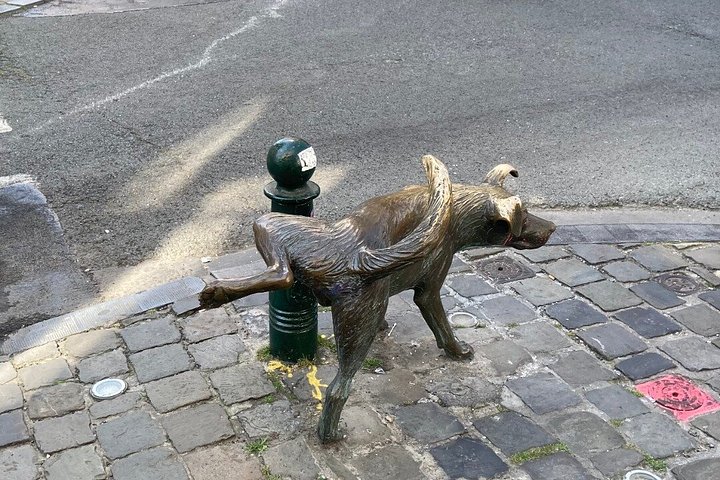
The audio guide is a handy mobile companion for a self-guided tour of Brussels. This tour is specifically designed for exploring the city in a short span of 2-3 hours. Simply follow the route on the app's map to stroll through the city center, passing by the main attractions. You're guaranteed to see: The Cathedral, The Royal Palace, The Wall Tower, The Old Masters Museum, The Palace of Justice, The Grand Place, The Statue of the Manneken Pis. Once you've downloaded the tour, the app functions offline. The audio guide can always be heard clearly through your headphones. Enjoy fascinating stories and legends at your own pace, without the need to keep up with a tour group. If you only have a few hours to visit Brussels, spend it with the audio guide and you won't miss a thing.
Inclusions
What's included
- One-year access to the tour in your preferred language
- Audio guide app for iPhone and Android
- Illustrations to recognize landmarks
- 34 audio recordings narrated by a professional historian
- Offline map featuring a route for effortless GPS navigation
What's not
- In-person tour guide
- Smartphone and Headphones
- Entry Tickets
- Transportation
- Food and Beverages
Itinerary
Halle Gate (Porte de Hal) is the last surviving gate of Brussels’ 14th-century city wall—a fairy-tale-like medieval tower rising in stark contrast to the modern city around it. Once a fortress, prison, and customs post, today it’s a museum showcasing Brussels' military and urban history, with armor, weapons, and sweeping views from the upper ramparts. Its round turrets and pointed roof evoke a time of knights and siege warfare. Step inside, and the echo of hooves and heraldry still lingers in the stone.
Jeu de Balle Square (Place du Jeu de Balle) in Brussels is best known for its daily flea market, where treasures and oddities spill from stalls and blankets — vinyl records, antique clocks, mismatched china, military jackets, and the occasional mystery item. Located in the heart of the Marolles district, the square hums with a mix of locals, bargain hunters, and curious wanderers. Surrounded by vintage shops and lively cafés, it’s a gritty, vibrant pocket of Brussels where stories are bought and sold under open skies, seven days a week.
The Palace of Justice (Palais de Justice) in Brussels is a colossal neoclassical building that dominates the skyline from its perch in the Marolles district. Completed in 1883, it's one of the largest courthouses in the world — its dome alone towers above much of the city. Designed by Joseph Poelaert, the structure symbolizes state power and legal authority, but its sheer scale and turbulent history (including WWII damage and endless renovations) give it a mythic weight. Part fortress, part labyrinth, it’s where law meets monumental ambition.
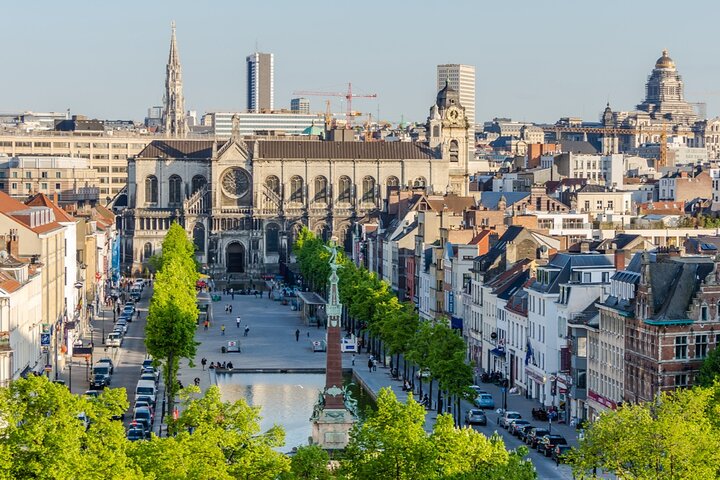
The Church of Our Lady of Victories at the Sablon (Église Notre-Dame du Sablon) is a Gothic jewel in the heart of Brussels, beloved for its soaring stained-glass windows, intricate stone carvings, and tranquil, light-filled nave. Built in the 15th century by the city's crossbowmen's guild, it was a place of both prestige and devotion. Legends surround its origins — particularly the story of a miraculous Madonna statue brought here by boat. Today, the church offers quiet beauty amid the antique shops and chocolate boutiques of the elegant Sablon district.
The Square of Petit Sablon (Square du Petit Sablon) is a refined, intimate garden in Brussels, tucked beside the Church of Our Lady of Victories. Laid out in the late 19th century, it’s framed by 48 elegant bronze statues representing traditional medieval guilds—blacksmiths, stonemasons, bookbinders, and more. At its center stands a monument to Counts Egmont and Hoorn, executed for resisting Spanish rule. With manicured hedges, fountains, and wrought-iron railings, it’s a quiet, symbolic space — where history is sculpted into every detail.
The Egmont and Horn Monument, located in the Square of Petit Sablon, commemorates Counts Lamoral of Egmont and Philip de Montmorency (Count of Horn) — two 16th-century nobles executed by the Spanish Inquisition for resisting King Philip II’s rule. Their deaths in 1568 helped ignite the Eighty Years’ War, a turning point in the fight for Dutch independence. The monument, unveiled in 1864, depicts them side by side, solemn and dignified. It’s not just a tribute — it’s a quiet act of remembrance for the price of political courage.
The Palace of Fine Arts in Brussels — better known as BOZAR (from Beaux-Arts) — is the city’s leading cultural venue, designed by architect Victor Horta in the 1920s. Behind its understated façade lies a vibrant maze of concert halls, exhibition spaces, and cinemas, hosting everything from symphonies and experimental art to film festivals and lectures. It’s where Brussels' artistic soul gathers — highbrow and curious, polished but playful. BOZAR isn’t just a palace of art — it’s a crossroads of ideas, constantly in motion.
Royal Square (Place Royale) in Brussels is a grand neoclassical plaza laid out in the late 18th century, once marking the entrance to the former Palace of Coudenberg. At its center stands an equestrian statue of Godfrey of Bouillon, the First Crusade leader. Surrounded by imposing buildings like the Church of Saint Jacques-sur-Coudenberg, Magritte Museum, and Royal Museums of Fine Arts, the square blends political, religious, and artistic power. More than a scenic stop, it's a symbolic heart of Belgian monarchy and identity — poised between the past and the present.
The BELvue Museum, located beside Royal Square in Brussels, offers an engaging deep dive into Belgian history, from independence in 1830 to today's constitutional monarchy. Housed in a neoclassical palace, the museum takes a thematic approach — exploring democracy, migration, industry, and identity through personal stories and historical objects. Beneath it lie the excavated ruins of the Coudenberg Palace, adding layers of medieval intrigue. Modern in design, rich in content, the BELvue turns national history into something tangible, nuanced, and unexpectedly personal.
The Royal Palace of Brussels is the official administrative residence of the Belgian monarch, facing Brussels Park across the grand Place des Palais. Though the king doesn’t live here, it's where state affairs, ceremonies, and receptions take place. The neoclassical façade hides richly decorated interiors—chandeliers, marble halls, and the famous Mirror Room with a ceiling covered in iridescent beetle wings. Open to the public each summer, the palace offers a rare glimpse into royal formality with a distinctly Belgian touch: grand, dignified, but never ostentatious.
The René Magritte Museum in Brussels, housed in a 19th-century mansion on Place Royale, is dedicated to Belgium’s most celebrated surrealist. Unlike the larger Magritte Museum at the Royal Museums of Fine Arts, this site is deeply personal — it was Magritte’s actual home and studio from 1930 to 1954. Inside, you’ll find original furniture, sketches, photographs, and everyday objects that shaped his dreamlike visions. It's an intimate portrait of the man behind the bowler hat and floating apples — a surrealist grounded in the ordinary, painting mystery into the mundane.
The Musical Instrument Museum (MIM) in Brussels is a treasure trove of over 7,000 instruments from around the world, housed in the striking Art Nouveau masterpiece of the Old England building. From ancient harps to futuristic synthesizers, the collection spans continents and centuries. Visitors get headphones to hear the sounds each instrument makes, turning the experience into an interactive concert. With its rooftop café offering panoramic city views, MIM is both a sensory feast and an architectural gem — where history sings in every room.
Cancellation
Free cancellation up to 24 hours before the experience starts, for a full refund.
Reviews
4.2
- 54
- 40
- 30
- 20
- 11
Ratings come from 5 reviews collected by our booking partner. They are travellers' own words, in the order they were written — never reordered to flatter the experience.
Know before you go
- Meeting point
- - The tour begins at Halle Gate - This is a self-guided tour, there will be no guide present at the meeting point - Open the app, start the Brussels City Tour, and proceed along the designated route
- Pickup
- Everyone meets at the starting point; there is no pickup.
- Ticket type
- Mobile or paper ticket accepted
- Group size
- Up to 20 travellers
- Operated by
- TouringBee
- Public transportation options are available nearby
- Suitable for all physical fitness levels
- The audio guide is available through a mobile app for iOS and Android
- Entry tickets to the museums are not included and must be purchased separately in advance
- The tour does not cover all sights in Brussels
- This is a self-guided tour, you will need to download the audio guide mobile app, activate your purchase, and follow the route on the app's map (without a human guide)
- The audio guide can be accessed at any time. The date and time provided during checkout are approximate
How it compares in Brussels
- Its from-price is 95% below the median of the 114 city tours we list in Brussels.
- Its length is typical for the group.
- By number of reviews it ranks 36 of 114.
- The operator lists free cancellation on it.
About Brussels
Brussels, Belgium's capital and a seat of European institutions, pairs a gilded Grand-Place with comic-strip murals, Art Nouveau houses and waffle stalls.
The Grand-Place is the centre of old Brussels, a cobbled square ringed by gilded guildhalls and the Gothic town hall, whose spire rises over everything. A few streets away, the small bronze Manneken Pis draws a crowd. On the hill above, the Royal Palace and the Mont des Arts gardens look down on the lower town, while the Atomium, a giant model of an iron crystal built for the 1958 World Fair, stands on the northern edge.
Top-ranked sights in Brussels: Grand-Place (Grote Markt), Manneken Pis, Royal Galleries of Saint Hubert (Les Galeries St-Hubert).
Special offers in Brussels
Was/now prices come from the operator, never from us.