Quito Audio Guided Walking Tour 2h10 and 19 audio reviews
Descriptions come from the operator and are translated automatically.
- 2h 10m
- Free cancellation up to 24h before
- 3 languages
- Instant confirmation
Highlights
Discover Quito, the Ecuadorian capital, on an immersive 5.2 km walking tour that immerses you in its rich cultural and historical heritage. Explore emblematic sites such as the Church of the Society of Jesus, the Palace of Carondelet and the Basilica del Voto Nacional. See local art at Mural Okuda and enjoy fine dining at Mercado San Francisco. This tour offers you a unique opportunity to understand the fascinating history and colonial architecture of the city, while enjoying the natural beauty of the surrounding Andes. - 5.2 km walking tour to explore the historic center of Quito - Visit 19 places of interest including churches and museums - Immerse yourself in Ecuadorian culture with gastronomic stops - Ideal for lovers of history and architectural heritage
Inclusions
What's included
- Recommendations for the best photo opportunities
- Immediate access to the audioguided circuit, no tickets or materials to collect
- Offline mode (no data consumption during the visit)
- 19 immersive audio comments along the way (History...)
- 3 languages available: French, English, Spanish
- Text transcripts of all audio content
- Admire the hidden gems that lie off the beaten track
- Interactive navigation with 3D map to discover the most beautiful streets,...
What's not
- Entrance fees to paid establishments along the route...
- Headphones or headphones (optional)
Itinerary
This strange volcanic black brick church framed by white doors is the Church of San Agustin. The Augustinian order, to which it belongs, arrived in Quito in the mid-16th century, but their convent will not be completed until 1617.
The Palais de Carondelet, which borders Independence Square, is the official residence of the Presidents of the Republic of Ecuador. In colonial times, the palace was the seat of the royal audience and the civil and military government of the region.
You have here, on your right, the entrance to the metropolitan cultural center. If you’ve had your fill of churches and convents and want to see some contemporary art, then open the door to this once prominent Jesuit university converted into a cultural centre.
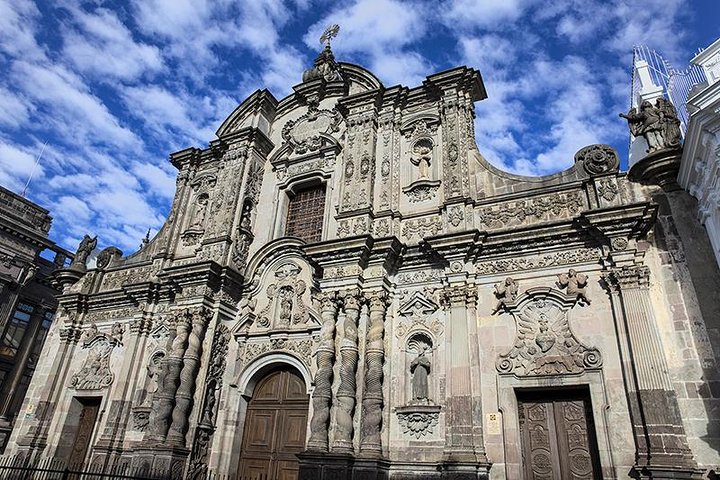
You now arrive in front of the one that is probably the most important church in Quito, that of the company of Jesus. This is the church of superlatives. Over time, it has been nicknamed “The Solomon Temple of South America,” “the Golden Ember,” and the Spanish ambassador to Ecuador has described it as “the best Jesuit temple in the world.”
This colorful mural is the magnificent work of the Spanish artist Oscar San Miguel, known as “Okuda”. His style is characterized by pop-surrealism and his works are as colorful and geometric as they are committed and full of contradictions.
Here on your right you have the cultural center called “El Tianguez”. It is a complex formed by a museum/craft shop, made up of seven exhibition and sales rooms, as well as a cultural café focused on discovering the culinary traditions of the Andes, the ocean coast and the Amazon.
The great church of San Francisco that stands before you is one of the oldest in the capital, having been built just one year after the founding of the city by Sebastian de Banalcazar after his capture of Quito.
You will certainly not contradict me, a large part of the trip takes place at the level of gastronomic discoveries! Nothing better to discover a country than to eat like its inhabitants.
From this square along the boulevard of May 24, you have a clear view of the Panecillo and its famous statue of the Virgin with angel wings. It was the Spaniards who named this hill the Panecillo, or bread roll, in relation to its shape.
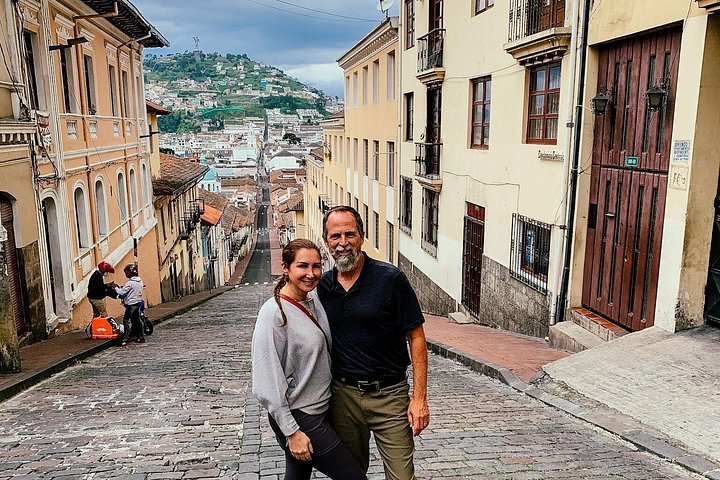
The street you are now walking up is known to be the prettiest in Quito. This well-maintained pedestrian street is as it was in the 18th century.
The large Santo Domingo Square is home to a monument to Marshal Sugar in the centre. Let me say a few words about this hero of the war of independence, admittedly less well known than his counterpart Simon Bolivar, but who liberated Quito and gave his name to the Bolivian capital of which he was the first president, as well as to the ancient currency of Ecuador.
The beautiful pale pink building you now have before you is the Teatro Bolivar. It was founded on 15 April 1933 and its large hall could accommodate more than 2,400 spectators.
Cancellation
Free cancellation up to 24 hours before the experience starts, for a full refund.
Know before you go
- Meeting point
- We build our circuits in the form of a loop so that you can easily start the tour at the point closest to you, the guidance will adapt automatically. If you are nearby, we recommend this ideal Check-out Point.
- Pickup
- Everyone meets at the starting point; there is no pickup.
- Ticket type
- Mobile or paper ticket accepted
- Operated by
- Ryo - Visites Audioguidées
- Service animals allowed
- Public transportation options are available nearby
- Suitable for all physical fitness levels
How it compares in Quito
- Its from-price is 94% below the median of the 83 city tours we list in Quito.
- It is shorter than most of them.
- The operator lists free cancellation on it.
About Quito
Quito, Ecuador's high Andean capital, has one of the best-preserved colonial centres in Latin America, ringed by volcanoes and green mountains.
The historic centre was among the very first places named a UNESCO World Heritage Site, and its churches, plazas and monasteries are spectacular. La Compañía de Jesús glows with gold leaf inside, the Basilica del Voto Nacional has gargoyles shaped like Ecuadorian animals, and Plaza Grande is surrounded by the cathedral and the presidential palace.
Top-ranked sights in Quito: Cotopaxi National Park, Basilica of the National Vow (La Basílica del Voto Nacional), Independence Plaza (Plaza de la Independencia).
Special offers in Quito
Was/now prices come from the operator, never from us.