Muynak Ship Graveyard and Ancient Mizdakhan
- 8 hours
- Free cancellation up to 24h before
- 5 languages
- Instant confirmation
Highlights
This is a fully private tour combining two of Uzbekistan's most powerful destinations in one day. No shared groups, no fixed schedules — just you and a comfortable private vehicle. At the Moynak Ship Graveyard, you'll walk freely among rusting Soviet-era vessels stranded in the middle of the desert, witnesses to one of the worst ecological disasters in history. Then stop at Mizdakhan, a 2,400-year-old necropolis where Zoroastrian and Islamic traditions intertwine amid ancient mausoleums, legends, and pilgrimage rituals found nowhere else in Central Asia. A rare journey through both natural tragedy and deep history — far off the standard tourist trail.
Inclusions
What's included
- Private vehicle provided based on group size — comfortable sedan for small groups or minivan for larger parties.
Itinerary
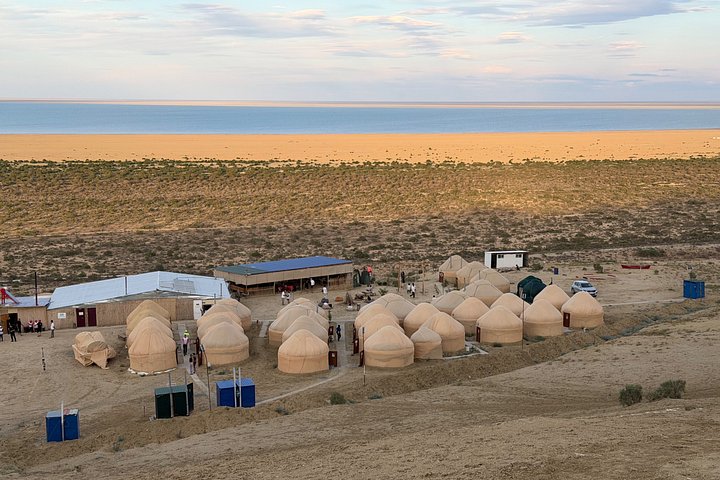
Stand among the rusting hulls of Soviet-era fishing vessels stranded in the middle of a vast desert — the Moynak Ship Graveyard is one of the most haunting sites in Central Asia. Once a thriving Aral Sea port, Moynak now sits 150 km from the water after one of the worst man-made ecological disasters in history. Explore the graveyard at your own pace, climbing around the abandoned ships and taking in the surreal landscape of endless sand dotted with sea shells — all that remains of what was once the fourth largest inland sea in the world. Nearby, the Regional History and Aral Sea Museum displays Soviet-era photographs, artifacts, and a short documentary that bring the story to life. Raw, eerie, and deeply moving — an experience unlike anything else in Uzbekistan.
Wander freely through one of Central Asia's most ancient and atmospheric sacred sites — a sprawling 200-hectare necropolis inhabited from the 4th century BC to the 14th century AD. Mizdakhan was once the second-largest city in Khorezm, where Zoroastrian and Islamic traditions intertwined over centuries. Explore at your own pace: descend into the remarkable semi-underground Mausoleum of Mazlumkhan Sulu, marvel at the seven-domed Mausoleum of Shamun Nabi, and seek out the legendary "World Clock" — an ancient crumbling wall where, according to local belief, one brick falls each year, and when the last falls, the world will end. Pilgrims stack small pyramids of seven stones nearby to hold back the apocalypse. Nearby, the ruins of Gyaur-Kala fortress — the "Fortress of the Unbelievers" — offer sweeping views across the desert landscape.
Cancellation
Free cancellation up to 24 hours before the experience starts, for a full refund.
Reviews
2.0
- 50
- 40
- 30
- 21
- 10
Ratings come from 1 reviews collected by our booking partner. They are travellers' own words, in the order they were written — never reordered to flatter the experience.
Know before you go
- Pickup
- Pickup is included for everyone.
- Ticket type
- Mobile or paper ticket accepted
- Operated by
- Aral Sea Discovery
- Public transportation options are available nearby
- Infants are required to sit on an adult’s lap
- Specialized infant seats are available
- Not recommended for travelers with spinal injuries
- Not recommended for travelers with poor cardiovascular health
- Suitable for all physical fitness levels
How it compares in Nukus
- Its from-price is 57% below the median of the 16 experiences we list in Nukus.
- It is shorter than most of them.
- By number of reviews it ranks 8 of 16.
- The operator lists free cancellation on it.
About Nukus
Nukus, capital of Karakalpakstan in north-western Uzbekistan, is a desert city known for its avant-garde art museum, within reach of the Aral Sea.
Nukus lies on the Amu Darya delta in north-western Uzbekistan, as the capital of the autonomous republic of Karakalpakstan, at the edge of the desert. It is a Soviet-era city of wide avenues and low blocks. Its great treasure is the Savitsky Museum, which holds an outstanding collection of Russian avant-garde art, gathered by the artist Igor Savitsky, who saved works banned in the Soviet era, together with Karakalpak textiles, jewellery and archaeological finds.