Khujand Private Day Tour from Tashkent
- 9 hours
- Free cancellation up to 24h before
- 3 languages
- Instant confirmation
Highlights
In this historic destination, we will see the oldest and most fascinating city in Central Asia - Khujand. We will visit the ancient Khujand Fortress, Jomi Mosque, Panjshanbe Bazar, Arbob Palace, and the beautiful Tajik Sea. The incredible city of Khujand is situated on the banks of the majestic Syr Darya, nestled below the Kayrakkum reservoir in the breathtaking Fergana Valley. Khujand is one of the oldest cities in Central Asia! Some sources even believe it was founded as far back as the 7th-6th centuries BC. It was conquered by none other than Alexander the Great himself! He rebuilt and strengthened it, calling it Alexandria Eskhata (Extreme). The Khujand Fortress was founded in the VI—V centuries BC. According to the fascinating archaeological dates, the Khujand fortress was first surrounded by a massive bulk rampart, later by a wall of remarkable thickness made of raw material. The city and the citadel — are two of the most important components of ancient Khujand.
Inclusions
What's included
- Private transportation
- Lunch
- All Fees and Taxes
- Licensed guide/driver
What's not
- Alcoholic Beverages
Itinerary
At 08:00 Pick up from Tashkent and departure to Khujand. Khujand is the second largest city in Tajikistan, an important transport hub, political, economic, cultural and scientific center of the country. Khujand is located on the banks of the Syr Darya, below the Qayroqqum reservoir, in the Fergana Valley. Khujand is one of the oldest cities in Central Asia, according to some sources, the foundation of the city falls on the VII-VI centuries BC. It was conquered by Alexander the Great, who rebuilt and strengthened it, calling Alexandria Eskhata (Extreme).
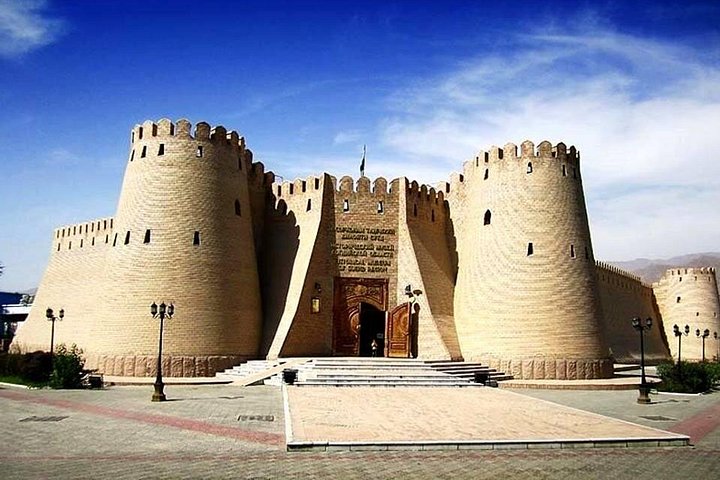
Khujand Fortress The Khujand Fortress was founded in the VI—V centuries BC. According to the archaeological dates, the Khujand fortress was first surrounded by a bulk rampart, later by a wall of considerable thickness made of raw material. The city and the citadel — components of ancient Khujand, had separate fortress walls surrounded by a wide and deep moat filled with water. The remains of these fortifications were found under the central part of the left-bank Khujand and surround the territory of the ancient city with an area of 20 hectares. With the development of the economy, trade, government system and population, the city is growing. In the VI—VII centuries, a new fortress was built. Medieval Khujand consisted of three main parts: Citadel, Shahristan and Rabad. The citadel was located on the bank of the Syr Darya at the Rabad gate. The medieval Khujand fortress was considered one of the most fortified in Central Asia.
The Jami Mosque is a complex of Sheikh Muslihiddin, a monument of folk architecture of the XVI century. The object is located on the western side of Panjshanbeh Square. The facade of the building faces Shark Street. The mosque was built in 1512-1513. The multi-column (30 columns) aivan adjoins the eastern wall of the winter hall, also multi-column (20 columns), and enters the courtyard of the mosque.
Panjshanbe Bazar is one of the attractions of Khujand, is located in the center of Khujand, and opposite it stands the mausoleum of Sheikh Muslihiddin. The bazar consists of the main pavilion and many shops, tents, and shops adjacent to it. It is always very noisy here, as not only residents of the city come to shop, but also guests from nearby villages. The main feature of the Panjshanbe Bazar is its unique architecture and decor. The bazaar building combines elements of classicism and Stalinist Empire style, and the decoration is harmoniously executed using Soviet and Oriental styles. A hemispherical portal decorated with bright paintings rises above the central entrance, and sculptures of a man and a woman are installed on the sides. If you go inside, you can see a long-vaulted hall with slender rows of columns. In Panjshanbe Bazar we have time for shopping
The Arbob Cultural Palace is a building in Khujand, Tajikistan, the former headquarters of a Soviet collective farm, built in the 1950s and modelled on the winter gardens of Peterhof, St Petersburg. The main building consists of three wings - with an ornate theatre seating 800 people in the main wing. The South wing currently houses a museum which tells the history of Arbob and of collectivization and the soviet empire in Tajikistan. The building had particular significance in 1992, when it was the site for the meeting of the Tajik Soviet which officially declared independence from the Soviet Union. It was the site where the Tajik flag was chosen. More recently, in the late 1990s it was also the site where peace conferences following the Tajik civil war were held. In particular, Tajik President Emomalii Rahmon first came to prominence speaking at the Palace, and it was the site for a "plov of peace" which celebrated successful negotiations towards an agreed end to the Tajik civil war.
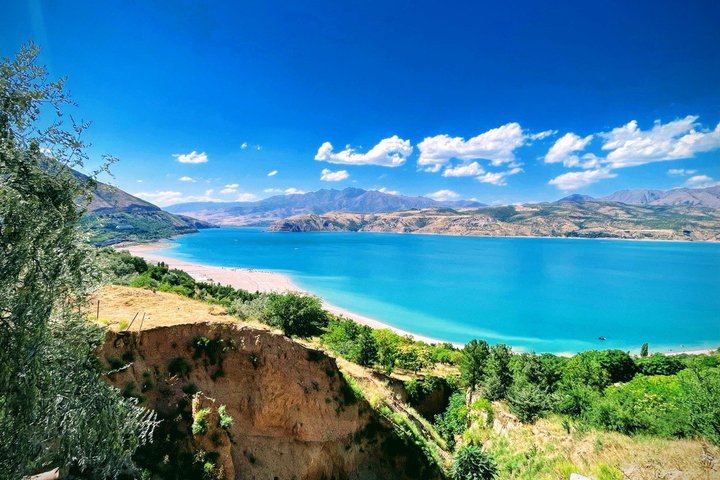
Kayrakum also spelled variously as Qayroqqum, Qayraqqum, Kayrakum or Kairakum, is a large artificial lake in Ghafurov District of Sughd Province, in northwestern Tajikistan. In 2016, the reservoir was renamed Tajik Sea (Tajik: Баҳри Тоҷик) by the country's parliament. The reservoir lies in the western part of the Fergana Valley on the Syr Darya river. The provincial capital of Khujand lies about 15 km west of the dam. A 1150 km2 tract of land encompassing the reservoir and its surrounds has been identified as an Important Bird Area (IBA) by BirdLife International because it supports 4 significant numbers of the populations of various bird species, either as residents, or as overwintering, breeding or passage migrants. In a vivid oasis of Sogd valley of Tajikistan, on a shore of a purest Kairakkum reservoir, which is also called the Tajik sea, is located a new sanatorium “Bahoriston”.
Way back to the border and seeing off with travelers
Cancellation
Free cancellation up to 24 hours before the experience starts, for a full refund.
Know before you go
- Pickup
- Pickup is included for everyone.
- Ticket type
- Mobile or paper ticket accepted
- Operated by
- Bunyod-Tour
- Wheelchair accessible
- Public transportation options are available nearby
- Specialized infant seats are available
- Transportation options are wheelchair accessible
- Suitable for all physical fitness levels
- We can accommodate dietary restrictions such as vegetarian, vegan, gluten-free, etc. If you have dietary requirements, please indicate them when booking. You can add this information under "Information travelers need from you"
How it compares in Tashkent
- Its from-price is 87% above the median of the 49 city tours we list in Tashkent.
- Its length is typical for the group.
- The operator lists free cancellation on it.
About Tashkent
Tashkent is the capital of Uzbekistan, an ancient Silk Road city of wide Soviet-era avenues, decorated metro stations, old madrasas and big bazaars.
Tashkent has been a trading city on the Silk Road for over two thousand years, but a major earthquake in 1966 destroyed much of it, and the modern capital was rebuilt with broad avenues, big squares and Soviet-era buildings. The old city, Eski Shahar, survives in pockets, with narrow lanes and mud-brick houses. The Khast Imam complex has madrasas and mosques, and its library holds the Uthman Quran, one of the oldest copies of the Quran.
Top-ranked sights in Tashkent: Uzbekistan State Museum of Applied Art, Broadway Alley.
Special offers in Tashkent
Was/now prices come from the operator, never from us.
Similar experiences
![Uzbekistan 8 Days Private Tour Tashkent-Urgench-Bukhara-Samarkand-Tashkent]() Free cancellation