Maputo Art Walking Tour
Les descriptions sont affichées en anglais.
- 3 heures
- Annulation gratuite jusqu’à 24 h avant
- 3 langues
- Confirmation immédiate
Points forts
Maputo Art & Architecture Tour it’s a tour for those who are most interested in art and architecture the best option is the Art & architecture walking tour, where we can see the best of Maputo’s art and architecture – from Art deco buildings to the ones of Pancho Guedes; from chairs and planes made out of guns and bullets by Gonçalo Mabunda to the artesans in FEIMA.
Inclus
Ce qui est inclus
- Bottled water
- All Fees and Taxes
Non inclus
- Alcoholic Beverages
Itinéraire
1- Natural history Museum (starting point): located in the Praça Travessia do Zambeze, the museum used to be called Museu Álvaro de Castro and was built in 1931 – 1933 in neo – Manueline (a kind of Portuguese gothic style ) by the municipal engineer António Ribeiro de Mendonça. The original idea had been to build a school. Worth mentioning are the collection of elephant fetuses aged 1 month to 20 months and realistic wildlife scenes (e.g. lioness tearing a zebra carcass), both are to be found in the big room downstairs. Taxidermist Peão Lopes made them, and nowadays they seem a bit dusty and not the state of the art. The elephant fetuses are said to be result of land clearance south of Maputo in the early 20th century during which around 2000 elephants were killed. There are also two rooms of traditional African art. Around the building threre are the annexes, built by architect João José Tinoco, in 1965. They are decorated with two mural paintings by Malangatana, one was painted in 1977/79 in two phases and depicts yhe fight of man in nature; the other was painted in 1989. In the workshop annex (onto which the first mural is painted) is the atelier of famous Makonde pottery artist Reinata Sadimba who works here weekdays. It is one of the most exciting and authentic experiences in Maputo to see her at work. The prime minister of the time Pascoal Mocumbi and many others invited her to come to Maputo and work in the Museum.
Nucleo De arte: Artists association, school for many Mozambican artists. There is a really nice gallery and ateliers of the artists working there. The artists are always happy to let people see them working on their paintings and sculptures. Eugenio Mucavele, always calm and concentrated, is one of the most if not the most experienced artist we always meet when we go to Nucleo.
Vila Algarve: built in 1934 by architect Augusto da Silva Pinto and engineer Alfredo F. Soares in the “português suave” style for Joé dos Santos Rutino who was a photographer and had a stationary shop but more lucratively also held the lottery concession. He came from the Algarve region in Portugal. The elaborate hand painted tiles (azulejos) were produced by the Aleluia company. In 1952 the Portuguese secret police PIDE took over the building . in the basement was the interrogation chamber called Kula, which in Shangaan means, “where one us eaten up”. Franciso Langa or “Chico Feio” was the main torturer here. Langa suffered a violent death after independence in 1975 – he was cut to pieces in his house
7- Wedding palace:The Palácio de Casamentos, the marriage palace was built in 1931 – 1934 by Agapus Nicolau and Nicolas Kassimatis as the “ateneu Grego”, the community center of the Greek colony. It was open to all, one of the favorite events being its well-known dance matinees. Inside it is possible to see how civil marriages are performed with style and singing. There are a few high quality artworks, a huge painting by Malangatana of 1979/80”the long passage towards marriage”, a carved pilar by Alberto Chissano and in the basement two painted concrete reliefs.
11- Polana: was commissioned by the Delagoa Bay Lands Syndicate, whose local representative was Leo Cohen. The building was completed in 1922. It is said to have been designed by Sir Herbert Baker (who also designed the Union Buildings in Pretoria), but the responsible architect was actually Walter Reid, the contractor was Hugh Le May. Polana was the name of the African Chief who had lived near the site, whose lands had been sold to sommerschield without compensation and whose descendants were finally evicted from the area in 1946. The tramway at that time came up to the hotel. There were tennis courts and a golf course (the golf club had been laid out in 1914 in the area where the “lemon squeezer” church is today). The hope was that Maputo would become the preferred holiday destination for wealthy people from Transvaal. Prior to independence around a million tourists came to Lourenço Marques from South Africa alone every year. They came for the latin atmosphere, the fado, the nightlife, the beaches, the Portuguese wines, the good beer, the famous shrimps and also for big-game hunting further north. At the time the Polana was one of the most modern hotels in the hemisphere and seemed quite out of place in the still rather backward Lourenço Marques. In 1936 the hotel was sold to I. W. Schlesinger. His son in turn sold it to a Portuguese group in 1963. The hotel was a center of espionage during the Second World War. Portugal was neutral and it was here that spies both of the Axis and Allies met with their sources. The British spy Malcolm Muggeridge was pitched against Italian Consul Umberto Campani and Lutpold Werz of the German Consulate. This were supplying information to German submarines lying in wait in the waters between Mozambique and Madagascar, preying on allied ships supplying the battle theaters of Russia, Egypt and India.
Lemon squeezer: the lemon squeezer or Polana Church was built in 1962 by Nuno Craveiro Lopes (son of the former Portuguese president). There is a miniature replica in the garden on the corner. It is also impressive inside. Sociedad Mauméjean Hermanos in Madrid produced the stained glass.it is commonly called lemon squeezer or inverted flower because of its shape.
FEIMA: handicraft market with nice restaurants. This is the ideal place to buy souvenirs to take back home. From fridge magnets to capulanas,
Annulation
Annulation gratuite jusqu’à 24 heures avant le début de l’expérience, avec remboursement intégral.
Avis
4,8
- 520
- 40
- 30
- 20
- 11
Les notes proviennent de 21 avis recueillis par notre partenaire de réservation. Ce sont les mots des voyageurs, dans l’ordre où ils ont été écrits — jamais réorganisés pour flatter l’expérience.
À savoir avant de partir
- Point de rendez-vous
- In front Office the Natural History Museum
- Prise en charge
- Tout le monde se retrouve au point de départ ; il n’y a pas de prise en charge.
- Type de billet
- Mobile or paper ticket accepted
- Taille du groupe
- Jusqu’à 20 voyageurs
- Opéré par
- Maputo Tour Guides
- Wheelchair accessible
- Public transportation options are available nearby
- Infants are required to sit on an adult’s lap
- Specialized infant seats are available
- Suitable for all physical fitness levels
How it compares in Maputo
- Its from-price is 81% below the median of the 106 experiences we list in Maputo.
- It is shorter than most of them.
- By number of reviews it ranks 11 of 106.
- The operator lists free cancellation on it.
About Maputo
Maputo is the capital of Mozambique, a seaside city of tree-lined avenues, Portuguese-era buildings, lively markets and fresh prawns.
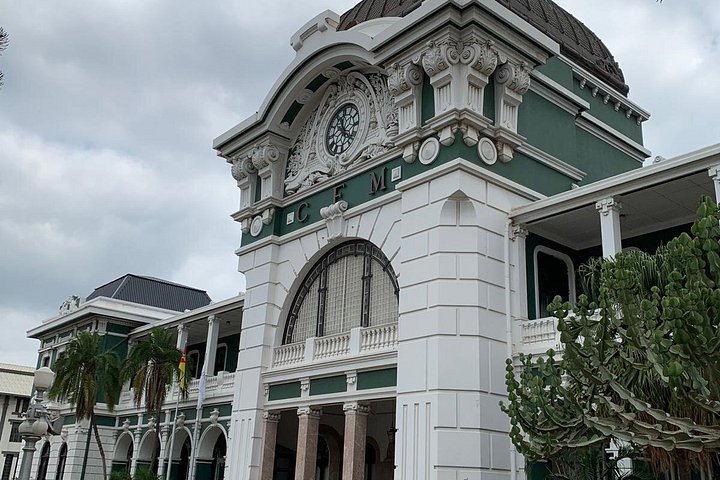
Maputo sits on a bay of the Indian Ocean in the far south of Mozambique, and until 1976 it was called Lourenço Marques. Its grid of wide avenues is lined with jacaranda and acacia trees and with colonial buildings of the early twentieth century, among them the domed railway station and the City Hall. The old Fortress, a stone fort begun in the eighteenth century, stands near the port, and the Central Market is a large hall of fruit, fish and spices.
Top-ranked sights in Maputo: Feira de Artesanato, Flores e Gastronomica (FEIMA), Maputo Special Reserve (Reserva Especial de Maputo), Maputo Central Market.
Offres spéciales à Maputo
Les prix barrés viennent de l’opérateur, jamais de nous.