Explore Evoa with Praca do Giraldo Walking Tour
Les descriptions sont affichées en anglais.
- 1,5–2 heures
- Annulation gratuite jusqu’à 24 h avant
- 7 langues
- Confirmation immédiate
Points forts
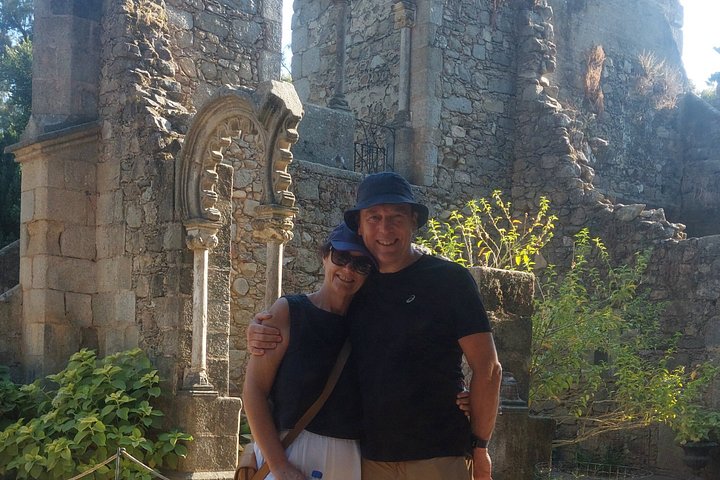
Evora is a city that recycled its own past, and this self-guided walking tour follows that reused stone through the golden UNESCO capital of the Alentejo. A Roman temple survived five centuries walled up as a butcher's shop. A 16th-century aqueduct has whitewashed houses built into its arches. One chapel is lined with the bones of five thousand people. Everything runs from your smartphone, with no app to download: a clear map of all 10 stops, walking directions, and a short audio story at each location followed by an interactive quiz that turns the walk into a game rather than a lecture. The route covers about 2 km at an easy pace, from the Agua de Prata Aqueduct and a hidden Roman gate to the Roman Temple, the fortress cathedral, the Chapel of Bones, the palace where Vasco da Gama received his command, the old Jewish quarter and Praca do Giraldo. Start any time, pause for a coffee, pick it back up. No groups, no schedule, no physical guide. Audio and text in 7 languages.
Inclus
Ce qui est inclus
- Self-guided tour on your smartphone, APP not needed!
- Audioguide with quizzes about each point of interest along the tour
Non inclus
- A physical guide (the tour is accessible on your smartphone)
- Access offline. Internet needed on your phone
Itinéraire
A 16th-century granite aqueduct, built between 1531 and 1537 under King John III to bring spring water into the walled city. Along Rua do Cano the arches taper as they run inland, and residents filled the bays between the piers with whitewashed houses, cafes and workshops that still use the monument as a party wall.
A Roman gate from the Cerca Velha, Evora's earliest defensive wall, built between the late 2nd and early 3rd centuries. Its heavy rusticated granite blocks now sit flush against whitewashed houses at the corner of Rua de Dona Isabel and Rua do Menino Jesus, the guard towers long gone.
The ducal palace of the Cadaval family and its private Church of Saint John the Evangelist, known locally as the Igreja dos Loios. Founded in 1485, the nave was lined in cobalt-and-white azulejos by Antonio de Oliveira Bernardes in 1711; grates in the floor reveal a Moorish cistern and a monastic ossuary below.
Fourteen granite columns with Estremoz marble Corinthian capitals, built in the early 1st century CE at the centre of the Roman forum. Long nicknamed the Temple of Diana, archaeological evidence points to the imperial cult of Augustus. Walled up as a castle store and municipal slaughterhouse until 1836, which is why it survived.
Portugal's largest medieval cathedral, begun in 1186 with castle-grade granite walls, machicolations and two mismatched towers. The Apostles Portal carries rare 14th-century free-standing marble apostles, and the nave holds a 15th-century Nossa Senhora do O showing the Virgin visibly pregnant.
A white marble globe fountain of 1556, commissioned by Cardinal Infante D. Henrique and designed by Diogo de Torralva, in a square ringed by manor houses. Water fell from winged seraph spouts into a raised drinking basin, with the overflow feeding a lower street-level trough for pack and riding animals.
A 16th-century ossuary inside the Church of Saint Francis, where Franciscan friars lined the walls and eight pillars with the bones of roughly five thousand people cleared from overcrowded graveyards. The doorway inscription reads, in translation, that the bones here wait for yours.
The surviving Ladies' Gallery of King Manuel I's royal palace, with late Gothic horseshoe-arched loggias. Vasco da Gama was formally given command of the India fleet inside this complex in 1497. The gallery outlived the rest because it was turned into an armoury during the 1640 Restoration War.
The lanes of Evora's medieval Jewish quarter, which before the expulsion edict of 1496 held one of Portugal's wealthiest Jewish communities. Small vertical slots cut into the granite doorposts mark where mezuzot were once fixed; residents later filled them with plaster, and the cavities survive today.
Evora's main square and the end of the walk, framed by arcades and paved in patterned calcada. At its centre stands the 1570 white marble fountain by royal architect Afonso Alvares, with eight mask spouts for the eight streets that run off the square into the old town.
Annulation
Annulation gratuite jusqu’à 24 heures avant le début de l’expérience, avec remboursement intégral.
À savoir avant de partir
- Point de rendez-vous
- Start your self-guided tour on Rua do Cano, beneath the arches of the Agua de Prata Aqueduct. Open your Ciceru experience nearby and follow the route on your smartphone.
- Prise en charge
- Tout le monde se retrouve au point de départ ; il n’y a pas de prise en charge.
- Type de billet
- Mobile or paper ticket accepted
- Opéré par
- Ciceru
- Service animals allowed
- Public transportation options are available nearby
- Not recommended for travelers with spinal injuries
- Not recommended for pregnant travelers
- Not recommended for travelers with poor cardiovascular health
- Suitable for all physical fitness levels
How it compares in Setúbal District
- Its from-price is 91% below the median of the 251 experiences we list in Setúbal District.
- It is shorter than most of them.
- The operator lists free cancellation on it.
About Setúbal District
Setúbal District lies across the Tagus from Lisbon, with the cliffs of Arrábida, the dolphins of the Sado estuary, fishing towns and long Atlantic beaches.
Setúbal District lies south of Lisbon on the far side of the Tagus, stretching from the estuary down the coast towards Sines in the Alentejo. Its heart is the Setúbal Peninsula, a land of limestone hills, pine woods, vineyards, fishing towns and long beaches. The city of Setúbal, on the Sado estuary, has a port, a market and the Convent of Jesus, with an early Manueline church. Palmela's hilltop castle looks over the vineyards and the estuary.
Top-ranked sights in Setúbal District: Arrábida Natural Park (Parque Natural da Arrábida), Sesimbra, Bacalhôa Wines of Portugal (Bacalhôa Vinhos de Portugal).
Offres spéciales à Setúbal District
Les prix barrés viennent de l’opérateur, jamais de nous.