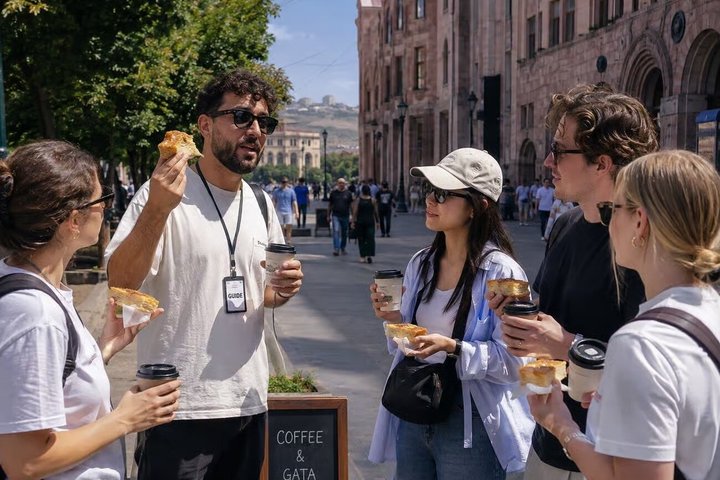
Private Tour to Garni Temple, Geghard Monastery, Echmiadzin Cathedral, Zvartnots
- 7 hours
- Free cancellation up to 24h before
- 2 languages
- Instant confirmation
Highlights
Visit the unique places included in this tour – the most famous & UNESCO listed places in Armenia: Garni temple, Geghard Monastery, Echmiadzin Cathedral and Zvartnots Temple with Jan Armenia Tours & Travel company! During this 9-hour private tour you will see a series of landmarks, you will discover the culture and history of Armenia starting from Paganism to Christianity . Choose one of the presented individual tours, customize it or create your private tour in Armenia with us! Book the tour & Let us show you the Land of old Legends, Biblical Stories and Ancient History!
Inclusions
What's included
- Private transportation
- Hotel pickup and drop-off
- Bottled water
- WiFi on board
- Professional guide (if the guide option is selected)
- Air-conditioned vehicle
- Professional driver
What's not
- Food and drinks
- Lunch
- Echmiadzin Treasury museum
- Zvartnots cathedral
- Garni temple and Symphony of the Stones
- Anything not mentioned in the “Inclusions” section
Itinerary
Charents Arch is located near Yerevan, between the pagan temple of Garni and Geghard Christian monastery complex in the village of Vokhchaberd. At first glance, the Arch seems to be the most ordinary and unremarkable, but coming closer, passing to the platform inside the arch and looking at the panorama, everything becomes clear – this is the best place to admire the great and sacred mountain of Ararat, to be in unity with it and enjoy the beautiful scenery.
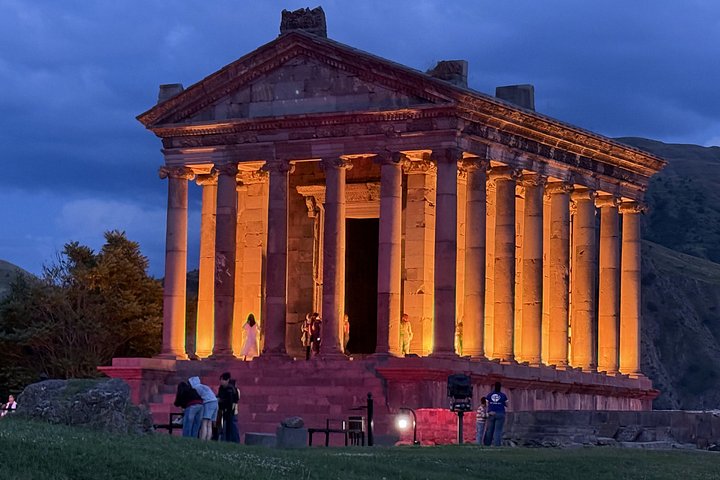
The pagan temple of Garni was built in the second half of the 1st century by King Trdat III. This is the only pagan temple, which has been preserved on the territory of Armenia. After the adoption of Christianity it became the summer residence of Khosrovadukht, sister of King Trdat III. It was destroyed in 1679 by an earthquake. Parts, fragments of graceful columns and wall stones were spread around the temple. It is supposed that the temple was dedicated to Mithra, the God of the Sun. The temple of Garni is included in UNESCO World Heritage List.
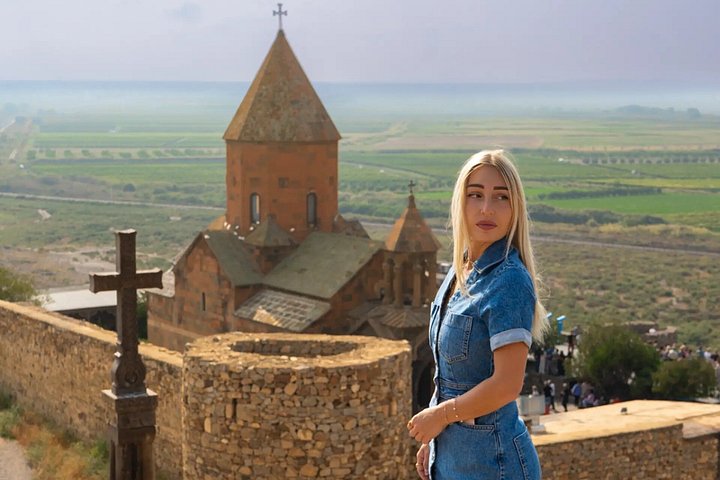
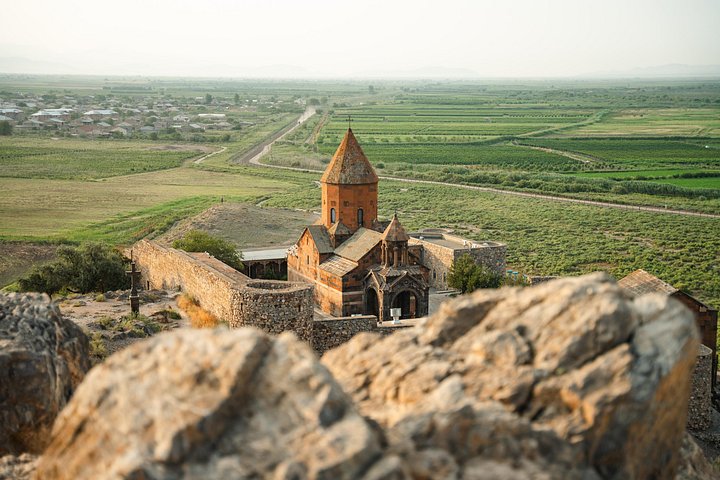
Geghard Monastery is one of the greatest medieval architectural structures in Armenia. Geghard is completely hollowed out in a cave, it is also called a “cave monastery”. This monastery was founded in the 4th century AD. in place of the sacred spring, originating in the cave. The name of the monastery complex Geghard (spear) comes from the Langin’n spear, which pierced the body of Jesus Christ on the cross. At the moment this spear is kept in the museum of Etchmiadzin. The monastery complex Geghard is included in UNESCO World Heritage List.
The first Christian cathedral of Echmiadzin was founded in the IV century BC, whose name means “place of the descent of the Only Begotten.” A feature of the Cathedral is that in addition to the main altar in the eastern part, there is another altar in the middle, at the site of the descent of Christ. In the right-hand boundary of the Etchmiadzin Cathedral there is the Treasury Museum, where are kept relics, church clothes, embroidered with gold and pearls, catholicos’ staffs and crosses, numerous ritual objects made of gold, silver and ivory. On the territory of the monastery complex is also the residence of the Armenian patriarch – the Catholicos of all Armenians. Also here you will see many cross-stones, of which “Amenaprakich” (1279), and the cross-stone devoted to the victims of the 1915 genocide.
The Temple of Saint Hripsime was founded in the 7th century by Catholicos Komitas I Aghtsetsi in the place of a sepulcher of Saint Hripsime. Since 2000 Saint Hripsime Temple has been included in UNESCO World Heritage List. Two prominent Armenian Cathlicoses are buried in the court yard of Saint Hripsime Temple. They are Catholicos Astvatsatur (1715-1725) and Catholicos Garaped II Oolnetzi (1725-1729).
St. Gayane Temple was built in honor of St. Gayane in the VII century on the place of IV century chapel, which is one of the best monuments of Armenian architecture. The relics of Saint Gayane are kept in the southern wall of the temple, next to the altar niche. Above the western entrance, there was preserved the murals of the 17th century on the theme of the birth of Christ. Near the Saint Gayane Temple there is a special room where animals are sacrificed and stabbed from the time of St. Gregory the Illuminator. This rite is called – matah, which is customary to perform for any occasion: weddings, birth of a child, etc.
Тhe magnificent Zvartnots Temple, which mean “Temple of Vigil Forces”, was built in the VII century. The temple was built for 20 years. Unfortunately, Zvartnots was destroyed by a powerful earthquake in the XX century and only its ruins remained. But even the ruins of this temple give us an idea of its rare and majestic beauty. Today the Zvartnots Temple is an archaeological reserve and museum founded in 1937, where you can see model-versions of the reconstruction of the temple, numerous sculptural fragments, impressive in size. The ruins of Zvartnots Temple are included in UNESCO as World Heritage Site.
Cancellation
Free cancellation up to 24 hours before the experience starts, for a full refund.
Reviews
5.0
- 57
- 40
- 30
- 20
- 10
Ratings come from 7 reviews collected by our booking partner. They are travellers' own words, in the order they were written — never reordered to flatter the experience.
Know before you go
- Pickup
- Pickup is included for everyone.
- Ticket type
- Mobile or paper ticket accepted
- Operated by
- Jan Armenia Tours
- Specialized infant seats are available
- Public transportation options are available nearby
- Suitable for all physical fitness levels
How it compares in Yerevan
- Its from-price is 13% below the median of the 769 experiences we list in Yerevan.
- Its length is typical for the group.
- By number of reviews it ranks 187 of 769.
- The operator lists free cancellation on it.
About Yerevan
Yerevan is Armenia's pink-stoned capital, a city of wide squares, café terraces and museums, with Mount Ararat standing on its southern skyline.
The city grew around Erebuni, a fortress founded in 782 BC, though most of today's centre was built in the Soviet era from the soft pink and orange tuff that earned Yerevan its nickname, the Pink City. Republic Square is the hub, framed by government buildings and museums. The Cascade, a giant stairway of terraces and sculpture, climbs a hillside, and the Matenadaran holds a famous collection of medieval manuscripts.
Top-ranked sights in Yerevan: Republic Square, Tsaghkadzor Ropeway, Matenadaran (Mesrop Mashtots Institute of Ancient Manuscripts).
Special offers in Yerevan
Was/now prices come from the operator, never from us.

Similar experiences
 Likely to sell outFree cancellation
 Likely to sell outFree cancellation
![Group Tour: Gyumri (Urban Life museum, Black fortress, old town), Harichavank]() Free cancellation