Anjar, Baalbek & Ksara Winery Small-Group Tour | Lunch included
- 8 hours
- Free cancellation up to 24h before
- 2 languages
- Instant confirmation
Highlights
The Bekaa Valley delivers three completely different historical registers in a single day — and this guided small-group tour covers all of them. Anjar: the only surviving Umayyad palatial city in the Levant, built and abandoned in the 8th century and never reoccupied. Baalbek: a UNESCO World Heritage Site where the Romans built temples on a scale that has never been equalled. Ksara: Lebanon's oldest winery, founded by Jesuits in 1857, with 2 kilometres of Roman cave cellars beneath it. Lunch and all entrance tickets included. Your guide connects the three stops into a single coherent narrative — Umayyad city-planning, Roman engineering at its most ambitious, and a winery that has been producing Lebanese wine since the Ottoman era. The Stone of the Pregnant Woman — a 1,000-tonne Roman quarry block abandoned 2,000 years ago — sets the scale before you even enter the temple complex.
Inclusions
What's included
- Lunch in a local restaurant (if option selected)
- Entry/Admission - Anjar ( if option Selected )
- Hotel Pick up & Drop off
- Entry/Admission - Temples of Baalbek ( if option Selected )
- Air-conditioned vehicle
- Professional Guide
What's not
- Gratuities
- Entry/Admission - Chateau Ksara
- Food or drinks unless specified
Itinerary
8:30 AM — Departure from Beirut Your guide meets the group at your hotel and heads east on the Damascus highway — climbing through the Lebanese mountains as the Bekaa Valley opens below.
Anjar — the only surviving Umayyad palatial city in the Levant Built in the early 8th century by Caliph Walid I — the ruler who also commissioned the Umayyad Mosque in Damascus and the Al-Aqsa Mosque in Jerusalem — and abandoned just decades later, never rebuilt. Colonnaded streets dividing the city into four quarters, a grand palace with over 40 towers, a mosque, and bathhouses — all still standing in the Bekaa plain. Most visitors to Lebanon drive straight past without stopping. Your guide makes sure you understand exactly what you are looking at and why it matters.
Stone of the Pregnant Woman — the quarry that sets the scale Before the temples — a stop at the ancient Roman quarry to see the Stone of the Pregnant Woman. A single limestone block, 21 metres long, weighing an estimated 1,000 tonnes, still lying where it was cut 2,000 years ago. Never moved. Your guide explains the engineering logic behind it — and why standing next to this unfinished block makes everything at the temple complex make more sense.
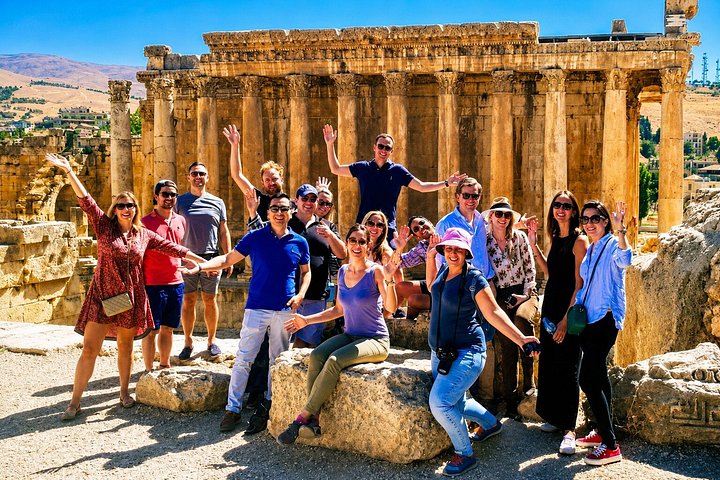
Baalbek Temple Complex — the greatest Roman temples ever built The Temple of Jupiter stands on Trilithon stones each weighing over 800 tonnes — the largest dressed stones in human history. The Temple of Bacchus is larger than the Parthenon and almost entirely intact — the best-preserved Roman temple in the world. The Temple of Venus completes a complex that took three centuries to build. Your guide covers the full architectural, religious, and historical significance of Baalbek — one of the most extraordinary sites on earth — in the time available, making every minute count.
Lunch in Zahle or Baalbek — included Lebanese mezze and grilled meats — either in Baalbek or at a riverside restaurant in Zahle, Lebanon's celebrated food capital, depending on the day and group preference. Fully included in the tour price.
Chateau Ksara — Roman caves, Lebanese wine, founded 1857 Lebanon's oldest winery — founded by Jesuit monks in 1857 — with 2 kilometres of Roman cave cellars discovered beneath it in the 19th century, where wine ages at a naturally constant temperature year-round. The cave tour comes first — ancient tunnels that connect directly to the Roman history you have just seen at Baalbek — then a tasting of Ksara's iconic Cabernet-Syrah blends, crisp Blanc de Blancs, and celebrated Sunset Rosé. Your guide frames the winery visit within the broader Roman story of the Bekaa Valley.
Return to Beirut — approx. 6:00–7:00 PM Drop-off at your Beirut hotel — the Umayyad, Roman, and Ottoman layers of the Bekaa Valley covered in a single guided day, from a ghost city to the world's greatest temples to ancient wine caves.
Cancellation
Free cancellation up to 24 hours before the experience starts, for a full refund.
Reviews
5.0
- 51
- 40
- 30
- 20
- 10
Ratings come from 1 reviews collected by our booking partner. They are travellers' own words, in the order they were written — never reordered to flatter the experience.
Know before you go
- Pickup
- Pickup is included for everyone.
- Ticket type
- Mobile or paper ticket accepted
- Group size
- Up to 15 travellers
- Operated by
- Lebanon Tours
- Specialized infant seats are available
- Suitable for all physical fitness levels
How it compares in Beirut
- Its from-price is 45% below the median of the 442 experiences we list in Beirut.
- Its length is typical for the group.
- By number of reviews it ranks 251 of 442.
- The operator lists free cancellation on it.
About Beirut
Beirut is Lebanon's capital on a Mediterranean headland, a Phoenician port city with Roman remains and mountains rising close behind.
Beirut juts into the Mediterranean on a rocky headland, with the snow-streaked peaks of Mount Lebanon rising behind. Founded by the Phoenicians, it became the Roman city of Berytus, famed for its school of law, and the remains of Roman baths lie in the city centre. The Mohammad Al-Amin Mosque, with its blue domes, and the nearby churches of St George show the mix of faiths.
Top-ranked sights in Beirut: Jeita Grotto, Our Lady of Lebanon (Notre Dame du Liban), Byblos (Jbeil).
Special offers in Beirut
Was/now prices come from the operator, never from us.