Central Naples Bike Tour
Las descripciones se muestran en inglés.
- 3 horas
- Cancelación gratuita hasta 24 h antes
- 6 idiomas
- Confirmación inmediata
Destacados
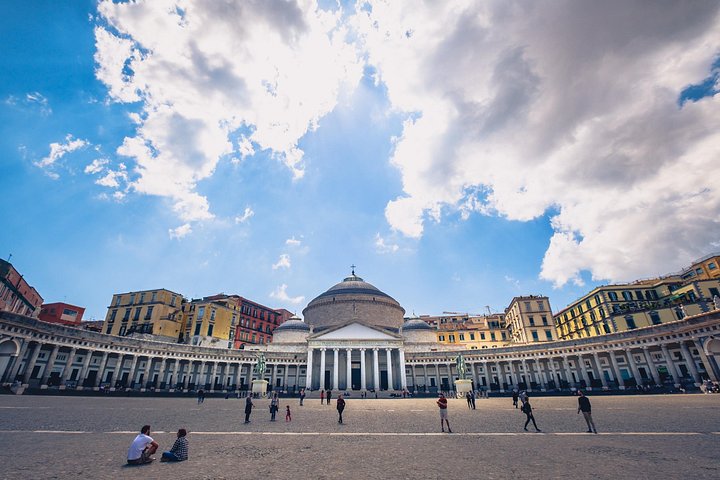
Explore Naples on a 3-hour bike tour. Discover the city's highlights such as Castel dell'Ovo, Gesu' Nuovo church and Piazza del Plebiscito.
Incluye
Qué incluye
- Local guide
- Use of bicycle and helmet
- 1 bottle of water
Qué no incluye
- Food and drinks
- Hotel pickup and drop-off
- e-bike extra fee (payment on site)
Itinerario
One of the most important squares of the city, rich in history and art, the square is close both to the area of the historical center and to the streets direct to the sea of Naples.
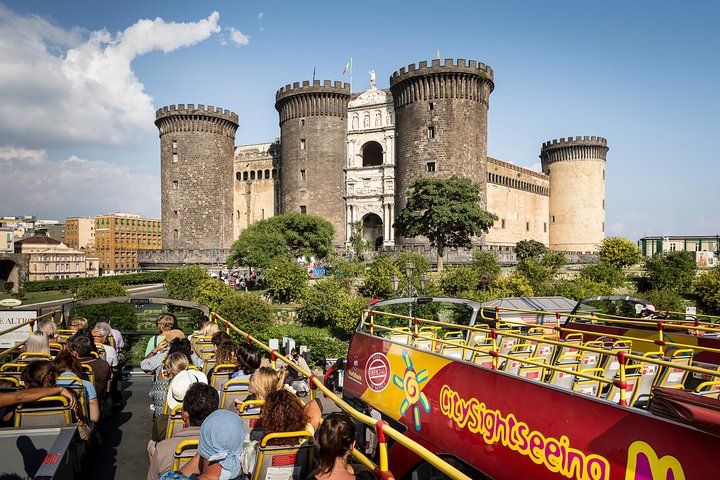
Located on the island of Megaride, where according to legend, the dead body of the mermaid Parthenope ran aground. It was here that the Cumans landed in the 6th century BC to found the first nucleus of the future city. It was here that Lucullus, returning from Asia with immense wealth, had a sumptuous residence built for him which extended as far as Mount Echia; here in the fifth century BC, the cenobite monks who built some monasteries lived; here landed and found refuge S. Patrizia having fled his uncle and emperor of the East; here the armies of Duke Sergio expelled the monks to set up a military garrison; here Roger the Norman assembled his army; here too, finally, Robert d’Anjou erected a real castle by giving it strong square towers and which today still force respect. The castle had even the role of prison, there were imprisoned Romulus Augustine, last emperor of the West; many Jacobins, Carbonari and liberals among whom Francesco de Sanctis.
The history of the Royal Palace (Palazzo Reale) of Naples dates back to the early seventeenth century under the Spanish occupation of the city, who decided to build a modern palace, large and well decorated. The monument was designed by Domenico Fontaine (1543 – 1607), on a model of Renaissance style, then enlarged and decorated in the eighteenth and nineteenth centuries. For three centuries, from 1600 to 1946, the Royal Palace was the seat of monarchical power in Naples and southern Italy, first inhabited by the Spaniards, then the Austrians, then by the Bourbons, and finally by the House of Savoy . The house of Savoy, at the head of the newly built Italian state, add on the facade of the Palace 8 statues representing the founders or the most illustrious sovereigns of the dynasties who reigned over Naples. From left to right: Roger the Norman, Frederick II of Svevia, Charles of Anjou, Alphonse of Aragon, Charles V, Charles III of Bourbon, Murat and Victor Emmanuel II.
In the heart of the inner city, in piazza del Gesú, there is the breathtaking church of Gesu' Nuovo which is an exquisite example of the Baroque, from the unique façade faced with diamond-shaped ashlars to the marvellous interiors in marble. It was originally a palace built in 1470 for Roberto Sanseverino, Prince of Salerno and became the centre of Neapolitan life. The façade is unique with its diamond shaped ashlars and its spectacular interiors made of marble. In the 1580s it was converted into a church by the Jesuits. The grandiose plan included a Greek cross church with its longitudinal arm slightly elongated, a great dome in the middle and four minor lateral ones. The interior is decorated with typical features of the Baroque style, like the elegant coloured marble creating illusions of vases with flowers, festoons, and masks embellished the architrave. Here worked the most important Neapolitan master painters, like Francesco Solimena, who frescoed the inner façade in 1725
It was the main decumanus or Decumanus Maggiore — that is, the main east-west street—of the ancient Greek and then Roman city of Neapolis, paralleled to the south by the lower decumanus (Decumano Inferiore, now called Spaccanapoli) and to the north by the upper decumanus (Decumano Superiore) (now via Anticaglia and Via della Sapienza). The three decumani were (and still are) intersected by numerous north-south cross-streets called cardini, together forming the grid of the ancient city. The modern streets/alleys that overlie and follow the ancient grid of these ancient streets. The street runs from the church of San Pietro a Maiella and adjacent Naples Music Conservatory at the west end of the old city for about three-quarters of a mile, passing the central cross-road at via San Gregorio Armeno, then crossing via Duomo near the Cathedral of Naples and ending at what was, until quite recently, the main Naples courthouse (Italian: Tribunale).
The French writer Stendhal had a profound love for Naples, and in the first half of the eighteenth century he called Via Toledo "the most populous and happy street in the world". And as you'll see, it has remained that way up to today, with its animated stores that make it the heart of Neapolitan shopping, but also its numerous civil and religious buildings. So begin cycling down this main road of the city, whose eastern limit is the popular and genuine "Spanish Quarter" that was built in the first half of the sixteenth century by Viceroy Pedro Álvarez de Toledo. The quarter stands where the city's original Aragonese-era western wall once stood, which essentially marked the border of the Greek-Roman city.
The 3 “Decumani” are the main roads that traverse the city from east to west, crossed by the “Cardini” from north to south. These words come from Latin, but the orthogonal city map was made by Greek, who founded the ancient “Neapolis”: they named those streets respectively “plateiai” and “stenopoi”.
A beautiful waterfront to see but also rich in history and culture, Lungomare Caracciolo takes its name from Via Caracciolo, the street is bordered by the sea of the city of Naples. A long and wide way to find important points of interest such as the Villa Comunale and the Riviera di Chiaia area.Lungomare Caracciolo extends along most of the coast of the city of Naples, crosses many areas: Via Santa Lucia where there is the famous church of Santa Lucia, the area of Borgo Marinaio with its very characteristic little port full of local and the Castel dell'Ovo, the area of the Riviera di Chiaia known for shopping and nightlife, the end is in the ascent of Posillipo that leads to a high part of the city. The name of the Lungomare is dedicated to Admiral Francesco Caracciolo, even if someone call it Mergellina or in recent years 'Lungomare Liberato', a historic hero of the Neapolitan Republic who was executed right in the waters of the nearby sea on his boat.
Piazza del Municipio is one of the largest squares in Europe and one of the most important in the city due to its proximity to marina, Maschio Angioino, San Giacomo palace, the Town Hall, and a Via Toledo. There is also the important Neptune Fountain. During the construction of the "Municipio" station, the 1 line of the Metro and the 6 line, have been brought to light of the very important archaeological finds (about 3000) dating back to the period from Roman times to some nineteenth-century buildings. In addition to the findings found (amphorae, ships, caravels, ancient walls completely intact) a real discovery was discovered citadel of Roman times which also includes a spa complex. Piazza Municipio is destined to become, therefore, a new archaeological site located in the city center from where you can admire the remains of the ancient port of the Greek-Roman Neapolis, whose exhibits will be on display in the "Neapolis station-museum" of Piazza Municipio.
Cancelación
Cancelación gratuita hasta 24 horas antes del inicio, con reembolso completo.
Opiniones
4,7
- 579
- 419
- 34
- 20
- 12
Las valoraciones proceden de 104 opiniones recogidas por nuestro socio de reservas. Son palabras de los viajeros, en el orden en que se escribieron — nunca reordenadas para favorecer la experiencia.
Antes de ir
- Punto de encuentro
- Primary location: Bicycle House - Nested in a 19th century art-decò style passage, conveniently located just in front of the MANN - National Archaeological Museum, our bike bar&shop welcomes the guests, catering them with drinks, coffee, snacks, fresh smoothies, toilets and luggage deposit.
- Recogida
- Todos se reúnen en el punto de inicio; no hay recogida.
- Tipo de entrada
- Mobile or paper ticket accepted
- Tamaño del grupo
- Hasta 20 viajeros
- Operado por
- Biketour Napoli
- Not recommended for pregnant travelers
- Not recommended for travelers with spinal injuries
- Not recommended for travelers with poor cardiovascular health
- Public transportation options are available nearby
- Specialized infant seats are available
- Suitable for all physical fitness levels
- Please contact local supplier post-booking to set departure time and location
- A cellular phone number, country code included, must be provided at the moment of the booking to be contacted on the field
How it compares in Nápoles
- Its from-price is 78% below the median of the 3135 experiences we list in Nápoles.
- It is shorter than most of them.
- By number of reviews it ranks 170 of 3135.
- The operator lists free cancellation on it.
About Nápoles
Apasionada y caótica a los pies del Vesubio, Nápoles es la cuna de la pizza y la puerta de Pompeya, Capri y la costa amalfitana.
El centro histórico, una densa cuadrícula de calles trazada por los antiguos griegos, es un mundo de iglesias, hornacinas callejeras y ropa tendida entre balcones. Spaccanapoli lo atraviesa en línea recta, la Via San Gregorio Armeno está flanqueada de talleres de belenes y la Capilla Sansevero guarda el asombroso Cristo velado. Bajo tierra, túneles y cisternas revelan la ciudad griega y romana que yace debajo.
Top-ranked sights in Nápoles: Mt. Vesuvius (Monte Vesuvio), Via dei Tribunali, Naples Historic Center (Napoli Centro Storico).
Ofertas especiales en Nápoles
Los precios tachados vienen del operador, nunca de nosotros.
 -10 %Cancelación gratuita
Private Walking Tour to Piazzas and Historical Sights in Naples
desde
407 US$367 US$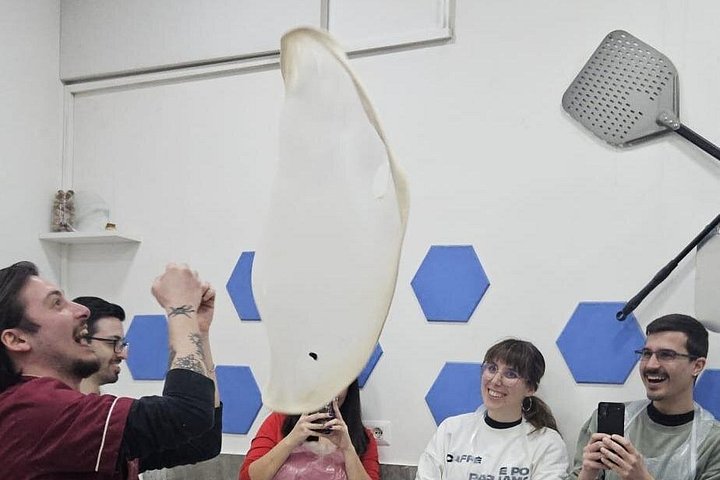 -20 %Cancelación gratuita
Naples Official Pizza Making Class & Tiramisu Cooking class
desde
56 US$45 US$![Día completo Sorrento, Costa Amalfitana, Pompeya desde Nápoles o Salerno]() -13 %Cancelación gratuita
Día completo Sorrento, Costa Amalfitana, Pompeya desde Nápoles o Salerno
desde
149 US$129 US$![Experiencia de día completo en la Costa Amalfitana con opción de barco]() -10 %Cancelación gratuita
Experiencia de día completo en la Costa Amalfitana con opción de barco
desde
113 US$102 US$![Desde Nápoles grupo pequeño Sorrento Positano & Amalfi con tour en barco]() -25 %Cancelación gratuita
![Tour de arte callejero por el Barrio Español y Nápoles Underground]() -8 %Cancelación gratuita
Tour de arte callejero por el Barrio Español y Nápoles Underground
desde
27 US$25 US$

Experiencias similares
- -20 %Cancelación gratuita
Naples Official Pizza Making Class & Tiramisu Cooking class
desde
56 US$45 US$  Cancelación gratuitaSin colas
 Cancelación gratuita
![Excursión de un día a Pompeya y el Monte Vesubio desde Nápoles con almuerzo de pizza]() Cancelación gratuita
![Nápoles : Tour por la costa de Amalfi con Villa Rufolo y Barco opcional]() Cancelación gratuita


Bus turístico en Nápoles
 -20 %Cancelación gratuita
Nápoles desde las colinas hasta el centro y autobús turístico
desde
63 US$50 US$