Private Tour Ancient Dark Rome: Catacombs and Aqueducts Park
Le descrizioni sono mostrate in inglese.
- 4 ore
- Cancellazione gratuita fino a 24 h prima
- 6 lingue
- Conferma immediata
In evidenza
One of the most peculiar aspect of Roman civilization is the care for what nowadays its call infrastructures and services. Romans roads pride of Romans engineers would link the capital to the entire empire up to its most remote borders. In this tour we will walk on the part of Via Appia that leads towards the outskirts of town following the ancient path. Another Roman civilization’s visible sign are the Aqueducts that guaranteed the town's water supplies. Their impressive skeletons characterize the landscape around town. Next, we will explore the catacombs in their evocative twilight. Rome's ground is made of tender volcanic rock that allowed to dig tunnels and subterranean. Therefore, it is still possible to go underground and visit the old cemeteries so widespread and deep to arouse continuous marvel.
Incluso
Cosa è incluso
- Private transportation
- Guiding Private Service: this is a Private Tour
Cosa non è incluso
- Personal Expenses
- Souvenirs
- Food, Drinks, Snacks
- The admission tickets will be paid in cash at the guide: € 10 per person
Itinerario
St. Callisto Catacombs The catacombs of St. Callixtus are among the greatest and most important of Rome. They originated about the middle of the second century and are part of a cemeterial complex which occupies an area of 90 acres, with a network of galleries about 12 miles long, in four levels, more than twenty meters deep.
Aqueducts Park The Roman aqueduct was a channel used to transport fresh water to highly populated areas. As water flowed into the cities, it was used for drinking, irrigation, and to supply hundreds of public fountains and baths. Roman aqueduct systems were built over a period of about 500 years, from 312 B.C. to A.D. 226
Ancient Appian Way The Appian Way was a Roman road used as a main route for military supplies since its construction for that purpose in 312 BC. The Appian Way was the first long road built specifically to transport troops outside the smaller region of greater Rome (this was essential to the Romans).
The Tomb of Cecilia Metella by outside This monument is dedicated to the daughter of the consul Quintus Metellus, wife of Marcus Crassus, the son of Marcus Licinius Crassus that in 71 BC suppressed the slave revolt led by Spartacus in 60 BC and formed the first triumvirate with Caesar and Pompey. The Tomb of Cecilia Metella has a structure similar to the mausoleum of Emperor Augustus: the original monument consisted of a circular building ,that still can be seen today, installed on a square foundation. The same battlements, later rebuilt higher in the Middle Ages, were already present in the structure in travertine.
Quo Vadis Church Domine Quo Vadis is a 17th century conventual and devotional church at Via Appia Antica 72, in the Appio Latino quarter. The postal address is at number 51. Pictures of the church at Wikimedia Commons are here.
We will see the Circus Maximus an ancient Roman chariot-racing stadium and mass entertainment venue in Rome. In its fully developed form, it became the model for circuses throughout the Roman Empire.
The Basilica of St. John Lateran The Cathedral of the Most Holy Savior and of Saints John the Baptist and the Evangelist in the Lateran, better known as the Basilica of San Giovanni in Laterano, is, by definition, the "mother of all the churches in the world" and represents the ideal trait d'union between the pagan and the Christian era. Initially born as a building for public meetings and for the administration of justice, it was transformed into a majestic ecclesiastical structure, suitable for hosting a large number of faithful, with the spread of the new cult. Standing near Mount Celio, the Basilica was built on the same site as the one erected by Constantine, around 314, on land formerly owned by the noble Lateran family, from which the whole area takes its name.
Cancellazione
Cancellazione gratuita fino a 24 ore prima dell’inizio, con rimborso totale.
Da sapere prima di partire
- Punto d’incontro
- at the exit of the Colosseo subway station (Metro B), street floor next to newsstand
- Prelievo
- Tutti si ritrovano al punto di partenza; non c’è prelievo.
- Tipo di biglietto
- Mobile or paper ticket accepted
- Gestito da
- Crazy4Rome Private Tours
- Public transportation options are available nearby
- Infants are required to sit on an adult’s lap
- Suitable for all physical fitness levels
How it compares in Roma
- Its from-price is 479% above the median of the 8352 experiences we list in Roma.
- It is longer than most of them.
- The operator lists free cancellation on it.
About Roma
Roma sovrappone quasi tremila anni di storia in una città da girare a piedi, dal Colosseo e dal Foro alle piazze barocche e all'arte del Vaticano.
L'antica Roma è ancora sotto gli occhi di tutti. Il Colosseo, il Foro Romano e il Palatino sorgono insieme nel cuore della città, il Pantheon si innalza con il suo oculo aperto, e frammenti di templi e acquedotti spuntano tra i palazzi. Oltre il Tevere, la Città del Vaticano custodisce la basilica di San Pietro, i Musei Vaticani e il soffitto della Cappella Sistina affrescato da Michelangelo.
Top-ranked sights in Roma: Colosseum, Vatican Museums, Sistine Chapel.
Offerte speciali a Roma
I prezzi barrati arrivano dall’operatore, mai da noi.
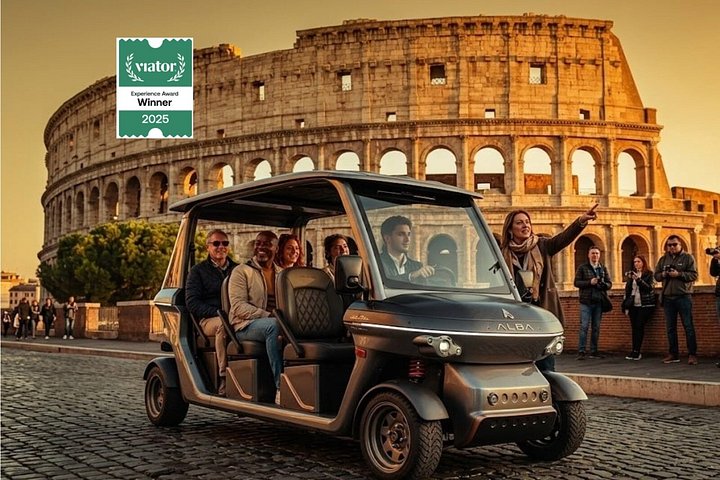
![Golf carrello Tour Roma : Glide by Ancient Wonders & Hidden Gems]() -20%Cancellazione gratuita
Golf carrello Tour Roma : Glide by Ancient Wonders & Hidden Gems
da
154 USD124 USD
Esperienze simili
 Cancellazione gratuita
 Cancellazione gratuitaSalta la fila
![Musei Vaticani, Cappella Sistina e Basilica di San Pietro Tour]() Presto esauritoCancellazione gratuita
![Vaticano salta fila, Cappella Sistina e San Pietro | Small Group]() Presto esauritoCancellazione gratuita

Hop-on hop-off a Roma
 -50%Cancellazione gratuita