Cancelación gratuita
Las descripciones se muestran en inglés.
The tour focuses on the places like most famous stepwell, biggest Jain temple of Ahmedabad and the famous Gandhi Ashram.
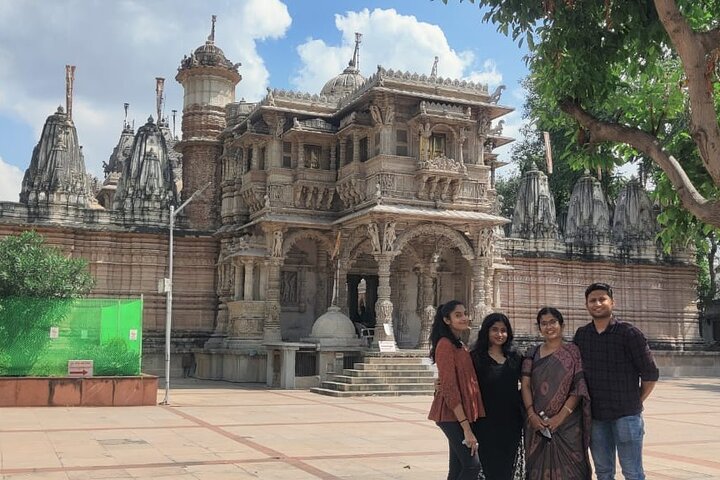
The temple was built 150 years ago in 1848 A.D. by artisans who came to Gujarat in search of work. Sheth Hutheesingh dreamt of building a large temple for which he started preliminary building activities but he died and later the task was taken over by his wife harkuvarba. It was built as a dedication to 15 tirthankars. The main temple has 11 deities, 6 in basement and 5 in a shelter. The main shrine lies on the east and temple is covered with a big dome supported by 12 carved pillars. In addition there are 52 shrines (devakulikas), each decorated with an image of a tirthankar. The front is delicately ornamented by a 'dome' shaped structure.
When Gandhiji returned from South Africa, he started First Ashram in India at Kochrab area on 25 May 1915. The Ashram was then shifted on 17 June 1917 on the banks of the river Sabarmati today knows as Gandhi Ashram; also known has Sabarmati Ashram or Satyagrah ashram was built in 1915. Gandhiji along with his wife and other freedom •ghters lived here from 1917- 1930. Mythological it is said it was the ashram site of Dadhichi Rishi who had donated his bones here for a righteous war. The well-known Salt March (Dandi Yatra) started in 1930 from the Sabarmati Ashram. It began from 12 March 1930 from the Ashram (with 78 companions) and ended on 6 April 1930 where he marched 390 kilometers in protest of the British Salt Law.
The factory transforms the scraps of waste cotton into paper, which was one of the cottage industries introduced by Gandhi. No chemicals are used in the process of transforming the cotton into paper in this factory. The factory is approved by Gujarat state Khadi Gramodyog Board. The artistic different product variety is available at the store like invitation card, wedding card, filter paper, bond paper, paper bag, photo frames and many more.
Adalaj ni Vaav was constructed by queen Rudabai wife Vaghela chief Vikramsingh in 1499. It is •ve stored step well. Its main purpose was to store rainwater. Adalaj ni Vaav is an example of Indo - Islamic architecture and design. It was construction for social, cultural and spiritual interaction for the local community and offered prayers to the deities carves on the walls. The carved motifs of •owers and graphics of Islamic architecture along with the symbols of Hindu and Jain gods carved at different levels of the well can be seen. The main carvings on the upper floors are of elephants (3 inches (76 mm) in size, each of different design). The walls are also carved with women performing daily activities such as churning of buttermilk, the performance of dancers and musicians. An interesting depiction carved from a single block of stone is of the Ami Khumbor (symbolic pot of the water of life) and the Kalp Vriksha (a tree of life).
All sales are final. No refund is available for cancellations.
Ahmedabad, on the Sabarmati River in Gujarat, is a historic merchant and textile city of carved wooden houses, mosques and Gandhi's ashram.
Ahmedabad was founded in 1411 by Sultan Ahmad Shah on the banks of the Sabarmati, and its walled old city is listed by UNESCO. Its pols, tight clusters of homes around shared courtyards, have carved wooden fronts. The Jama Masjid, the Sidi Saiyyed Mosque with its lattice window carved as a tree, and the Teen Darwaza gateway show the Indo-Islamic style of the sultanate.
Top-ranked sights in Ahmedabad: Sabarmati Ashram, Adalaj Stepwell (Adalaj ni Vav), Sidi Saiyyed Mosque.


Añada Ticket Hall a su pantalla de inicio
Entradas y guías de ciudad a un toque, incluso sin conexión.
Ticket Hall