Independence Route Tour
Las descripciones se muestran en inglés.
Las descripciones provienen del operador y se traducen automáticamente.
- 8 horas
- Cancelación gratuita hasta 24 h antes
- Guía en español
- Confirmación inmediata
Destacados
Tour of Dolores Hidalgo, Atotonilco and San Miguel from Guanajuato. Discover the rich history and culture of three colonial cities in the heart of Mexico. Visit the most emblematic churches and historical places, learning about the history of independence and the artistic influence of the region. In Dolores Hidalgo, you can learn more about the important artisanal work carried out in Guanajuato and its role in the Independence of Mexico. In Atotonilco, you will visit the Sanctuary with its beautiful paintings and altarpieces. In San Miguel, you will admire the impressive colonial architecture. This cultural tour is an enriching and exciting experience for lovers of history, art and culture who want to immerse themselves in the rich cultural heritage of this region of central Mexico. In San Miguel there will be time to eat and 1 hour free to explore on your own. At the end of the tour, the tourist returns to Guanajuato capital. ---- Tour 100% in Spanish.
Incluye
Qué incluye
- Tour guide certified by the Guanajuato City Hall
- Accident insurance
- Tour taught 100% in Spanish
- Round transportation (round trip)
Qué no incluye
- Tour guide tip
- food cost
- Mausoleum of José Alfredo Jiménez
- House of Hidalgo
- Any English translation
Itinerario
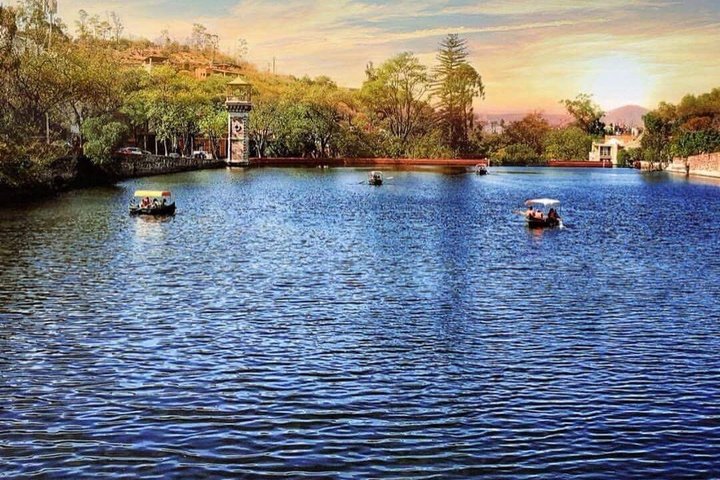
The Sierra de Santa Rosa de Lima is a mountain range located in the central region of Mexico, in the state of Guanajuato. This mountain range is part of the Sierra Madre Oriental, a mountain range that runs through a large part of the country. The Sierra de Santa Rosa de Lima is known for its great biodiversity, its beautiful landscapes and its cultural and historical wealth.
The tomb is a white marble mausoleum with a sculpture on top of it representing a Mexican charro playing the guitar. The sculpture is a replica of one of the most iconic photos of José Alfredo Jiménez, and is surrounded by a garden that has been built in order to create a calm and serene environment. The tomb of José Alfredo Jiménez is considered one of the most emblematic places in Dolores Hidalgo, and is visited by thousands of people every year. In addition to being a tribute to the life and work of the singer-songwriter, it is also a place where you can find objects and memorabilia related to his career and legacy.
The Parish of Our Lady of Sorrows is a Catholic temple located in the city of Dolores Hidalgo, in the state of Guanajuato, Mexico. The temple was built in the 18th century and is considered an important historical and architectural monument. The parish was the place where the priest Miguel Hidalgo gave the famous "Grito de Dolores" in 1810, which marked the beginning of the fight for the independence of Mexico. Due to its historical importance, the temple has been declared a national monument by the Mexican government. The architecture of the parish is in the Baroque style and has ornamental elements that make it very visually attractive, such as its dome and its main façade. Inside, you can find numerous works of religious art, such as paintings and sculptures.
The house that houses the museum was where the priest Miguel Hidalgo lived and worked, and is considered an important historical and cultural monument. The enclosure exhibits a wide collection of objects related to the life and work of priest Hidalgo, as well as the history of Mexico. Among the exhibits are paintings, documents, furniture, weapons and other objects from the colonial era. The museum also has several exhibition rooms that focus on different themes, such as the struggle for Mexican independence, daily life in colonial times, and the history of Dolores Hidalgo. In addition, you can see some elements of the original architecture of the house, such as furniture and decoration.
It was on the centenary of the consummation of independence when the government of Mexico City sent a shoot of the tree of the sad night to the place where the fight for independence began. The original tree, located in Mexico City, is an ahuehuete, also known as "El Viejo del Popó" and is believed to be over 500 years old. In this place, the conquistador Hernán Cortés wept on the night of June 30, 1520 after being expelled from Tenochtitlán in an event known as "La Noche Triste".
Atotonilco is a small town located about 15 kilometers east of San Miguel de Allende in the state of Guanajuato, Mexico. It is known for its impressive Sanctuary of Atotonilco, declared a World Heritage Site by UNESCO in 2008. The Atotonilco Sanctuary is a Baroque church built in the 18th century by Father Luis Felipe Neri de Alfaro, who decorated it with beautiful wall paintings depicting scenes from the life of Jesus and the saints. The paintings, which span the walls and ceilings of the church, are considered a masterpiece of Mexican colonial art. The Sanctuary of Atotonilco is also known for its historical importance in the Mexican War of Independence, since it was used as a refuge by the priest Miguel Hidalgo and his troops during the fight against the Spanish army. In addition to the Sanctuary, Atotonilco is a quiet and picturesque place, surrounded by mountains and with a relaxed and pleasant atmosphere.
It was built in the 18th century and its main façade has an impressive neo-Gothic baroque tower that has become an emblem of the city. Inside, the church has an elaborate decoration with paintings, sculptures and gold altarpieces that reflect the wealth and religiosity of the colonial era. In addition, the church houses an image of the Lord of the Conquest, considered by the faithful as one of the most miraculous in the region. The parish is an important site of pilgrimage and religious tourism, and has been declared a World Heritage Site by UNESCO.
Free time to explore the historic center on your own
The journey time on Highways will be approximately 2 hours
Cancelación
Cancelación gratuita hasta 24 horas antes del inicio, con reembolso completo.
Opiniones
4,0
- 53
- 41
- 31
- 21
- 10
Las valoraciones proceden de 6 opiniones recogidas por nuestro socio de reservas. Son palabras de los viajeros, en el orden en que se escribieron — nunca reordenadas para favorecer la experiencia.
Antes de ir
- Punto de encuentro
- - Meeting point: Plazuela in front of the Macro Foto store. Before picking you up, your guide will communicate through Whatsapp to facilitate the meeting, at the meeting point there is a small square with benches, you can wait there.
- Recogida
- Todos se reúnen en el punto de inicio; no hay recogida.
- Tipo de entrada
- Mobile or paper ticket accepted
- Tamaño del grupo
- Hasta 14 viajeros
- Operado por
- Guanajuato Vip
- Public transportation options are available nearby
- Infants are required to sit on an adult’s lap
- Not recommended for travelers with spinal injuries
- Suitable for all physical fitness levels
How it compares in Guanajuato
- Its from-price is 76% below the median of the 17 excursiones de un día we list in Guanajuato.
- Its length is typical for the group.
- By number of reviews it ranks 3 of 17.
- The operator lists free cancellation on it.
About Guanajuato
Guanajuato is a silver-mining city in the Mexican highlands, a World Heritage town of steep alleys, underground roads and colourful houses.
Guanajuato lies at about 2,000 metres in a narrow valley of central Mexico, and its houses in blue, yellow and rose climb the hillsides in tiers. Spanish miners founded it in the sixteenth century on the strength of rich silver veins, and its old centre, with the baroque Basílica Colegiata, is a UNESCO World Heritage Site. Old river tunnels now carry traffic beneath the centre, so many of its roads run underground.
Ofertas especiales en Guanajuato
Los precios tachados vienen del operador, nunca de nosotros.