Easter Island Highlights: Private Tour with Native Guide
Die Beschreibungen werden auf Englisch angezeigt.
- 7 Stunden
- Kostenlos stornierbar bis 24 Std. vorher
- 2 Sprachen
- Private Tour
Highlights
Discover the essential sites of Rapa Nui on a private full-day tour with a native Rapa Nui archaeologist as your guide. Visit the island’s most important archaeological sites, including Ahu Tongariki, Rano Raraku, Anakena, Rano Kau and Orongo, while discovering the history, archaeology and living culture of Rapa Nui from a local perspective. Because this is a private tour, the day is entirely yours. There is no waiting for other guests, and the pace can be adapted to your interests—whether you want more time for archaeology, photographs or simply enjoying the sites. Travel comfortably in an air-conditioned private vehicle with pickup and drop-off at your accommodation. More than seeing Rapa Nui’s famous sites, you’ll understand the stories and culture behind them with a guide experienced in archaeology, conservation and restoration. Ideal for travelers who want to experience the highlights of Easter Island in one day with the personal attention of a private tour.
Leistungen
Inbegriffen
- Hotel pickup and drop-off
- Bottled water
- Air-conditioned vehicle
- 100% Private and personalized experience
- Accredited local guide
Nicht inbegriffen
- Gratuities
- Lunch is not included
- National park fee
Ablauf
Anakena Beach is revered as the historical and cultural cradle of Easter Island. Legend has it that the first king, Hotu Matu'a, landed here, establishing the initial settlement of Rapa Nui culture. Initially named Hanga Mori or One, it was later dubbed Anakena after a nearby cave. This beach evolved into a significant population center and a crucial site for the Miru tribe. Anakena boasts vital archaeological remains dating back to 1200 AD, including ceremonial centers, residential areas, and ahus—ceremonial platforms. Notable among these ahus are Ahu Ature Huki, featuring a single moai, and the impressive Ahu Nau Nau, adorned with seven finely detailed moai. The latter, restored in 1978, is a remarkably preserved complex, its moai protected from weathering by being buried in sand after their initial destruction.
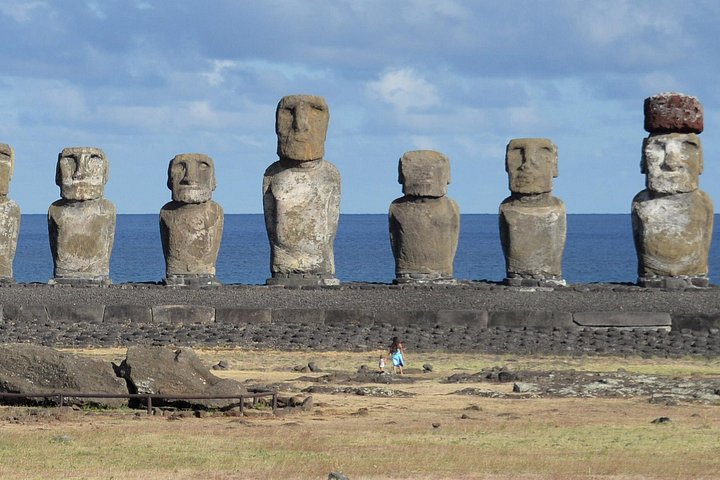
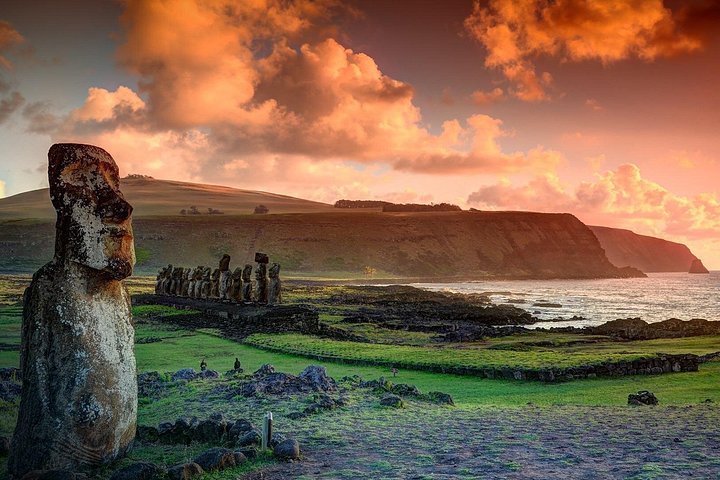
Ahu Tongariki, the grandest and most imposing monument of Rapa Nui, is believed to be a sociopolitical and religious center dating back to 900 AD. The ahu at Tongariki is the largest ceremonial structure on the island, holding 15 moai, representing the zenith of Rapa Nui's sacred constructions. Once devastated, the site has been meticulously restored, allowing visitors to witness the megalithic structures in a state akin to their original splendor. The 15 giants, each with unique shapes and sizes, stand on a 100-meter-long altar, projecting spiritual protection to the ancient village. The restoration has allowed for the observation of the wonderful structure, showcasing the diverse characteristics and expressions of the statues, reflecting the features of each ancestor and the evolution of their stylized features over time.
Rano Kau with its almost circular crater forms one of Rapa Nui's most stunning natural landscapes. Spanning 1.5 kilometers, the crater houses the largest reserve of endemic flora on the island, while its lake served as a vital source of drinking water. Additionally, obsidian, found primarily in Maunga Orito and Maunga Te Manavai, was a valuable resource used for crafting various tools and artifacts. Rano Kau's serene ambiance, accompanied only by the sounds of wind and distant waves, makes it a must-visit destination.
Ahu Akivi, is unique due to its location, astronomical orientation, and the restoration work that marked a milestone in the island's recent history. It is the most significant interior ahu, associated with the powerful Miru clan, featuring seven carefully crafted moai, indicative of political stability and economic abundance. The statues were transported 15 km from Rano Raraku quarry and are facing the sea, unlike others. The seven statues are thought to symbolize the island's first explorers or ancient Polynesian kings.
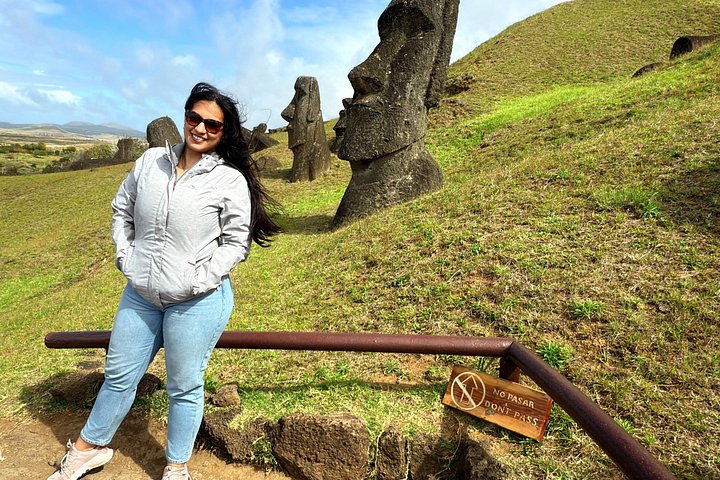
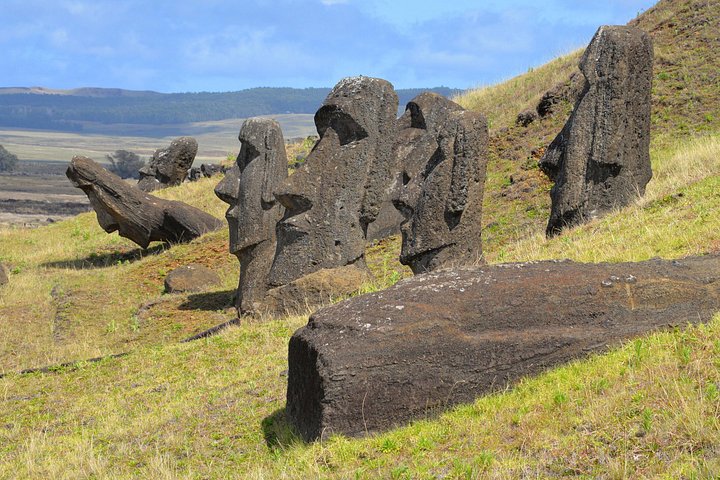
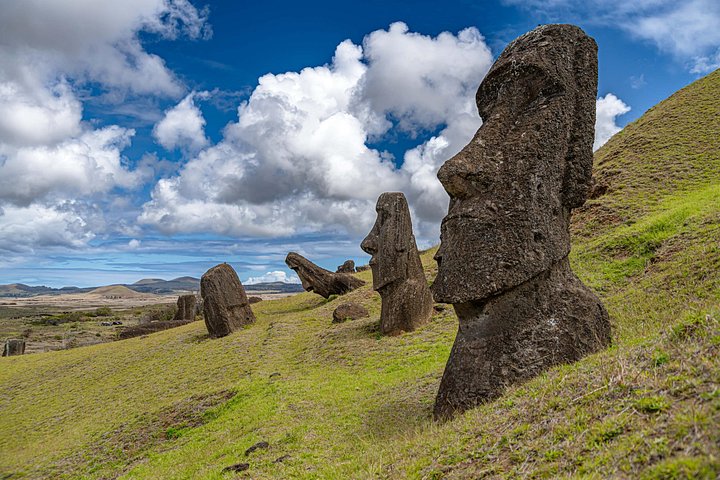
Rano Raraku is the monumental volcanic quarry that served as the production site for the iconic moai statues. Composed of unique volcanic tuff, it provided the raw material for sculptors to create the nearly 1,000 statues found on the island. The quarry's southern slope is adorned with dozens of stone heads and figures, showcasing the remarkable craftsmanship of the ancient sculptors. The presence of numerous unfinished statues and empty niches signifies the quarry's pivotal role in the island's cultural and ceremonial practices.
The ceremonial complex of Tahai on Easter Island is a historically significant archaeological site. Occupied by the Marama and Miru clans, it served as a political and religious center. The restoration of the site by William Mulloy revealed that between 75 and 200 people lived there, utilizing nearby caves and rocky shelters as rooms. The most striking features are the three ahu or ceremonial platforms. Additionally, a stone ramp between Ahu Vai Uri and Ahu Tahai is believed to have been used to lower fishing boats from the upper level to the shore, showcasing the practical ingenuity of the ancient inhabitants.
Orongo was the location of the ancient ritual known as the Tangata Manu competition. This ritual, held in honor of the creator god Make Make, determined the tangata manu or birdman of the season, granting the winner rights and privileges over rivals. The site's first constructions were built around 1400 AD, with houses specially constructed for the competition. The village's surroundings are adorned with over 1,700 petroglyphs, making it the place with the highest concentration of rock art on the entire island. The competition involved representatives from different clans descending the cliff, swimming to Motu Nui, and waiting for the arrival of seabirds to obtain the first Manutara egg, signifying the chosen tangata manu. This tradition emerged when the old political and religious order lost prestige, and opposing tribal groups competed for power.
Stornierung
Kostenlose Stornierung bis 24 Stunden vor Beginn, mit voller Rückerstattung.
Bewertungen
5,0
- 56
- 40
- 30
- 20
- 10
Die Bewertungen stammen aus 6 Rezensionen, die unser Buchungspartner gesammelt hat. Es sind die eigenen Worte der Reisenden, in der Reihenfolge ihres Entstehens — nie umsortiert, damit das Erlebnis besser dasteht.
Gut zu wissen
- Abholung
- Die Abholung ist für alle inbegriffen.
- Ticketart
- Mobile or paper ticket accepted
- Durchgeführt von
- MATU
- Not recommended for travelers with poor cardiovascular health
- Suitable for all physical fitness levels
- Not available for cruise ship
How it compares in Hanga Roa
- Its from-price is 13% below the median of the 34 tagesausflüge we list in Hanga Roa.
- Its length is typical for the group.
- By number of reviews it ranks 15 of 34.
- The operator lists free cancellation on it.
About Hanga Roa
Hanga Roa is the only town on Easter Island, Chile's remote Pacific outpost, with a small harbour and giant stone moai within walking distance.
Hanga Roa stretches along the west coast of Easter Island, called Rapa Nui by its people, some 3,500 km west of the Chilean coast. Nearly all the island's residents live here, in low houses among gardens, around a small fishing harbour and a church. A short walk north, the moai of Tahai stand on a platform beside the sea, facing inland, and the sun sets behind them.
Top-ranked sights in Hanga Roa: Ana Kai Tangata.