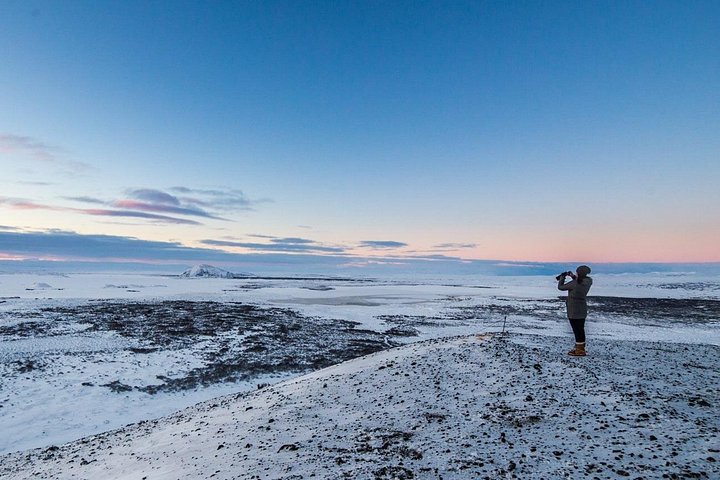
Snowmobile Tour by Lake Mývatn
Beskrivningarna visas på engelska.
- 1 tim 30 min
- Fri avbokning till 24 tim före
- Guidning på engelska
- Omedelbar bekräftelse
Höjdpunkter
In Lake Mývatn region, snowmobiling is our favourite way of traveling trough the rough arctic conditions. Our guides grew up riding snowmobile on they’re farms. For us, Snowmobiling is a part of our lifestyle, we love to share our passion for snowmobiling and allow our guests to experience the incredible freedom that a snowmobile provides
Ingår
Det här ingår
- Helmet and a Warm Overall
Ingår inte
- Personal insurance
Avbokning
Fri avbokning till 24 timmar innan upplevelsen börjar, med full återbetalning.
Omdömen
5,0
- 517
- 40
- 30
- 20
- 10
Betygen kommer från 17 omdömen som vår bokningspartner samlat in. Det är resenärernas egna ord, i den ordning de skrevs — aldrig omsorterade för att smickra upplevelsen.
Bra att veta
- Mötesplats
- Meet us at the Geo Travel / Mývatn snowmobile Base camp. Located at our Farm "Hella"
- Upphämtning
- Alla möts vid startpunkten; ingen upphämtning finns.
- Biljettyp
- Mobile or paper ticket accepted
- Gruppstorlek
- Upp till 16 resenärer
- Arrangeras av
- Geo Travel ehf
- Not recommended for travelers with spinal injuries
- Not recommended for pregnant travelers
- Not recommended for travelers with poor cardiovascular health
- Suitable for all physical fitness levels
How it compares in Reykjahlíð
- Its from-price is 14% below the median of the 12 experiences we list in Reykjahlíð.
- It is shorter than most of them.
- By number of reviews it ranks 4 of 12.
- The operator lists free cancellation on it.
About Reykjahlíð
Reykjahlíð is the main village on Lake Mývatn in northern Iceland, a base for lava fields, steaming geothermal ground and big waterfalls.
Reykjahlíð lies on the north-east shore of Lake Mývatn, in a volcanic landscape of lava, craters and hot ground about 54 km east of Akureyri. Lava from the Mývatn Fires of the 1720s flowed through this district, and the village church is said to have been spared in 1729 when a flow divided around it. The lake's name means midge lake, for the clouds of harmless midges that hover over the water in summer.