Aral Sea - Lost Paradise
Beskrivningarna visas på engelska.
- 48 timmar
- Fri avbokning till 144 tim före
- Guidning på engelska
- Omedelbar bekräftelse
Höjdpunkter
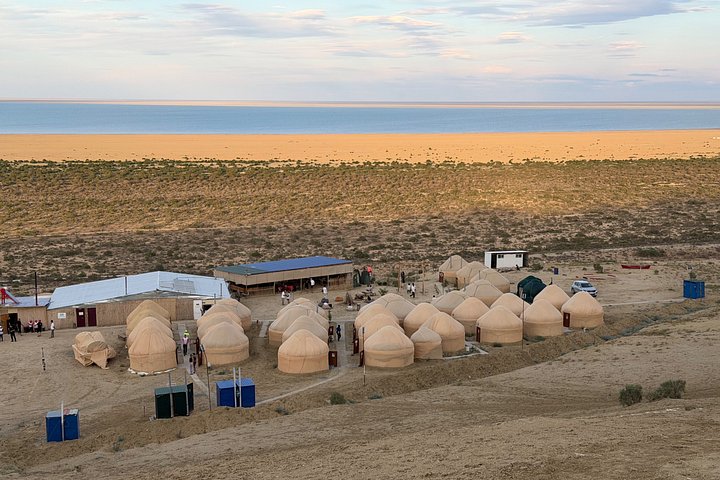
With us in those days you will be able to get acquainted with one of the most amazing places in the region and see with your own eyes one of the examples of environmental disasters. This program allows you to feel the spirit of the "Great Desert" and its unpredictability and the "Great Sea" and its catastrophe. You will witness places that are not without reason was named as "Cemetery of Ships" and "White Canyon"
Ingår
Det här ingår
- 4WD cars
- Lunch
- All Fees and Taxes
- Dinner
- Air-conditioned vehicle
- Breakfast
- Entrance tickets to all mentioned monuments in program
Ingår inte
- Medical insurance
- Alcoholic beverage
- Other expense which is not specified in the program
Avbokning
Fri avbokning till 144 timmar innan upplevelsen börjar, med full återbetalning.
Omdömen
5,0
- 51
- 40
- 30
- 20
- 10
Betygen kommer från 1 omdömen som vår bokningspartner samlat in. Det är resenärernas egna ord, i den ordning de skrevs — aldrig omsorterade för att smickra upplevelsen.
Bra att veta
- Upphämtning
- Upphämtning ingår för alla.
- Biljettyp
- Mobile or paper ticket accepted
- Arrangeras av
- Sayyah Uzbekistan
- Not recommended for pregnant travelers
- Travelers should have at least a moderate level of physical fitness
How it compares in Nukus
- Its from-price is 49% above the median of the 16 experiences we list in Nukus.
- Its length is typical for the group.
- By number of reviews it ranks 5 of 16.
About Nukus
Nukus, capital of Karakalpakstan in north-western Uzbekistan, is a desert city known for its avant-garde art museum, within reach of the Aral Sea.
Nukus lies on the Amu Darya delta in north-western Uzbekistan, as the capital of the autonomous republic of Karakalpakstan, at the edge of the desert. It is a Soviet-era city of wide avenues and low blocks. Its great treasure is the Savitsky Museum, which holds an outstanding collection of Russian avant-garde art, gathered by the artist Igor Savitsky, who saved works banned in the Soviet era, together with Karakalpak textiles, jewellery and archaeological finds.