
Independent guide
Big Bus Paris: routes, stops and tickets
Independent guide, not operated by or affiliated with Big Bus Tours.
We list 3 Big Bus ticket options in Paris, from 2–10 hr. Big Bus Tours sells the Paris hop-on hop-off route on its own Paris pages. This guide covers the route, its 10 distinct stops, when to ride and who it suits, then lines up the tickets.
- Routes1
- Stops10
- Full loop2H 15M
- Tickets3
Route and stops
- Classic Route (Red)
Ten-stop loop between the Louvre, Notre-Dame, Musee d'Orsay, the Champs-Elysees, Trocadero and the Eiffel Tower, finishing at the Opera Garnier.
Classic Route (Red)
Show all 10 stops
Big Bus tickets in Paris
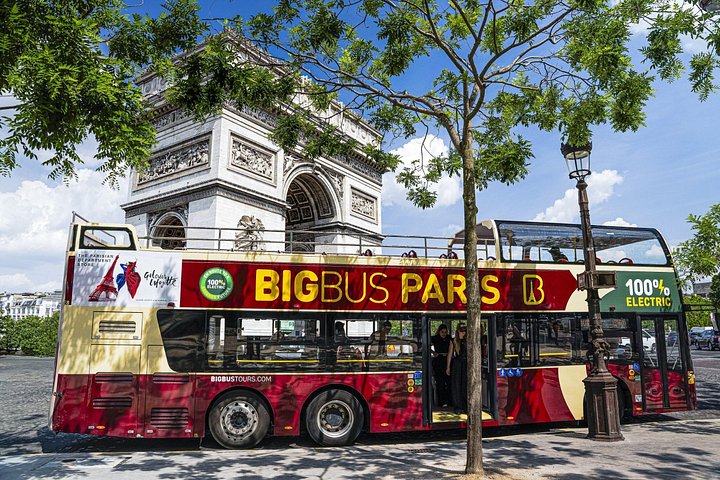
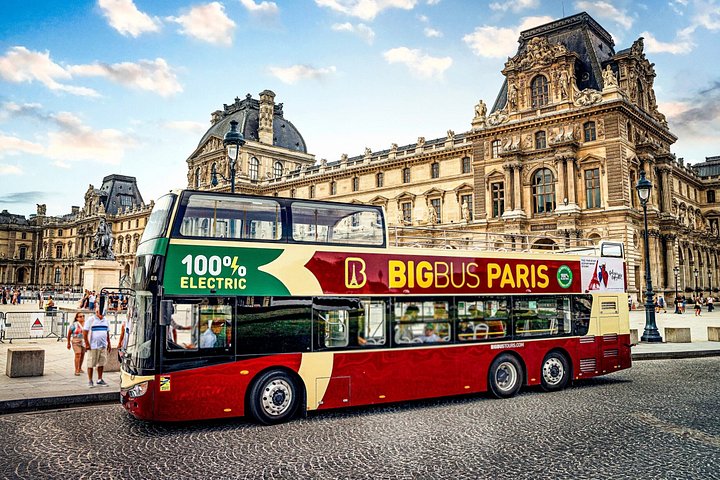

Want to see every hop-on hop-off bus in Paris, not just this one? Compare hop-on hop-off tours in Paris.
What riders say
Across these tickets travellers rate Big Bus Paris 3.9 out of 5 from 7,142 reviews.
Fabulous, very good value. Best way to see the sights of Paris. We did both, bus and river cruise, all well organised
Easy to purchase and all went smoothly. Great way to get around and see the sights. We enjoyed it lots.
Clean buses with stops at the majority of Paris' attractions. Plenty of busses so waiting isn't excessive. Audio provided helps you know where you are and what you're looking at.
Best time to ride
Spring and early autumn are generally mild and good for an open-top ride, while July and August are busiest at the major sights. Starting in the morning helps, as the last full tour from the first stop leaves in the late afternoon.
Who it suits
- Families
- The loop passes the Eiffel Tower, Champ de Mars and the Louvre, and hop-on hop-off lets children break the ride at the Trocadero or Champ de Mars.
- Couples
- An evening Night Tour is sold separately as a non-stop panoramic ride, in addition to the daytime hop-on hop-off loop.
- Seniors
- Hop-on hop-off lets riders choose only a few stops. Check the operator for current accessibility details before booking.
- First-time visitors
- Ten stops cover the best-known landmarks on one circuit of about two hours fifteen minutes, so the route works well as an orientation on a first visit.
Tips before you go
- The Red Route page states the circuit runs about 2 hours 15 minutes, with buses every 10 to 20 minutes.
- Commentary is available in 11 languages, according to the route page.
- Stop 7 near Trocadero has been moved to Avenue d'Iena, facing the Shangri-La hotel.
- Boarding after about 17:30 means tours end at the Louvre-Pyramide stop rather than completing the loop.
- The service information page lists closures on 25 and 26 September 2026 for a papal visit; check live notices for any other road closures.
Sights along the way
Louvre, Notre-Dame, Musée d'Orsay, Champs-Élysées, Grand Palais, Eiffel Tower, Champ de Mars, Opéra Garnier.
Top-ranked in Paris: Louvre Museum, Eiffel Tower, 4th Arrondissement, Notre-Dame Cathedral, 8th Arrondissement. All things to do in Paris.
Why take the bus in Paris
The case for a sightseeing bus here is orientation. Paris landmarks are famous individually, but visitors often have no sense of the distances between the Louvre, the Eiffel Tower and the Champs-Élysées. A single circuit gives you that mental map, and it does so from an open-top vantage that the metro, which runs underground, cannot offer. The Paris sightseeing bus also suits the stretches between the river monuments, which are pleasant to look at but long to walk back to back.
It is a good fit for a first visit, for anyone with only one or two days, and for travellers who want to tick off the grand sights without planning every transfer. It also helps families, because you can break the ride when children need space, for example near Trocadéro or the Champ de Mars.
Walking and the metro win in other situations. The Louvre, Notre-Dame, the Musée d'Orsay and the Place de la Concorde sit close enough to combine on foot in one half-day, so if that cluster is your whole plan, a bus adds little beyond a lift between them. The 8th Arrondissement and the Arc de Triomphe likewise work well together on foot. For the Marais, the Latin Quarter, Montmartre and similar neighbourhoods, the character is in the side streets, which no bus can enter. And for Versailles, you need a separate trip, as the bus does not go there.
On the question of the Big Bus versus a walking tour, the two do different jobs. A walking tour, typically led by a guide in a small group, gives you stories and detail in one area. The bus gives you range and flexibility across the city. Many visitors do one of each.
How the routes work together
Paris has a single daytime route: the Classic Route, shown in red. It is a loop, so you can board at any stop and keep going round.
In plain terms, the loop links three zones. The first is the museum and river core, starting at the Louvre-Pyramide stop and running past Pont des Arts, Notre-Dame and the Musée d'Orsay. The second is the grand western axis, where the bus calls at Champs-Élysées and the Grand Palais. The third is the Eiffel Tower district, with stops at Trocadéro, Tour Eiffel and Champ de Mars. The loop also calls at Opéra Garnier.
That shape tells you how to use it. Because Notre-Dame and the Musée d'Orsay have stops right at their doors, and the Louvre is about 150 metres from its stop, the eastern half of the loop is ideal for getting on and off. The Eiffel Tower stop is only about 50 metres from the tower.
Some sights have no stop close by: the Place de la Concorde, the Arc de Triomphe and the Palace of Versailles. Treat those as walking or metro targets. The Place de la Concorde, for instance, is within a walk of the Louvre and Musée d'Orsay.
A sample day on the bus
Ride the full circuit once without getting off. That first pass is the orientation, and it lets you decide which places deserve more time. Then pick two or three stops to return to.
A sensible order is to get off at Notre-Dame to see the cathedral and the Île de la Cité area, then rejoin the bus for the Musée d'Orsay if you like Impressionist art. Walking between these along the river is easy, so you may prefer to leave the bus for that stretch and rejoin later.
For the afternoon, head west. Get off at Trocadéro for the classic view of the Eiffel Tower across the river, then continue to Tour Eiffel and Champ de Mars for a walk on the lawns. This is where the bus saves the most effort, because the distances between the river museums and the tower are large for tired legs.
What to skip on a short visit: trying to enter every museum. One major interior per half-day is plenty. Use the bus for everything else and keep the evening free for a dinner and a stroll.
If you have two or three days in Paris, give the bus the first day as your overview, then spend the following days on foot in the neighbourhoods, and reserve one for Versailles.
Booking advice
In July and August, when the major sights are busiest, it is safer to settle your ticket before you arrive than to decide at the kerb.
Think about how you will really use the bus: one orientation loop with a couple of stops is a different plan from riding between the Louvre, the Eiffel Tower and the Champs-Élysées over two days. Compare the options on the ticket page to see what is on offer.
Before buying, check three things on the ticket page: what the ticket includes, how you redeem it, and whether any extras such as the evening Night Tour are sold separately. Also check current accessibility details with the operator if anyone in your group needs step-free access.
Sights worth the stop
The Louvre Museum is the obvious anchor, and the bus stop is about 150 metres away. Give it its own block of time, as the collection is too large to rush.
Notre-Dame Cathedral has a stop right beside it, and the area around the Île de la Cité is among the most photogenic stretches of the river. The Musée d'Orsay, also directly at a stop, is a better choice than the Louvre if you want a smaller museum with a strong Impressionist focus.
The Eiffel Tower has a stop about 50 metres away, and Trocadéro and Champ de Mars on either side give you two different views of it. For the Arc de Triomphe and the 8th Arrondissement, ride to the Champs-Élysées or Grand Palais stop and walk, since they are best combined on foot. The Place de la Concorde sits in the same walkable group as the Louvre and the Musée d'Orsay.
For the Latin Quarter, the Marais and Montmartre, plan separate walking time, and reserve a day for the Palace of Versailles if you can.
More on Paris sightseeing
- Big Bus Paris FAQ: Answers Before You Book
- Hop-On Hop-Off Bus vs Public Transport in Paris
- Hop-On Hop-Off Bus vs Walking Tour in Paris
- 1 Day in Paris: A First-Timer's Itinerary With a Hop-On Hop-Off Bus
- 2 Days in Paris: An Itinerary Built Around a Hop-On Hop-Off Bus
- 3 Days in Paris: A First-Timer's Itinerary
- Romantic Things to Do in Paris: A Slow Itinerary for Couples
- Paris with Kids: A Family Itinerary Built Around the Hop-On Hop-Off Bus
Questions about Big Bus Paris
How long is the Paris loop?
The Red Route is about 2 hours 15 minutes for a full circuit, with 10 stops.
Does the bus stop at the Eiffel Tower?
Yes, the Red Route has stops at Trocadero, the Eiffel Tower and Champ de Mars.
Is there a night tour in Paris?
Yes, a separate non-stop panoramic Night Tour departs from 11 Avenue de l'Opera (Stop 1).
Can I hop on at the Louvre?
Yes. Stop 1 is at the Louvre-Pyramide and Stop 2 at Pont des Arts.
How many Big Bus ticket options are there in Paris?
We list 3 Big Bus ticket options in Paris, lasting 2–10 hr, rated 3.9 out of 5 across 7,142 traveller reviews.
Route and stop details checked 2026-10-13; routes and times change with the season, so confirm on the ticket page before you travel.